
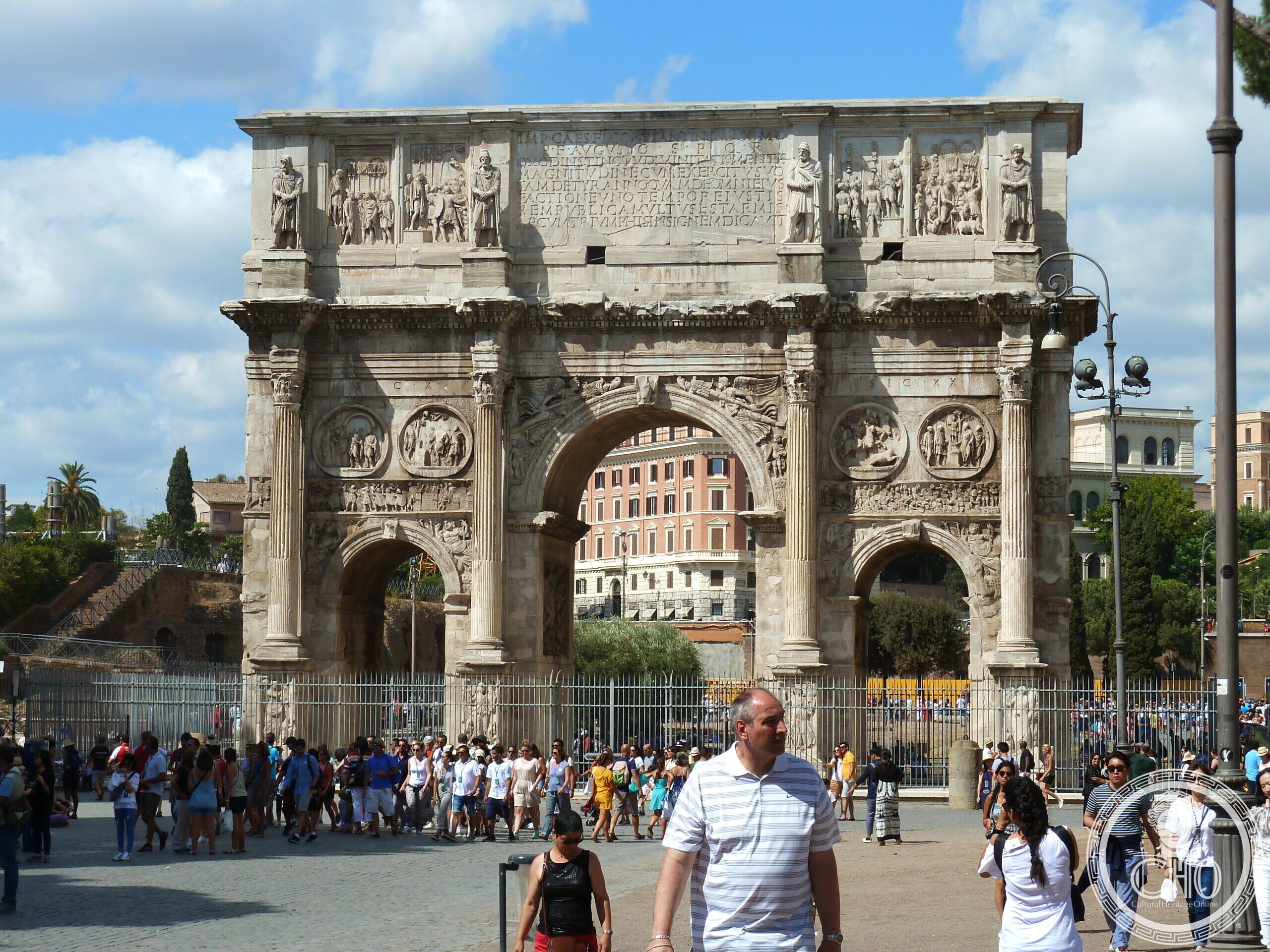
The largest surviving triumphal arch of Rome celebrates Constantine’s victory over Maxentius at the Milvian Bridge. Much of its sculpture is older than the arch: reliefs of Trajan, Hadrian and Marcus Aurelius were taken from their monuments and given Constantine’s face.
At a glance
The Arch of Constantine stands on the Via Triumphalis between the Colosseum and the Palatine, at the start of Via di San Gregorio. The Senate dedicated it in 315 AD to celebrate the victory of 28 October 312 over Maxentius at the Milvian Bridge, and the tenth year of Constantine’s reign. It is about 25 metres high and has three passages, the central one richly carved. It is the first great example of the systematic reuse of older sculpture: the statues of Dacian prisoners and the reliefs inside the central arch come from Trajan’s monuments, the eight round medallions with hunting and sacrifice scenes are Hadrianic, and the large panels of the attic belong to a monument of Marcus Aurelius.
Key facts
- Dedicated: 315 AD, by the Senate, for the victory at the Milvian Bridge (312) and Constantine’s decennalia
- Size: about 25 m high; three passages (fornici)
- Reused sculpture: Dacian statues and reliefs of Trajan; eight tondi of Hadrian with hunts and sacrifices; eight panels of Marcus Aurelius with the German wars
- Constantinian sculpture: the friezes above the side arches, with the campaign against Maxentius, and the bases of the columns
- Later: incorporated in the Frangipane fortress in the 12th century; restored in the 15th–16th centuries and in 1733
- Faces: the heads of the earlier emperors in the reused reliefs were recut as Constantine
- GPS: 41.88981, 12.49068 · Open in Google Maps
History
The arch was built in a hurry, in a city whose workshops no longer produced sculpture on the imperial scale, and the builders took what they needed from older monuments. Modern eyes read the difference between the classical panels of the second century and the stiff, frontal Constantinian friezes as the moment when late antiquity begins.
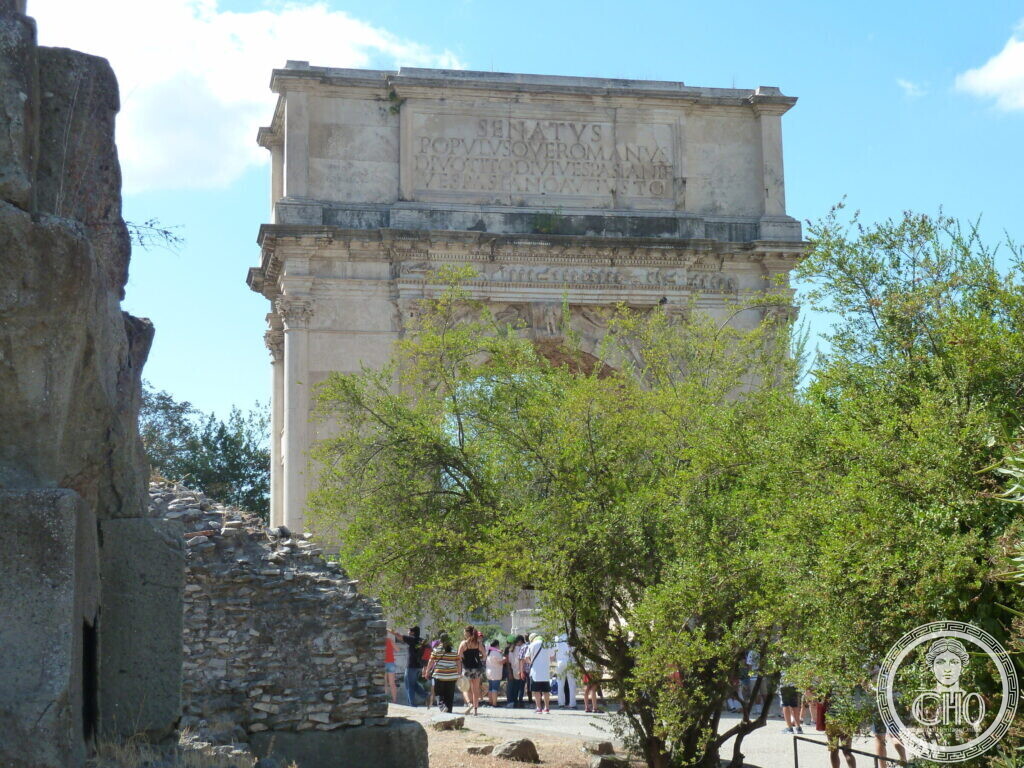
In the Middle Ages the Frangipane family made the arch part of their fortress around the Colosseum. The popes cleared it and restored it, most thoroughly in 1733, when missing parts were replaced. The third photograph on this page, taken from the same walk, shows the attic of the Arch of Titus on the Via Sacra nearby, with its dedication to the deified Titus.
What you see
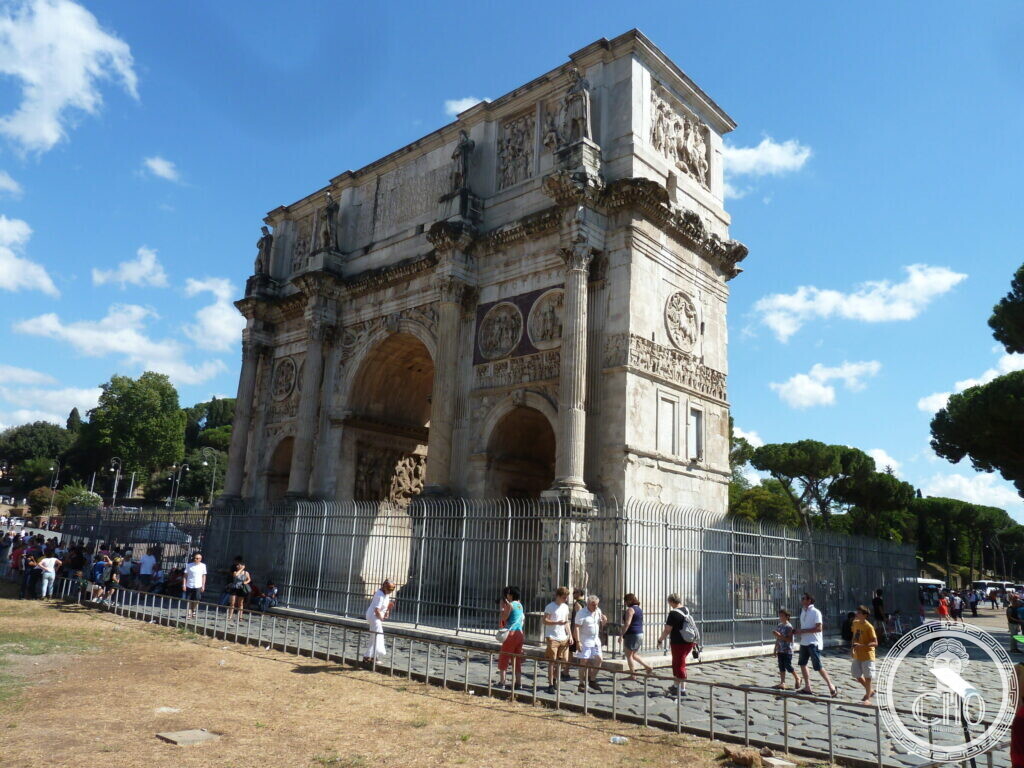
A triple arch of white marble with four detached Corinthian columns on each face, crowned by the eight statues of Dacian prisoners and the long inscription of the attic. The round medallions sit in pairs above the side arches. In the photographs the arch is seen from the Colosseum side, with the queue of visitors along the railing, and at an angle from the Via di San Gregorio.
Nearby
- Colosseum — beside the arch
- Roman Forum — through the Arch of Titus, a short walk up the Via Sacra
Gallery
Sources
- Turismo Roma — Arco di Costantino: the date 315, the height, the three passages, the reuse of material from Trajan, Hadrian and Marcus Aurelius, the eight Dacian statues, the tondi and the panels, the recut faces, the Frangipane and the restoration of 1733
- Italia.it — Arco di Costantino: the victory at the Milvian Bridge, 25 metres, the three fornici and the decoration of the central one, the Dacians from Trajan’s Forum, the Hadrianic tondi and the Aurelian panels
Find it on the map
See this place and what’s around it →📷 Become a Cultural Heritage Online photographer
Share your photos of places: they stay published under your name as the author. The more they're seen, the more you get noticed — and soon a contest will reward the most appreciated photos.
Log in or sign up free to add a photoIs this page about you?
This page is read by travellers and heritage enthusiasts who find it on Google. Tell us how you are connected to this place and we will take it from there.