
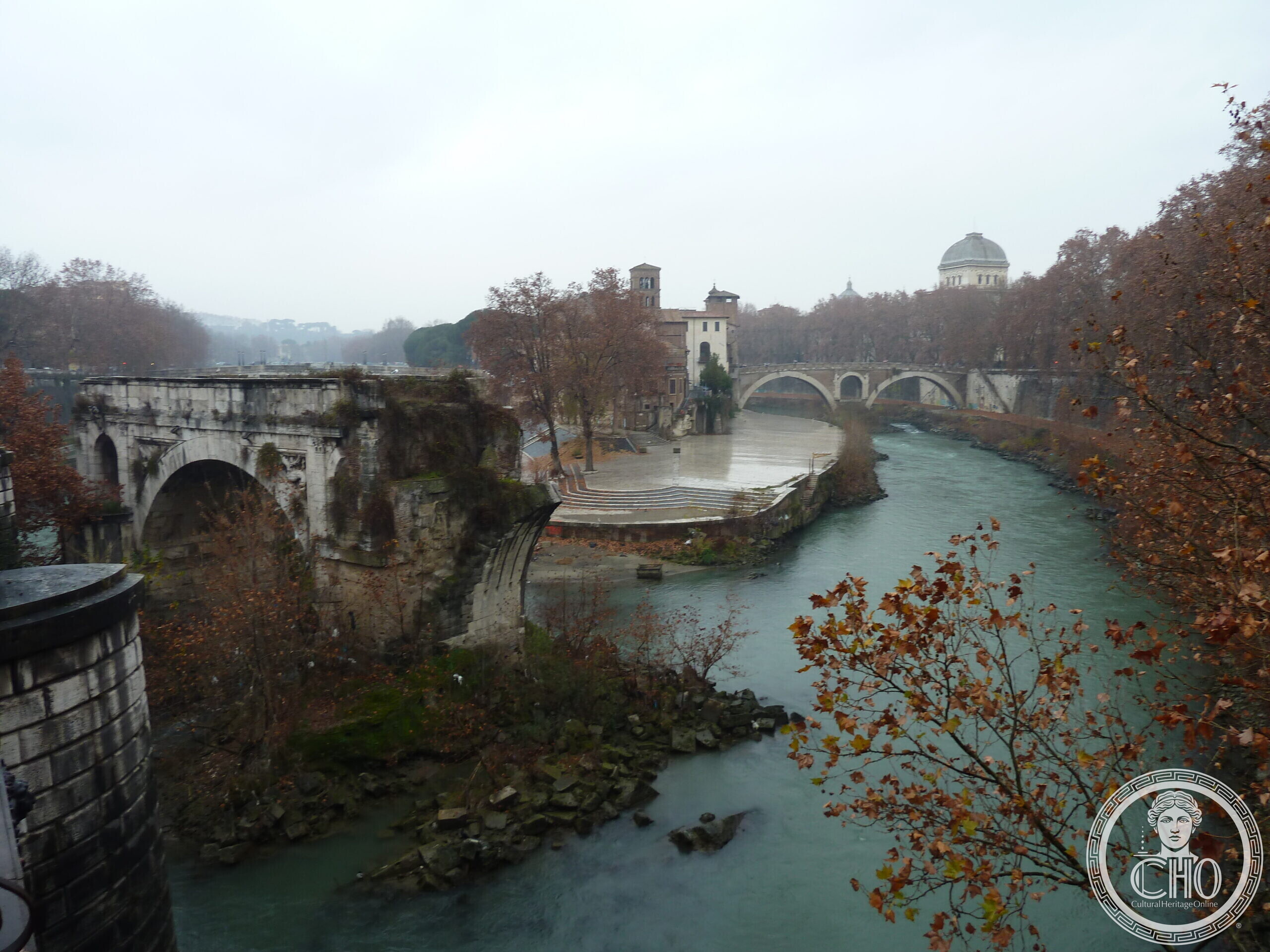
A lone arch stands in the middle of the Tiber below the Tiber Island. It is what remains of the first stone bridge of Rome, carried away piece by piece by the floods of 1598 and finally by the engineers of 1887.
At a glance
The Pons Aemilius crossed the Tiber from the Forum Boarium to Trastevere. Its stone piers were begun in 179 BC by the censors Marcus Fulvius Nobilior and Marcus Aemilius Lepidus, and the arches were completed in 142 BC. It had six arches. Floods damaged it repeatedly; after the restoration of Gregory XIII in 1575 the great flood of 1598 swept away the eastern half, and the bridge was abandoned. The arch that survives in midstream has been called Ponte Rotto, the broken bridge, ever since.
Key facts
- Built: piers 179 BC, arches 142 BC; the first stone bridge in Rome
- Arches: six originally; one survives
- Floods: damaged in 1230, 1557 and 1575; the flood of 1598 destroyed the eastern half
- 1853: an iron footbridge was attached to the surviving half under Pius IX; it weakened the stone
- 1887: two more arches were demolished for the Lungotevere and the new Ponte Palatino
- Today: a single arch in the river, covered in capers and wild plants
- GPS: 41.88936, 12.47947 · Open in Google Maps
History
The bridge served the busiest crossing of ancient Rome, between the cattle market and the Trastevere bank, and was rebuilt or repaired many times under the emperors and the popes. Its last full restoration was ordered by Gregory XIII in 1575, which is why old views call it Ponte di Santa Maria or Ponte Senatorio.
On Christmas Eve 1598 the worst flood in the recorded history of the city, which reached Piazza di Spagna, carried away half of the bridge. For two and a half centuries the stump stood in the water. In 1853 Pius IX had an iron walkway built to reconnect it to the left bank, but the old masonry could not take the strain; in 1887, when the embankments of the Lungotevere were built and the Ponte Palatino was planned beside it, the iron was removed and two of the three remaining arches were demolished. One arch was left standing, as a monument.
What you see
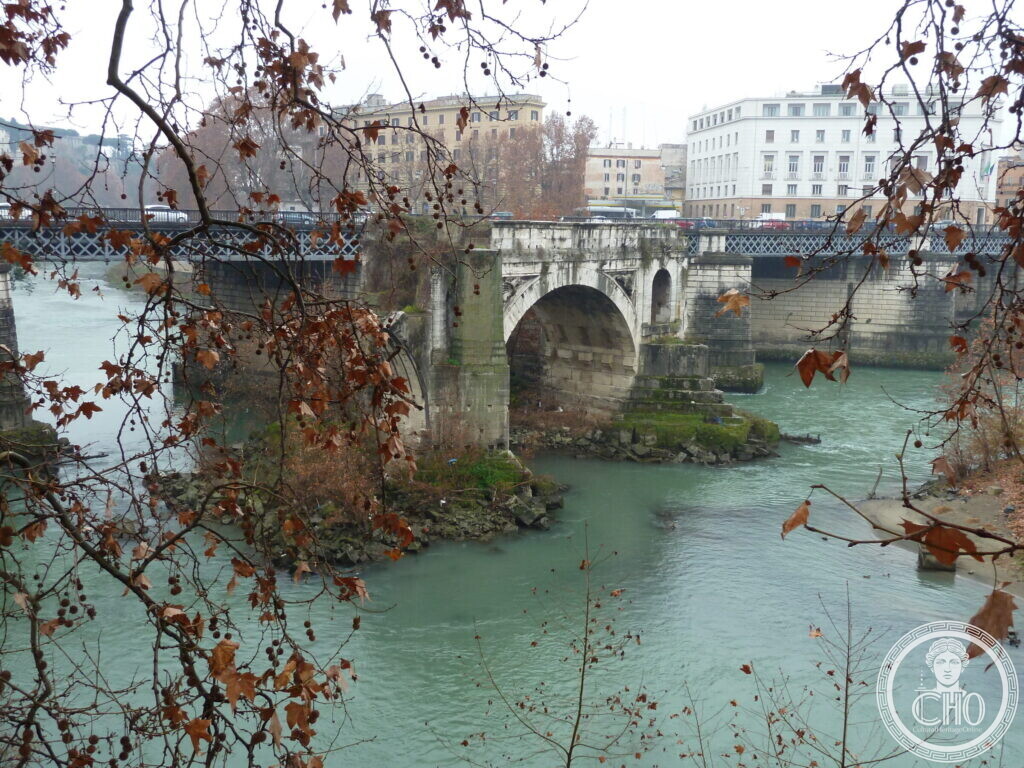
A single wide arch of travertine and tufa standing on its two piers in the current, with grass and caper bushes growing from the joints, seen here from the Ponte Palatino. Behind it, in the first photograph, the Tiber Island with the dome of the synagogue beyond; in the second, the modern bridge and the houses of the Lungotevere.
Nearby
- San Bartolomeo all’Isola — on the Tiber Island just upstream
- Forum Boarium — the market the bridge once served
Gallery
Sources
- Structurae — Pons Aemilius: the censors of 179 BC, the arches of 142 BC, the six spans, the floods of 1575 and 1598, the iron footbridge of 1853, the demolition of 1887 and the Ponte Palatino
- Through Eternity — Ponte Rotto, Rome’s broken bridge: the flood of 1598 that reached Piazza di Spagna, the half of the bridge carried away, Pius IX’s iron extension and its removal, the single surviving arch
Find it on the map
See this place and what’s around it →📷 Become a Cultural Heritage Online photographer
Share your photos of places: they stay published under your name as the author. The more they're seen, the more you get noticed — and soon a contest will reward the most appreciated photos.
Log in or sign up free to add a photoIs this page about you?
This page is read by travellers and heritage enthusiasts who find it on Google. Tell us how you are connected to this place and we will take it from there.