
Founded in 1927 in the Lütter valley at the foot of the Wasserkuppe, the Alexander Schleicher complex in Poppenhausen is the world’s oldest continuously operating sailplane manufacturing plant. Comprising historic timber-frame assembly hangars, composite airframe workshops, and a private grass airstrip, the site represents nearly a century of pioneering unpowered aviation engineering.
At a glance
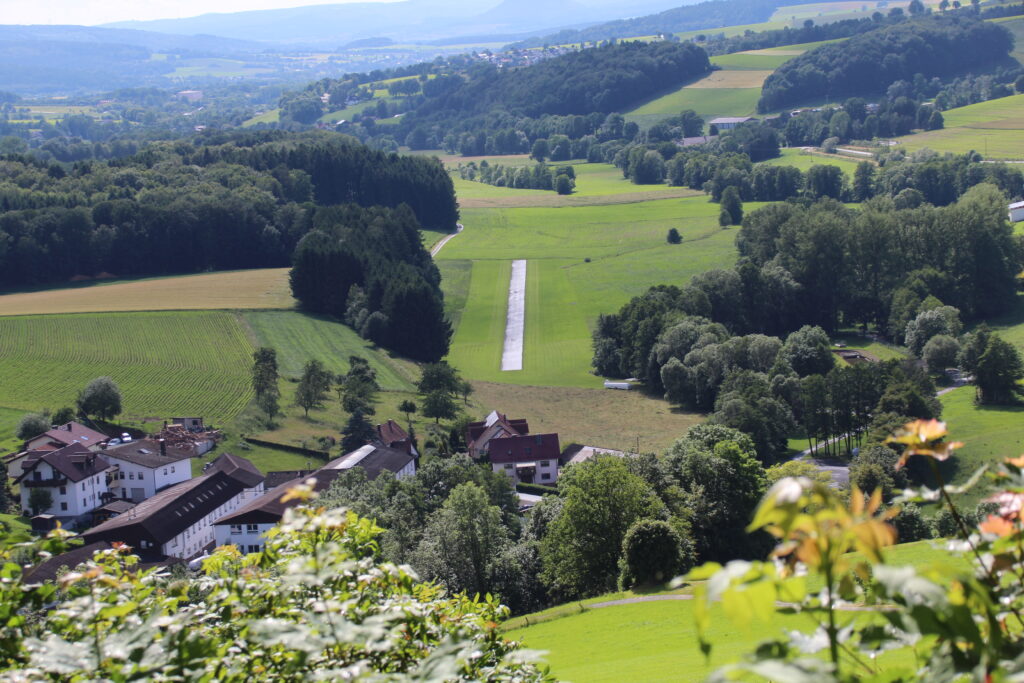
Located in the Rhön biosphere reserve just below the peak of the Wasserkuppe, the factory of Alexander Schleicher Segelflugzeugbau has stood at Alexander-Schleicher-Straße 1 since 1927. Established by Alexander Schleicher using prize money won at the historic Rhön gliding contests, the site was positioned strategically in the valley to test aircraft gliding down from the mountain plateau. Today, the complex combines early twentieth-century industrial hangar architecture with high-tech carbon-fiber curing workshops, alongside a dedicated 400-meter grass airstrip used for developmental test-flights and customer airframe handovers.
Key facts
- Location: Alexander-Schleicher-Straße 1, 36163 Poppenhausen (Wasserkuppe), Hessen, Germany
- Established: 1927, by master carpenter and soaring pioneer Alexander Schleicher
- Industrial function: Specialized design, hand-crafting, and series manufacture of high-performance sailplanes and motor gliders
- Architectural components: Interwar assembly halls, specialized woodworking and composite cure workshops, administrative offices, and testing runway
- Testing grounds: Private grass airfield (Sonderlandeplatz Poppenhausen) aligned along the Lütter stream
- Current status: Active, privately owned industrial manufactory; exterior and airfield visible from public valley walking paths
- Coordinates: 50.49053, 9.85429 · open in Google Maps
History and aviation heritage
Following the 1919 Treaty of Versailles, which prohibited the construction of powered military aircraft in Germany, unpowered gliding emerged as a hotbed of aerodynamic experimentation. Aviation enthusiasts and university engineering societies congregated on the bare slopes of the Wasserkuppe, utilizing thermal upcurrents and ridge winds to break international endurance records. Alexander Schleicher, a trained carpenter who had studied sailplane fabrication under Gottlob Espenlaub, piloted his own wooden glider to victory at the 1926 Rhön competition.
With his winnings, Schleicher purchased parcel land in neighboring Poppenhausen in 1927, opening the first commercial enterprise exclusively dedicated to glider production. The workshop pioneered standardized training gliders such as the ‘Hol’s der Teufel’ and the ‘Anfänger’, supplying flying clubs worldwide. Surviving mid-century destruction, the company re-established wooden production in 1951, transitioning in the 1960s under designers Rudolf Kaiser and Gerhard Waibel to pioneering fiberglass and carbon-composite construction. The Poppenhausen workshops have produced more than 8,000 sailplanes that have dominated international soaring championships for decades.
Architecture and the industrial site
The facility occupies an elongated layout bordered by the Lütter brook and the country lane leading into Poppenhausen. The architectural character reflects decades of organic industrial expansion: the earliest western workshops retain steep gabled roofs and reinforced timber framing typical of Rhön vernacular rural construction, while subsequent mid-century and modern additions incorporate broad steel truss roofs designed to accommodate forty-foot wingspans.
Directly south of the main assembly halls lies the private grass testing strip. Oriented northwest-southeast to catch the valley breezes, this private airstrip allows newly finished airframes to undergo flight calibration without requiring road transportation to public airports. The juxtaposition of quiet agrarian meadows, forested volcanic peaks, and high-precision aeronautical fabrication gives the compound a distinctive industrial atmosphere.
What you see today
The Alexander Schleicher manufactory is an active, private workplace rather than a public tourist venue. From Alexander-Schleicher-Straße and the adjacent Rhön circular hiking trails (including the Hochrhöner trail network), visitors can clearly see the historic manufacturing hangars, wind socks, and the open runway. On clear days between spring and autumn, gliders are regularly rolled out onto the grass apron for winch-launch testing and technical shake-downs.
While unauthorized entrance to the production hangars is prohibited for flight-safety and proprietary engineering reasons, travelers seeking a comprehensive historical exploration can visit the nearby German Gliding Museum (Deutsches Segelflugmuseum) on the summit plateau of the Wasserkuppe, just six kilometers uphill, where original Schleicher gliders from 1927 to the modern era are preserved on public display.
Practical information and visits
- Viewing points: Excellent public views of the factory grounds and grass runway are available from the hiking path along the Lütter stream and from the Stein viewpoint overlooking Poppenhausen.
- Factory visits: Internal workshops are closed to drop-in tourists. Scheduled technical tours are restricted to aviation associations and owners by advance arrangement.
- Museum exhibition: The official historical collection of Schleicher sailplanes is exhibited at the German Gliding Museum on the Wasserkuppe, open daily year-round.
Getting there
Poppenhausen lies approximately 18 kilometers southeast of the cathedral city of Fulda in eastern Hesse. By road, take the B458 highway from Fulda toward the Wasserkuppe, turning onto the L3307 into Poppenhausen. Regional bus line 35 connects Fulda main railway station directly to the Poppenhausen village square, from which the factory is an easy ten-minute walk west along Alexander-Schleicher-Straße.
Related enterprise history
This place card documents the physical workshop facilities, testing airfield, and landscape context in Poppenhausen. For the corporate history, pilot records, and design biographies of the aircraft manufactured here, read our in-depth magazine feature on Alexander Schleicher and the 1927 founding of sailplane manufacturing.
Sources
- Deutsches Segelflugmuseum mit Modellflug (Wasserkuppe): Comprehensive archive of Wasserkuppe soaring contests, Alexander Schleicher’s 1926 competition victory, and the 1927 founding of the Poppenhausen workshop.
- Hessisches Staatsarchiv Marburg, Gewerbe- und Handwerksregister Poppenhausen / Rhön (1927): Archival documentation of artisan business registration and early workshop construction along the Lütter valley.
- Rhönklub e.V. Archiv: Historical topography and trail records detailing the relationship between mountain updrafts, Wasserkuppe aviation, and valley manufacturing.
- OpenStreetMap: Building geometry and airfield perimeter of Alexander-Schleicher-Straße 1 (Way 385534057), Poppenhausen (Wasserkuppe), Hessen, Germany.
Find it on the map
See this place and what’s around it →📷 Become a Cultural Heritage Online photographer
Share your photos of places: they stay published under your name as the author. The more they're seen, the more you get noticed — and soon a contest will reward the most appreciated photos.
Log in or sign up free to add a photo