
Established by Grand Ducal law in April 1928, the Luxembourg Stock Exchange (Bourse de Luxembourg) laid the structural cornerstone of the Grand Duchy’s transformation into a premier international financial centre. Operating from its monumental headquarters along Boulevard Joseph II, the institution represents a key landmark in twentieth-century European financial history and corporate architecture.
At a glance
Positioned along the tree-lined Boulevard Joseph II on the western edge of Luxembourg City’s historic Ville-Haute quarter, the headquarters of the Luxembourg Stock Exchange (Société de la Bourse de Luxembourg) serves as the operational nerve center for thousands of international sovereign and corporate debt listings. Originally founded in 1928 under Grand Duchess Charlotte to diversify the domestic economy away from steel heavy industry, the exchange operated successively from the Cercle Municipal and Rue de la Porte-Neuve before establishing its dedicated modern headquarters at 35A Boulevard Joseph II. The building stands as an emblem of Luxembourg’s emergence as the primary global venue for international Eurobonds and sustainable green finance.
Key facts
- Location: 35A Boulevard Joseph II, 1840 Luxembourg City, Grand Duchy of Luxembourg
- Established: April 5, 1928, by Grand Ducal decree; inaugural trading opened on May 6, 1929
- Institutional role: National securities exchange, global market leader in international bond listings and green finance (LGX)
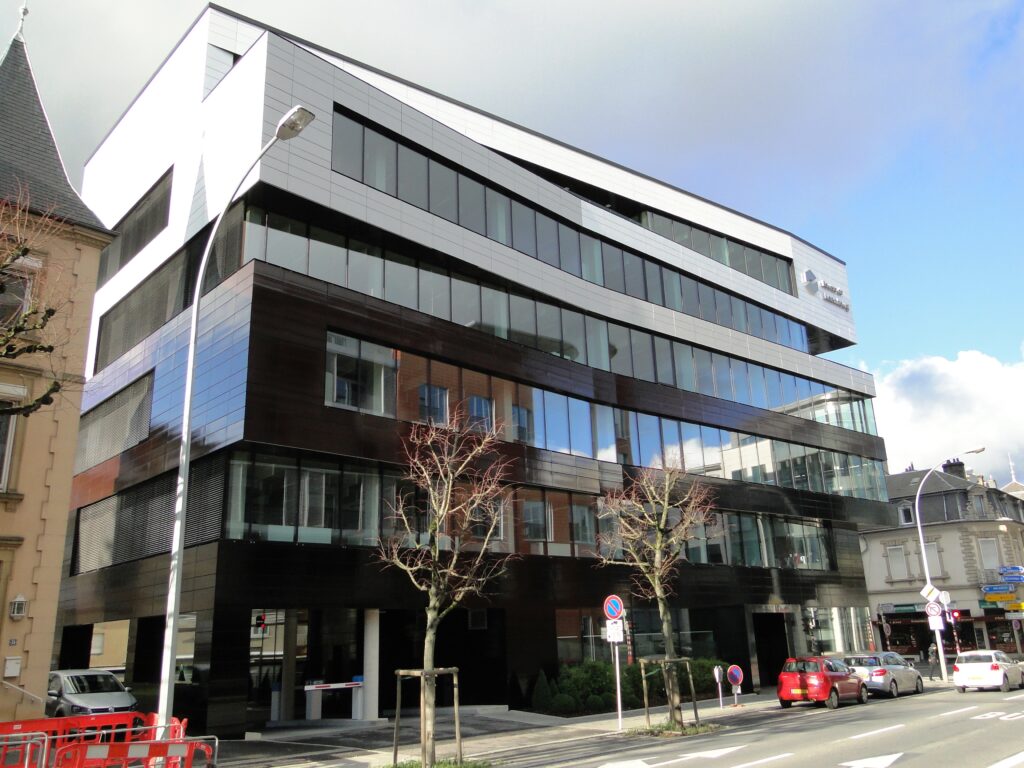
- Architectural character: Contemporary financial headquarters incorporating polished stone ashlar, high-transparency curtain walls, and formal civic landscaping
- Urban context: Boulevard Joseph II diplomatic and financial corridor, bordering Municipal Park and the upper city bastions
- Current status: Active corporate and financial institution; exterior architecture easily viewed from the public boulevard
- Coordinates: 49.6149, 6.1221 · open in Google Maps
History and financial heritage
Following the First World War and the dissolution of the Zollverein customs union with Germany, the Grand Duchy sought economic autonomy through financial service expansion. On April 5, 1928, Grand Duchess Charlotte ratified the legislative charter incorporating the Société de la Bourse de Luxembourg as a public joint-stock enterprise. Early trading sessions in 1929 primarily handled equity shares of domestic steel titan ARBED, regional iron-ore mines, and state reconstruction bonds.
The exchange secured global distinction in 1963 when it listed the world’s first Eurobond—a $15 million issuance by Italian highway operator Autostrade organized by Warburg bank. By offering neutral, efficient multilingual listing services unencumbered by restrictive capital controls, the exchange became the primary European gateway for international cross-border capital. In 2016, the institution further shaped modern sustainable investment by launching the Luxembourg Green Exchange (LGX), the planet’s first dedicated platform exclusively listing green, social, and sustainability-linked securities.
Architecture and urban setting
The building at 35A Boulevard Joseph II reflects the corporate restraint and security requirements of a modern international bourse. Its rectilinear facade combines precision-cut sandstone masonry—echoing the traditional golden Luxembourg sandstone of the historic Vauban fortifications—with crisp modern glazing and solar-shading louvers. Deep entrance reveals and structural granite piers project a sense of enduring institutional stability.
The site sits within an elegant urban enclave defined by late-nineteenth-century town residences, embassies, and the adjacent Municipal Park designed by Édouard André. Broad pedestrian walkways, manicured hornbeam hedges, and setback security barriers establish a calm civic interface that integrates the high-density financial complex seamlessly into the residential fringe of the capital.
What you see today
Today, the physical presence of the Bourse reflects the digital era of financial markets. The bustling, loud open-outcry trading pits of the mid-twentieth century have long been replaced by high-speed electronic trading networks, meaning the building functions as an executive, regulatory, and listing headquarters rather than a crowded market exchange floor.
From the public sidewalk on Boulevard Joseph II, visitors can admire the formal corporate architecture, official institutional crests, and entrance halls. The avenue itself offers one of Luxembourg City’s pleasantest architectural walks, leading southward toward the historic Villa Foch and northward to the Glacis plateau.
Practical information and visits
- Public access: As a secure financial facility, internal trading offices and executive suites are closed to casual tourists without professional business appointments.
- Exterior viewing: The building facade and surrounding streetscapes are fully accessible at all times from the public sidewalk.
- Photography: Non-commercial exterior photography from the public boulevard is permitted; security guidelines request respecting privacy near controlled vehicle barriers.
Getting there
The exchange is conveniently situated on Boulevard Joseph II in central Luxembourg City. From the Luxembourg-Gare central railway station, take the Luxtram tramway north to the “Stäreplatz / Étoile” stop, which is located less than a five-minute walk from the building. Several municipal bus lines also stop directly along Boulevard Joseph II and Avenue Émile Reuter.
Related enterprise history
This place card documents the physical headquarters, architecture, and urban setting of the exchange on Boulevard Joseph II. For the detailed corporate history of the institution, Grand Ducal decrees, and the evolution of the 1963 Eurobond market, read our companion magazine feature on the founding history of the Luxembourg Stock Exchange (1928).
Sources
- Bourse de Luxembourg (LuxSE) Official Institutional Archives: Corporate documentation on the 1928 Grand Ducal charter, inaugural May 1929 trading sessions, the 1963 Autostrade Eurobond listing, and the Boulevard Joseph II headquarters.
- Legilux — Le Journal Officiel du Grand-Duché de Luxembourg: Grand Ducal legislative records and state concessions establishing the Société Anonyme de la Bourse de Luxembourg in April 1928.
- Ville de Luxembourg, Service Urbanisme et Patrimoine Architectural: Urban inventory and civic planning records documenting civic institutional buildings along Boulevard Joseph II in the Ville-Haute district.
- OpenStreetMap: Street alignment, parcel boundaries, and spatial coordinates of Boulevard Joseph II (Way 50293246), Luxembourg City.
Find it on the map
See this place and what’s around it →📷 Become a Cultural Heritage Online photographer
Share your photos of places: they stay published under your name as the author. The more they're seen, the more you get noticed — and soon a contest will reward the most appreciated photos.
Log in or sign up free to add a photo