
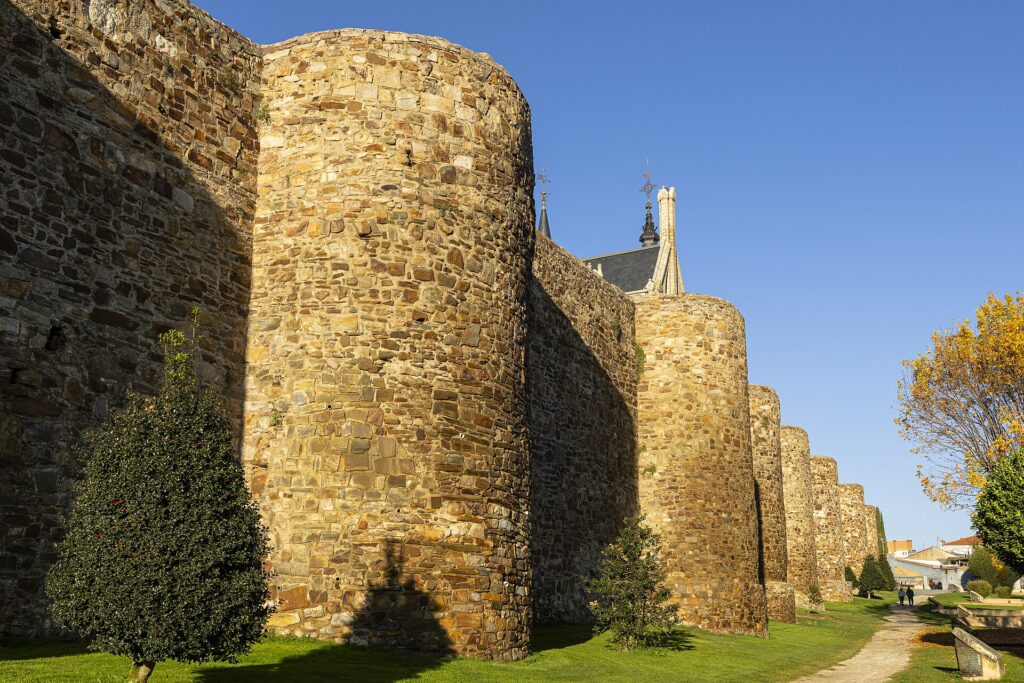

Built at the end of the third century or the beginning of the fourth to enclose the Roman city of Asturica Augusta, the wall still rings the old town of Astorga for more than two kilometres. Besieged in the Middle Ages and battered by artillery in the Peninsular War, it has been rebuilt again and again, and is today one of the town’s protected monuments.
At a glance
Astorga grew out of a Roman military camp on a hill above the plain of León, which became the civil city of Asturica Augusta. The wall visible today is the third defensive line built on the site, and the only one that survives above ground. It follows the foot of the hill for about 2.2 kilometres and encloses some 26 hectares, the area that still defines the historic centre. The Junta de Castilla y León records it as a protected monument, a Bien de Interés Cultural, and the whole walled town was declared a historic ensemble in 1978.
Key facts
- Where: around the old town of Astorga (León); the best-preserved stretches are along the Paseo de la Muralla and beside the Episcopal Palace
- Built: end of the third century or beginning of the fourth century AD
- Size: about 2.2 km long, enclosing about 26 hectares; the curtain walls are 4 to 5 metres thick
- Construction: two faces of rough local quartzite with a core of Roman concrete (opus caementicium); large granite blocks at the gates
- Protection: Bien de Interés Cultural, declared on 22 April 1949 (BOE of 5 May 1949); inside the historic ensemble of Astorga, declared in 1978
- Visiting: the Paseo de la Muralla is open and free; the stretch in the gardens of the Episcopal Palace is open during the palace’s hours
- Coordinates: 42.457716, -6.054977 (stretch by the Episcopal Palace) · open in Google Maps
History
Excavations in the town have identified three successive defences. The first was the earth-and-timber rampart of the camp of the Legio X Gemina, known from its ditches. The second was a stone wall with round towers, built when the camp gave way to a civil town in the first century and demolished before the end of that century to make room for houses. The third, the wall that stands today, was raised at the end of the third century or early in the fourth, during the unrest of the last decades of the Western Empire, at the same time as the walls of León, Lugo and other towns of north-western Hispania. Unlike the earlier one, it was built at the foot of the hill and closed it entirely.
The municipal account follows the wall through the town’s later history. After the Roman period the town was assaulted and sacked by the Visigothic king Theodoric. After the repopulation of the ninth century under Ordoño I, Alfonso III made the town the seat of his court. At the end of the tenth century al-Mansur stormed it, and according to the chronicles of the time he knocked down the tops of the towers; at the end of the twelfth century the town withstood sieges by Alfonso of Aragon and Alfonso VIII of Castile. Repairs by Bishop Nuño are recorded at the end of the thirteenth century.
The heaviest damage came in the Peninsular War. The French siege brought down long stretches of the north and east sides with artillery, and once the town was recovered the Spanish army demolished part of what still stood, so that it could not be used again by the French. Since then the history of the wall has been one of rebuilding, against both the war damage and the slow undermining of its foundations, which has caused collapses along its course. Part of the south-western stretch was raised to make the Paseo de la Muralla, so that the Roman masonry there is hidden. None of the gates survives standing; the only gate of Roman date, excavated in 1971 and 1972, is preserved as ruins in the Parque del Melgar.
What you see
The photograph shows one of the best-kept stretches: a high curtain of rough, warm-coloured stone broken at short intervals by massive semicircular towers, built of the same irregular masonry laid in rough courses. The towers stand out from the wall like a row of drums along a grassy strip and a path. Behind the wall, above its line, rise the grey pinnacles of the Episcopal Palace designed by Antoni Gaudí.
What cannot be seen is the construction inside: according to the municipal description, each wall is a sandwich of two rough quartzite faces filled with poured Roman concrete, and it was at the gates, the places of prestige, that the builders used large squared blocks of granite, often reused from older buildings.
Practical information
- The Paseo de la Muralla, on the south side of the old town, is a public walk along the top of the rebuilt wall, free at all times.
- The stretch in the gardens of the Episcopal Palace can be visited when the palace is open.
- The remains of the Roman gate are in the Parque del Melgar.
Getting there
Astorga lies about 50 km west of León, on the Camino Francés to Santiago, which crosses the old town. The walls can be followed on foot around the historic centre; the Paseo de la Muralla on the south side is the easiest stretch to reach.
Nearby
- Palacio Episcopal de Astorga, Gaudí’s palace, now the Museo de los Caminos, directly behind this stretch of wall.
- Astorga Cathedral, a few steps away.
- The Plaza Mayor and the town hall, and the Roman “Ergástula” with the Museo Romano, about 400 metres to the south-east.
Do you know more?
On this page we have published what the municipality of Astorga and the Junta de Castilla y León record about the walls. The dates of the medieval repairs, and the exact stretches rebuilt after the Peninsular War and in the twentieth century, are not set out in the sources we could read. If you know more — a study, an old photograph of the walls before a collapse or a rebuilding, a document — write to Sofia, who looks after these pages.
Write to Sofia or send a message on WhatsApp
Please start your message with the title of this page, so it reaches the right file. Every contribution is checked against independent sources before it goes on the page, and we always say where a piece of information came from.
Sources
- Junta de Castilla y León, Dirección General de Patrimonio Cultural, catalogue of protected property, «Murallas», Astorga: Bien de Interés Cultural, declared 22 April 1949, BOE 5 May 1949; free outside visit.
- Ayuntamiento de Astorga, Turismo de Astorga, «Murallas de Astorga»: date, length, area, thickness, construction, the Roman gate in the Parque del Melgar, and the history of the wall from the sixth century to the Peninsular War.
- M. Á. Sevillano Fuertes, “De la excavación a la vitrina. Historia de un pequeño Museo”, Boletín del Museo Arqueológico Nacional 35 (2017), pp. 1053–1061: the declaration of the historic ensemble in 1978 and the late Roman wall as its boundary.
- Wikipedia (es), Muralla de Astorga: the three successive defences, the Paseo de la Muralla, the gate excavated in 1971–1972.
- OpenStreetMap / Nominatim: position of the wall, returned as Muralla de Astorga, Calle El Doctoral, Astorga.
Find it on the map
See this place and what’s around it →📷 Become a Cultural Heritage Online photographer
Share your photos of places: they stay published under your name as the author. The more they're seen, the more you get noticed — and soon a contest will reward the most appreciated photos.
Log in or sign up free to add a photoIs this page about you?
This page is read by travellers and heritage enthusiasts who find it on Google. Tell us how you are connected to this place and we will take it from there.