
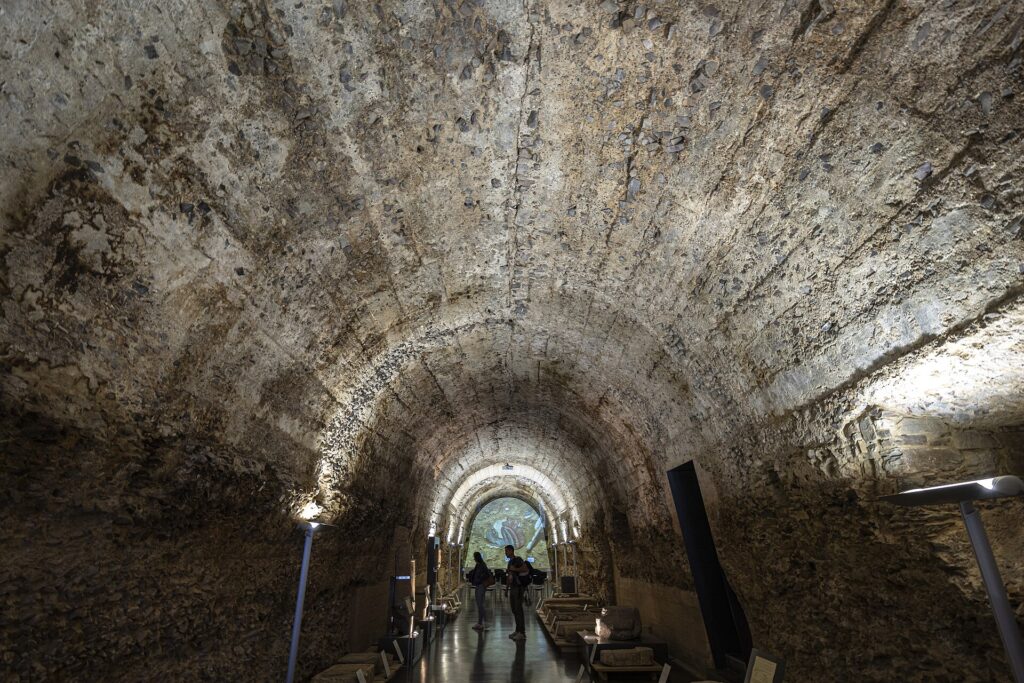

A barrel-vaulted gallery some fifty metres long, built in Roman concrete on the east side of the forum of Asturica Augusta. Tradition called it a slave prison, an ergastulum; archaeologists read it as part of the base of a great altar to the emperor. Divided into four private premises in the twentieth century, it was bought back piece by piece by the town and opened in 2000 as the Museo Romano.
At a glance
The name Ergástula is a traditional one: in Latin an ergastulum was a prison where slaves were locked up, and the dark vaulted gallery beside the Plaza Mayor of Astorga suggested one. The museum’s own research tells a different story. The gallery is the eastern arm of a triple portico laid out in a U, which is interpreted as the substructure of the Ara Augusta, a monumental altar in the forum of Asturica Augusta. It was declared a national historic monument in 1951, and since April 2000 it has been the ground floor of the Museo Romano, which displays the finds of decades of excavation in the town.
Key facts
- Where: Plaza de San Bartolomé 2, Astorga (León), beside the Plaza Mayor
- What it is: a Roman gallery covered by a barrel vault, built in opus caementicium; about 50 m long, 5.30 m wide and 5.30 m high on average
- Interpretation: the eastern side of a U-shaped triple portico, the base of the Ara Augusta in the forum of Asturica Augusta
- Protection: declared a national historic monument in 1951; Bien de Interés Cultural (register no. RI-51-0001235)
- Museum: bought back by the town from 1985; excavated and project approved in 1996 (architects Antonio García Paniagua and Javier Pérez López); Museo Romano open since April 2000
- Coordinates: 42.454282, -6.052540 · open in Google Maps
History
Asturica Augusta began as a military camp and became a civil town, and the large open space at its centre, more than thirty thousand square metres, was used first by the camp and then as the forum. On its eastern side stood a monumental altar framed by porticoes; the vaulted gallery known as the Ergástula formed part of its base, and foundations running from its ends towards today’s Plaza Mayor show that the structure was laid out in a U.
At the beginning of the twentieth century the gallery passed into private hands and its interior was split into four separate premises. In 1951 it was declared a national historic monument. From 1985 the Ayuntamiento of Astorga bought the four sections one after another until it owned the whole Roman building again. Excavations were carried out inside, and in 1996 the project for the museum was approved: the gallery was restored, and two new floors were built above it, keeping the Roman structure intact, for the archaeology service and for the permanent exhibition. The Museo Romano opened in April 2000.
What you see
The photograph shows the gallery from one end: a long tunnel under a round barrel vault of rough grey concrete in which the stones of the aggregate and the lines of the Roman formwork can still be seen. Lights set low along the walls wash up the vault. Along the floor run the museum’s display stands, and at the far end, where the gallery narrows into a lit opening, two visitors stand in front of a projection.
The ground floor is used for an audiovisual introduction to Roman Astorga; the permanent collection is upstairs, in the hall named after the archaeologist José María Luengo. It includes funerary inscriptions of soldiers, augurs, slaves and freedmen, the Pompeian-style wall paintings found by Luengo in the mid-twentieth century, coins including a gold aureus of Tiberius and a hoard of denarii, pottery and jewellery.
Practical information
- The Museo Romano is run by the Ayuntamiento of Astorga and is open to visitors with a ticket; it is closed on Mondays and on Sunday afternoons. Check the current hours on the municipal tourism site before a visit.
- Combined tickets are available with the Ruta Romana, the town’s circuit of Roman remains preserved on site, and with the chocolate museum.
Getting there
The museum is on the Plaza de San Bartolomé, right beside the Plaza Mayor in the middle of the walled old town. Astorga lies about 50 km west of León, on the Camino Francés to Santiago.
Nearby
- The town hall on the Plaza Mayor, a Baroque front of 1683–1704 with its clock automata, next to the museum.
- The Domus of the Mosaic of the Bear and the Birds and the other sites of the Ruta Romana, in the old town.
- Astorga Cathedral and Gaudí’s Episcopal Palace, about 500 metres to the north-west.
Do you know more?
On this page we have published what the Museo Romano and the municipality of Astorga record about the Ergástula. We could not find who owned the four premises into which the gallery was divided in the twentieth century, or what they were used for, and we have no old photograph of the gallery before the museum. If you know more — a family who had a shop or a store there, an old photograph, a document — write to Sofia, who looks after these pages.
Write to Sofia or send a message on WhatsApp
Please start your message with the title of this page, so it reaches the right file. Every contribution is checked against independent sources before it goes on the page, and we always say where a piece of information came from.
Sources
- María Ángeles Sevillano Fuertes (Museo Romano de Astorga), “De la excavación a la vitrina. Historia de un pequeño Museo”, Boletín del Museo Arqueológico Nacional 35 (2017), pp. 1053–1061: the gallery and its interpretation as the base of the Ara Augusta, the forum, the privatisation and division into four, the purchases from 1985, the declaration of 1951, the project of 1996 and its architects, the opening in April 2000, the collection.
- Ayuntamiento de Astorga, Turismo de Astorga, «Museo Romano»: the collection, the “portico abovedado” in the forum, address, opening days and combined tickets.
- Wikipedia (es), Museo Romano (Astorga): dimensions of the gallery.
- List of Bienes de Interés Cultural of the province of León (Wikipedia, es): Ergástula romana, RI-51-0001235, 18 May 1951.
- OpenStreetMap / Nominatim: position, returned as Museo Romano La Ergástula, Astorga.
Find it on the map
See this place and what’s around it →📷 Become a Cultural Heritage Online photographer
Share your photos of places: they stay published under your name as the author. The more they're seen, the more you get noticed — and soon a contest will reward the most appreciated photos.
Log in or sign up free to add a photoIs this page about you?
This page is read by travellers and heritage enthusiasts who find it on Google. Tell us how you are connected to this place and we will take it from there.