
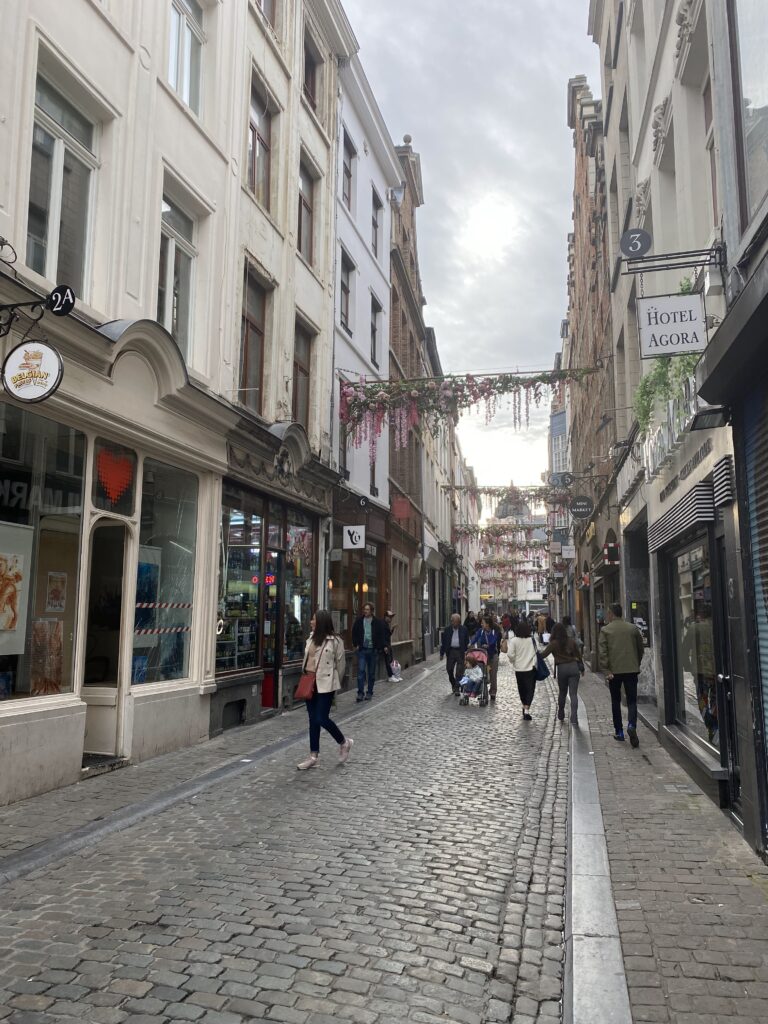

A narrow house at the lower end of the Spurmakers’ Street, built around a seventeenth-century core, refronted in the nineteenth century and raised by a storey in 1903. It is on the Brussels legal heritage inventory and today houses the Hotel Agora.
At a glance
Number 3 on the Rue des Éperonniers is the second house up the street from the Rue du Marché aux Herbes, next to the corner building known as the Cheval Volant. The Brussels regional inventory of architectural heritage describes it as a house of three storeys and three bays whose present form comes from a nineteenth-century remodelling of a core of the seventeenth century, raised in 1903 by one more storey under a flat roof.
The house was entered on the Brussels legal heritage inventory (inventaire légal) on 19 August 2024. The street takes its name from the spur makers (éperonniers in French, spoormakers in Dutch). The Hotel Agora, which occupies the house, describes it as a restored seventeenth-century building.
Key facts
- Where: Rue des Éperonniers 3 / Spoormakersstraat 3, 1000 Brussels (Pentagon), Brussels-Capital Region, Belgium
- Date: core of the second half of the 17th century (1650–1699, according to the inventory); remodelled in the 19th century; raised by one storey in 1903
- Architect: not known
- Type: town house (single-family or rental, undetermined)
- Style: traditional Brussels architecture and neoclassicism
- Protection: on the Brussels legal heritage inventory since 19 August 2024
- Inventory record: Inventaire du patrimoine architectural, Région de Bruxelles-Capitale, notice 31032
- Current use: Hotel Agora
- Coordinates: 50.846159, 4.354432 · open in Google Maps
History
The inventory dates the core of the house to the second half of the seventeenth century, without naming a builder. It does not say whether that core predates or follows the bombardment of 1695, after which much of the quarter around the Grand-Place was rebuilt, and we have not found another source that does.
In the nineteenth century the house was given a new arrangement, which accounts for the regular front with its rectangular windows in moulded frames. In 1903 it was raised by a further storey under a flat roof; the building file for that work, dated 1903, is kept in the Brussels City Archives (TP 10672) and is the only archival source the inventory cites. The ground floor has since been altered.
The house was recorded during the heritage survey of the Brussels Pentagon carried out in 1989–1993, and the entry has since been kept up to date by the regional heritage service. On 19 August 2024 it was entered on the legal inventory, together with its neighbours along the street.
What you see
The photograph is taken from the lower end of the street, looking up the cobbled lane between rows of old houses, with garlands of pink and mauve artificial flowers strung from side to side and a dome closing the view in the distance. On the left are shopfronts under pale rendered fronts; on the right, close to the camera, is number 3.
The house is seen in steep perspective. Its front is rendered and painted a pale cream, and the windows of the upper floors sit in moulded frames with carved ornament at the keystones. From an iron bracket hang a round black sign with the number 3 and a white signboard lettered Hotel Agora, with a trailing green plant below. At street level the old front has given way to dark modern cladding and glass, in line with the inventory’s note that the ground floor has been altered.
The inventory describes the upper front in more detail than the photograph shows. The render is held by I-shaped iron wall anchors. Each rectangular window has a moulded surround stamped with a keystone that encloses a garland, an ornament that has been lost on the top floor, and continuous string courses serve as the window sills. It also records a gable with five steps and a crowning element under a triangular pediment, pierced by three rectangular windows, which is not visible in this view.
Practical information
- The house is a working hotel, the Agora; the front can be seen from the street at any time.
- The Rue des Éperonniers is a pedestrian street. The upper floors are easiest to read from the opposite pavement, a few metres up the street.
- A walk up the whole street, past the screen fronts of the Galerie Agora to Place Saint-Jean, takes about ten minutes.
Getting there
Brussels-Central station, with its metro stop, is about 200 metres to the east on foot. The Grand-Place is about 150 metres to the north-west, and the Bourse premetro stop about 450 metres to the north-west.
Nearby
- The Cheval Volant, next door at the corner of the Rue du Marché aux Herbes: a Second Empire house built in 1861 to replace an older house of that name, also on the legal inventory.
- The Galerie Agora, about 50 metres up the same street: a shopping arcade laid out to plans of 1963 by the architect J. Van de Putte behind a row of rebuilt stepped and bell-shaped gables.
- Le Dixseptième, Brussels, three old houses behind one baroque front on the Rue de la Madeleine, about 70 metres south-east.
- Galeries Royales Saint-Hubert, Brussels, about 130 metres north, and King’s House, Brussels, on the Grand-Place, about 150 metres north-west.
Sources
- Inventaire du patrimoine architectural, Région de Bruxelles-Capitale — Rue des Éperonniers 3: dating of the core (1650–1699), 19th-century remodelling, 1903 extra storey (Brussels City Archives, TP 10672), description of the front, legal inventory since 19 August 2024.
- Inventaire du patrimoine architectural — Cheval Volant, Rue du Marché aux Herbes 113 / Rue des Éperonniers 1 and Galerie Agora, Rue des Éperonniers 7–27: the neighbouring buildings.
- Hotel Agora: current use, address and the hotel’s own description of the house as a restored seventeenth-century building.
- OpenStreetMap / Nominatim — position of Rue des Éperonniers 3.
Find it on the map
See this place and what’s around it →📷 Become a Cultural Heritage Online photographer
Share your photos of places: they stay published under your name as the author. The more they're seen, the more you get noticed — and soon a contest will reward the most appreciated photos.
Log in or sign up free to add a photoIs this page about you?
This page is read by travellers and heritage enthusiasts who find it on Google. Tell us how you are connected to this place and we will take it from there.