
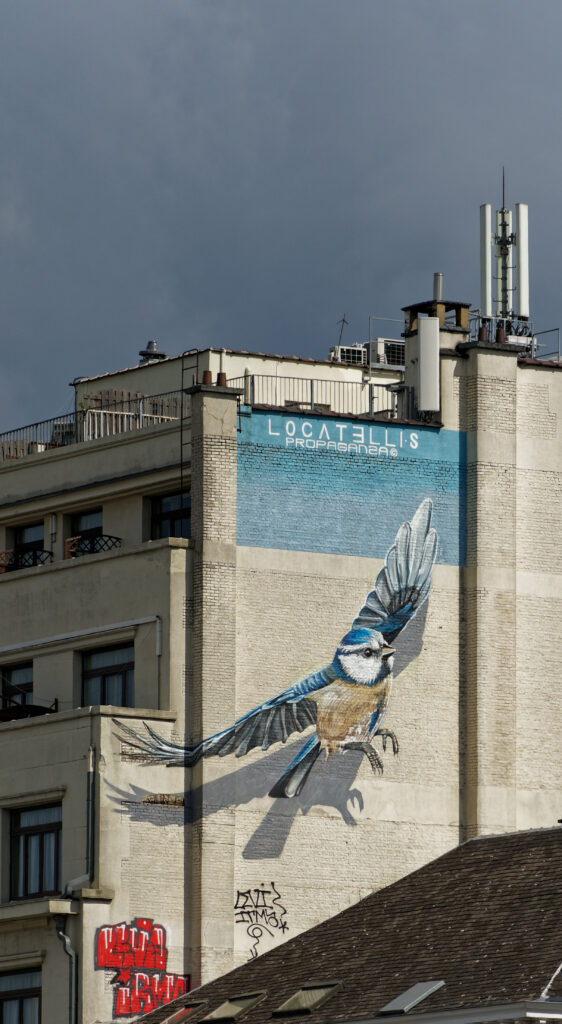

An apartment block designed in 1928 by the architect Michel Polak, with a showroom for Minerva motor cars on its ground floor and three attic storeys stepping back towards the sky. It is on the Brussels legal heritage inventory and has long been a hotel, the Chambord.
At a glance
Number 82 on the Rue de Namur stands a few steps inside the old city, next to the corner building on the Boulevard du Régent at the Porte de Namur. The Brussels regional inventory of architectural heritage records it as the former Immeuble Minerva: an apartment building in the functionalist style, drawn in 1928 by Michel Polak, whose ground floor and mezzanine were built as an exhibition hall for Minerva automobiles. The inventory notes that it now serves as a hotel.
The building was entered on the Brussels legal heritage inventory (inventaire légal) on 19 August 2024. Since August 2015 its blind side wall, which faces the Porte de Namur, has carried a large mural of a bird in flight by the street artist Steve Locatelli.
Key facts
- Where: Rue de Namur 82, 1000 Brussels (Pentagon), Brussels-Capital Region, Belgium
- Date: designed in 1928 (building permit of 1928 in the Brussels City Archives)
- Architect: Michel Polak (1885–1948)
- Type: apartment building with a car showroom on the ground floor and mezzanine
- Style: functionalism, according to the inventory; the hotel describes itself as Art Deco
- Protection: on the Brussels legal heritage inventory since 19 August 2024
- Inventory record: Inventaire du patrimoine architectural, Région de Bruxelles-Capitale, notice 30388
- Current use: Hotel Chambord
- Coordinates: 50.839144, 4.361617 · open in Google Maps
History
Minerva was a Belgian firm that made bicycles, motorcycles and then motor cars between 1897 and 1958, and its luxury cars were known for the quietness of their Knight engines. In 1928 a new building went up on the Rue de Namur, close to the busy crossroads of the Porte de Namur, with apartments above and a ground floor fitted out as a showroom for the make. The regional inventory, which cites the 1928 building file in the Brussels City Archives, gives the design to Michel Polak.
Polak was a Belgian-Swiss architect, born in 1885. In the same years he also designed the Hotel Albert I on Place Charles Rogier and, with Alfred Hoch, on the Hotel Le Plaza on the Boulevard Adolphe Max. The Brussels heritage service itself names him, with Victor Horta and Victor Bourgeois, as an example of an architect whose work gives a building historical interest.
At some point the car showroom and the apartments gave way to a hotel; the inventory records that use, and the building is now the Hotel Chambord, but we have not found when the change was made. In August 2015 the street-art programme PARCOURS Street Art and the Atrium Brussels collective commissioned seven murals along the Rue de Namur, to draw people up this short street between the lower and upper parts of the city. The one on number 82, a carte blanche to Steve Locatelli of the PROPAGANZA collective, is a bird in flight. On 19 August 2024 the building was entered on the legal heritage inventory.
What you see
The photograph is taken from the Porte de Namur side and shows the building above the slate roof of its lower neighbour, against a dark grey sky. On the left, the street front is seen at an angle. Its upper floors step back one above the other, as the inventory describes: three storeys, then three attic storeys each set further back. The walls are pale, with rectangular windows set in wide horizontal openings; some of the upper windows have low black railings, and the top terrace is closed by a light metal rail.
On the right rises the blind side wall, built of pale brick. Across its upper part a sky-blue band carries the painted words LOCATELLIS PROPAGANZA, and below it a blue tit in flight, wings spread and claws forward, is painted life-like at the scale of several storeys, with its shadow cast on the wall. A mast with three white cylindrical antennas stands on the roof. At the bottom left, a red graffiti tag has been added to the wall of the lower floors.
The street front itself, not visible in this photograph, is described by the inventory. The ground floor and mezzanine, the former showroom, are faced with granite slabs and have metal window frames, with a large opening in the centre leading between the display windows. Above, the facing is white stone and imitation stone; the windows are laid out in width and separated by fluted piers, and the sills and drip mouldings run continuously across the front.
Practical information
- The building is a working hotel, the Chambord; the front can be seen from the Rue de Namur at any time.
- The mural is best seen from the Porte de Namur crossroads, looking north over the corner building.
- The other murals of the 2015 project are spread along the Rue de Namur and can be seen on the walk up to the Place Royale.
Getting there
Porte de Namur metro station, at the crossroads, is about 100 metres away. From the Place Royale and the museums of the Mont des Arts, the Rue de Namur leads here in about ten minutes on foot.
Nearby
- Fondation Universitaire, Brussels, the academics’ club on the Rue d’Egmont, about 280 metres east.
- Royal Palace of Brussels, about 280 metres north.
- Royal Museums of Fine Arts of Belgium, about 350 metres north-west.
Sources
- Inventaire du patrimoine architectural, Région de Bruxelles-Capitale — Ancien Immeuble Minerva, Rue de Namur 82: architect, 1928 design (Brussels City Archives, TP 36503), original use as a Minerva showroom, description of the front, current use as a hotel, legal inventory since 19 August 2024.
- PARCOURS Street Art — Steve Locatelli, Oiseau en vol, Rue de Namur 82: date of the mural (August 2015) and the project with Atrium Brussels.
- Hotel Chambord: current use, address and the hotel’s own description of the building as Art Deco.
- Wikipedia (French) — Michel Polak and Wikipedia (English) — Minerva (automobile): the architect’s other works of 1927–1932; the car maker’s dates.
- OpenStreetMap / Nominatim — position of Rue de Namur 82.
Find it on the map
See this place and what’s around it →📷 Become a Cultural Heritage Online photographer
Share your photos of places: they stay published under your name as the author. The more they're seen, the more you get noticed — and soon a contest will reward the most appreciated photos.
Log in or sign up free to add a photoIs this page about you?
This page is read by travellers and heritage enthusiasts who find it on Google. Tell us how you are connected to this place and we will take it from there.