
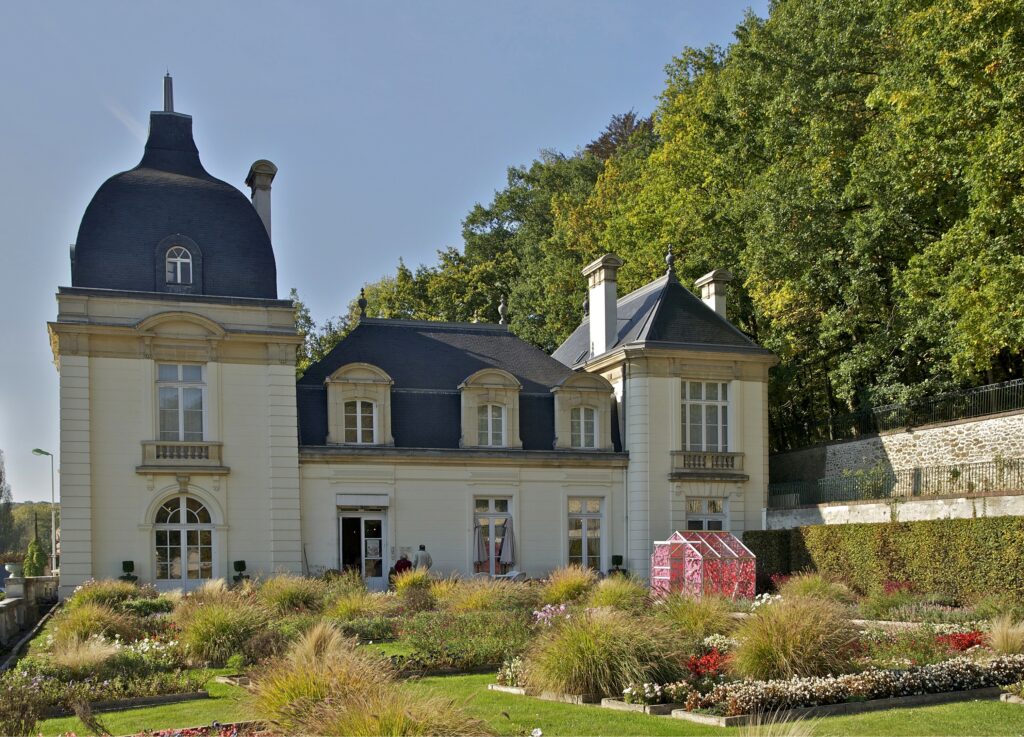

The museum of the printed cotton that took the name of a village near Versailles and kept it. Toile de Jouy was made here by the Oberkampf manufactory from 1760 to 1843; the collection that records it fills a late nineteenth-century château above a garden.
At a glance
Jouy-en-Josas lies south-west of Paris, in the district of Versailles. In 1760 Christophe-Philippe Oberkampf, born in 1738 at Wiesenbach in what is now Germany into a family of dyers and engravers, founded a manufactory here for printing cotton. It ran until 1843, and the cloth it produced, printed with pastoral scenes, allegories and small repeating patterns, became known simply as toile de Jouy. The municipal museum devoted to it was created in 1977 and moved in 1990 into the Château de l’Églantine, a house of 1891–92 by the architect Alfred Vaudoyer. It holds the Musée de France label and some ten thousand objects: lengths of cloth and samples, paintings, costumes, and the tools of the printing trade. The museum runs temporary exhibitions, lectures and workshops; the exhibition on show until January 2027 is devoted to the textile designer Amédée Couder.
Key facts
- Where: Château de l’Églantine, 54 rue Charles de Gaulle, 78350 Jouy-en-Josas, Yvelines, France
- Manufactory: founded in 1760 by Christophe-Philippe Oberkampf, born in 1738 at Wiesenbach; closed in 1843
- Museum: created in 1977; in the Château de l’Églantine since 1990; label Musée de France
- Building: Château de l’Églantine, built 1891–92 by Alfred Vaudoyer for a M. Viennot, on a U-shaped plan with two pavilions under slate roofs
- Collection: about 10,000 works — textiles, paintings, costumes, printing blocks and tools
- Run by: the town of Jouy-en-Josas, with a friends’ association, Les Amis de la Toile de Jouy
- Coordinates: 48.769098, 2.151850 · open in Google Maps
History
Oberkampf was a designer and engraver as well as a manufacturer, with what the museum calls a very pronounced curiosity for colour. The manufactory he opened at Jouy in 1760 printed on cotton, and its output ran for eighty-three years. The designs came from artists of the first rank: Jean-Baptiste Huet the elder (1745–1811) drew models for Jouy that include the allegories of the Revolution, among them the Fête de la Fédération of 1790 and the dancing on the ruins of the Bastille, examples of which are held today by Paris Musées.
In the early nineteenth century the manufactory worked with independent designers. One of them, Amédée Couder (1800–1864), transposed the woven palmettes and boteh motifs of cashmere shawls, then at the height of fashion, into patterns for printing on cloth, and founded a studio that sold designs to textile and decorative manufacturers, one of the first of its kind. The museum’s exhibition of 2026–27 sets his work beside that of other industrial designers of the period and traces their relationship with the Parisian printing houses.
The museum itself is younger than its subject. Created in 1977, it first occupied the Château de Montebello, then moved in 1990 to the Château de l’Églantine, a house built in 1891–92 by Alfred Vaudoyer for a M. Viennot. The move gave the collection a garden setting and room for the workshops and lectures that now make up much of its programme.
What you see
From the garden the château reads as three pieces: a tall square pavilion at one end with a domed slate roof and a lantern, a lower central range with dormer windows, and a second, smaller pavilion at the other end. The walls are rendered in a pale cream; the roofs are slate. Wide french windows on the garden front open the ground floor to the beds outside.
Inside, the collection is shown in the rooms of the house: printed cottons by the length and by the sample, the copper plates and wooden blocks that printed them, costumes and furnishings that show how the cloth was used, and paintings. There is a museum shop, and a temporary exhibition alongside the permanent display.
Practical information
- Opening hours: closed Monday; Tuesday 2 pm – 6 pm; Wednesday to Sunday 11 am – 6 pm. Closed 25 December and 1 January.
- Telephone: +33 1 39 56 48 64
- Exhibition until 10 January 2027: Amédée Couder, dessinateur sur étoffes, from 19 June 2026, with an exhibition booklet in French and English
- Programme: lectures, guided tours of the permanent collection and workshops for children; booking through the museum
Getting there
Jouy-en-Josas is in the Yvelines, in the district of Versailles, south-west of Paris. The museum stands on the rue Charles de Gaulle, the main road through the village; the museum’s website gives directions by public transport and by car.
Nearby
- Versailles, with the palace and its gardens, in the same district
- Paris and its museums of decorative art, where toile de Jouy is also shown
Sources
- Musée de la Toile de Jouy, official website: history page, contact page, exhibition page Amédée Couder, dessinateur sur étoffes and agenda (read 29 September 2026)
- Paris Musées collections, records of toiles de Jouy by the Manufacture Oberkampf after Jean-Baptiste Huet, via Wikimedia Commons
- Wikipédia (fr), Musée de la toile de Jouy, for the Château de l’Églantine and the size of the collection
- OpenStreetMap Nominatim, for the coordinates
Find it on the map
See this place and what’s around it →Events here — now on & upcoming
- Amédée Couder, dessinateur sur étoffes — the exhibition at the Musée de la Toile de Jouy, Jouy-en-Josas, until 10 January 202719 Jun 2026 — 10 Jan 2027See the event →
📷 Become a Cultural Heritage Online photographer
Share your photos of places: they stay published under your name as the author. The more they're seen, the more you get noticed — and soon a contest will reward the most appreciated photos.
Log in or sign up free to add a photoIs this page about you?
This page is read by travellers and heritage enthusiasts who find it on Google. Tell us how you are connected to this place and we will take it from there.