
.jpg)
A competition won in the 1890s, a foundation stone laid in 1926, a nave consecrated in 1929 and an east end finished in 1991: one cathedral built in instalments, out of the stone and slate of the coast around it.
At a glance
Christ Church Cathedral stands on Church Hill in the Fairfield neighbourhood of Victoria, on the south-east corner of Quadra Street and Rockland Avenue, beside the Pioneer Square burying ground. It is the seat of the Anglican Diocese of British Columbia, which covers Vancouver Island and the islands of the Gulf of Georgia. The design is by John Charles Malcolm Keith, who won an architectural competition for the commission; construction ran from 1926 to 1991. The City of Victoria gave the building a heritage designation on 24 June 1982, and it was listed on the Canadian Register of Historic Places on 4 February 2010.
Key facts
- Where: 911 Quadra Street, Victoria, British Columbia V8V 3K3
- Architect: John Charles Malcolm Keith, who moved his practice from England to supervise the work
- Competition: won by Keith in 1896 according to the cathedral’s own account; the Canadian Register of Historic Places gives 1891. We have not found which is right.
- Built: foundation stone laid by the Bishop of London in August 1926; nave consecrated 29 September 1929; western towers completed in the 1950s; east end and the Chapel of the New Jerusalem consecrated 1 November 1991
- Style: Gothic Revival on thirteenth-century models, blending ideas from Durham Cathedral and Grace Cathedral in San Francisco
- Materials: Newcastle Island sandstone facing, Nelson Island granite for foundations and steps, Jervis Inlet slate for the roof, native woods inside, cast stone tracery
- Size: interior 93 by 140 feet, towers 122 feet above street level; one of the largest churches in Canada
- Bells: hung in the north tower in 1936, modelled on those at Westminster Abbey, with two more added in 1983
- Protection: local heritage designation, 24 June 1982; Canadian Register of Historic Places, 4 February 2010
- Coordinates: 48.422272, -123.359453 · open in Google Maps
History
This is the diocese’s third cathedral of the name. The first, built in 1856, burned; the second, of 1872, grew too small for its congregation. Both stood across the street from the present building, on the ground now held by the Law Courts. When the diocese ran an architectural competition for a permanent cathedral, J. C. M. Keith won it — in 1896 by the cathedral’s own account, in 1891 by the Canadian Register’s. Then the money took decades to gather, and the Bishop of London did not lay the foundation stone until August 1926. Keith had in the meantime moved his practice from England to Victoria and designed several other local buildings while he waited.
Only the nave was completed at first, and it was consecrated on 29 September 1929. The Depression stopped the work, the Second World War stopped it again, and for two decades the cathedral was a long Gothic hall with a temporary wall at its east end. The western towers went up in the 1950s, and not as drawn: they were built one stage short of the design, which is why they read as square and blunt instead of rising to a further stage. The east end was not resolved until 1991, when the reconstructed chancel and the Chapel of the New Jerusalem were consecrated on 1 November.
The Canadian Register is unusually specific about the materials, and the reason is local. Sandstone from Newcastle Island faces the walls, granite from Nelson Island carries the foundations and steps, slate from Jervis Inlet covers the roof, and native woods finish the interior. Keith looked to Durham and to Grace Cathedral in San Francisco, but the fabric comes from the Strait of Georgia. The Register also records that the site itself was chosen for effect: on the crown of Church Hill, so that the building would be seen from a distance across a young colonial city.
The bells in the north tower, installed in 1936 and modelled on the ring at Westminster Abbey, are still rung to changes by one of the few bands left in Canada that do so — the Register cites the practice, not only the metal, as part of the building’s heritage value. In 2026 the cathedral’s other instrument came back: its four-manual, 67-stop organ of some four thousand pipes, built in 2005, was cleaned, regulated and mechanically overhauled over the summer by the Montreal builders Juget-Sinclair, with a rededication set for Evensong on 4 October.
What you see
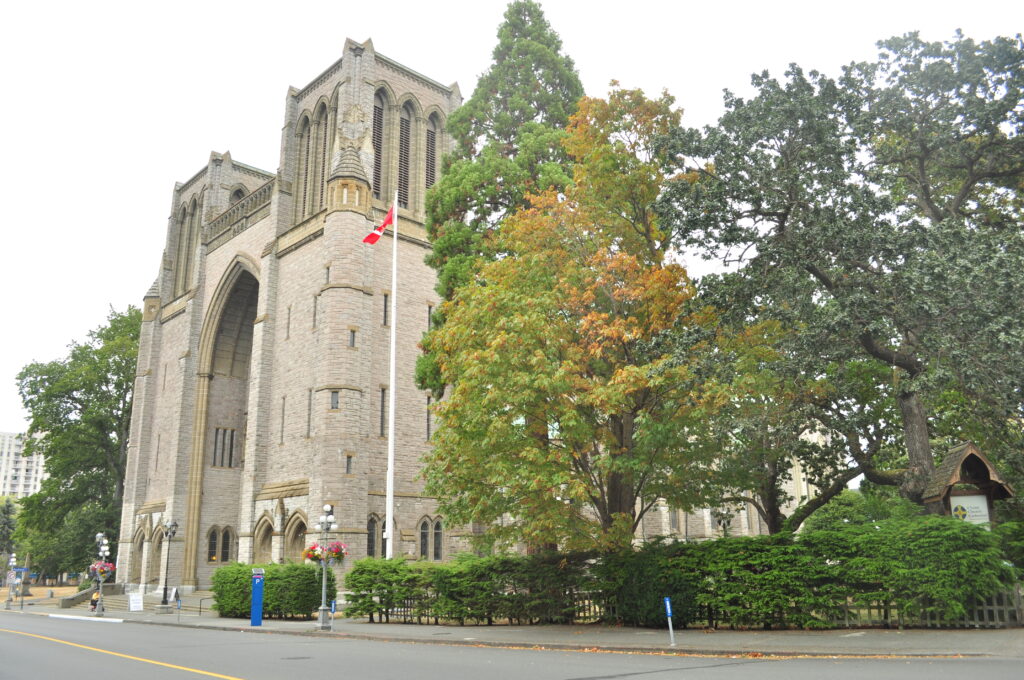
The west front faces the street corner and is dominated by one enormous pointed arch, recessed in deep orders of moulded stone, set between two square towers with stepped buttresses and battlemented tops. Above the arch a carved frieze runs across the wall with the words GOD SO LOVED THE WORLD cut into it, under a band of blind arcading and a row of tall two-light openings. The nearer tower carries a slim octagonal turret with a conical cap at its corner and long louvred belfry openings above; no spires were ever built.
The masonry is coursed grey stone with warmer sandstone dressings picking out the openings, the string courses and the buttress weatherings — the contrast is the front’s main colour. At street level, paired pointed doorways under low gabled hoods flank the great arch, with narrow lancets between them and steps up from the pavement. The flank of the building runs back along the block with buttresses between the bays. The ground rises above the street, with lawn, clipped hedges and mature trees around it, and Pioneer Square immediately to the north.
Practical information
- The cathedral is an active Anglican church, open to visitors outside services; recitals and concerts are held in the nave, and a board at the steps announces them.
- The exterior can be walked round completely; the west front is best read from the Quadra Street corner.
- Pioneer Square, the city’s first burying ground, adjoins the grounds to the north.
- Allow half an hour for the exterior, longer if the building is open.
- The cathedral office is at 930 Burdett Avenue, on the other side of the block.
Getting there
The cathedral is about a fifteen-minute walk uphill from the Inner Harbour and the Legislature, at the eastern edge of downtown Victoria. Local buses run along Fort Street and Quadra Street. Victoria is reached by ferry from Tsawwassen near Vancouver and from Port Angeles in Washington State, and by air to Victoria International Airport, about half an hour north.
Nearby
- Pioneer Square, the burying ground immediately north of the cathedral grounds.
- St. Andrew’s Cathedral, the Roman Catholic cathedral, a few blocks west.
- The Church of Our Lord at Blanshard and Humboldt Streets, John Teague’s board-and-batten Gothic of 1875 and a national historic site.
- The Butchart Gardens, north of the city on the Saanich Peninsula.
Sources
- Canadian Register of Historic Places — Christ Church Cathedral, Victoria: address, architect, the 1891 competition date, the foundation stone of August 1926, construction to 1991, the designation of 24 June 1982 and listing of 4 February 2010, the building materials, the bells, the choice of site and the character-defining elements.
- Christ Church Cathedral, “Our Cathedral”: the cathedral’s own account — the 1896 competition, the consecration of the nave on 29 September 1929, the towers of the 1950s, the east end consecrated 1 November 1991, the interior dimensions and tower height, and the two earlier cathedrals of 1856 and 1872.
- Archiseek — 1929, Christ Church Cathedral, Victoria, British Columbia: the towers completed “shorter and missing an intended stage”.
- Victoria News, 2 September 2026 — “Victoria’s Christ Church Cathedral organ returns after restoration”: the four-manual, 67-stop, 4,000-pipe organ of 2005, the summer restoration by Juget-Sinclair, and the rededication at Evensong on 4 October.
- Parks Canada — Church of Our Lord National Historic Site of Canada: date, architect and designation of the church named under Nearby.
- OpenStreetMap / Nominatim — position, returned as Christ Church Cathedral, 911, Quadra Street, Fairfield, Victoria, British Columbia.
Find it on the map
See this place and what’s around it →📷 Become a Cultural Heritage Online photographer
Share your photos of places: they stay published under your name as the author. The more they're seen, the more you get noticed — and soon a contest will reward the most appreciated photos.
Log in or sign up free to add a photoIs this page about you?
This page is read by travellers and heritage enthusiasts who find it on Google. Tell us how you are connected to this place and we will take it from there.