
.jpg)
A medieval Benedictine house rebuilt from 1755 around a Baroque church crowned by a dome. The monks left in 1834; the town hall moved in, and the church still rises over the square.
At a glance
São Miguel de Refojos is the monastery around which the town of Cabeceiras de Basto grew. It is documented from 1122 and joined the Portuguese Benedictine Congregation in 1570. Between 1755 and the 1760s the monks replaced their church with a new Baroque building, attributed to the Braga architect André Soares, and filled it with gilded woodwork designed by Friar José de Santo António Vilaça. Its crossing is crowned by a dome, which sources describe as unique among the Benedictine monasteries of Portugal. The church and sacristy have been classified as a Property of Public Interest since 1933, and the monastic wings house the municipality.
Key facts
- Where: Praça da República, Refojos de Basto, Cabeceiras de Basto, Braga district, Portugal
- Heritage status: Imóvel de Interesse Público (Property of Public Interest), Decree no. 23 011, Diário do Governo no. 197, 31 August 1933 — church, sacristy and the ceiling of one room of the former monastery; national inventory SIPA 1049, DGPC 74946
- First document: 1122; charter (couto) from King Afonso Henriques, 1131
- Order: Benedictine; joined the Portuguese Benedictine Congregation in 1570
- Present church: begun 1755; attributed to André Soares of Braga, with interiors designed by Friar José de Santo António Vilaça, who worked here in 1764–1770
- Dissolution: 1834, with the extinction of the religious orders; the property passed to the State
- Current use: parish church; the monastic wings house the Câmara Municipal of Cabeceiras de Basto
- Coordinates: 41.513473, -7.993247 · open in Google Maps
History
The monastery is older than the Portuguese kingdom it later served. The first document naming it dates from 1122, and in 1131 Afonso Henriques granted it a couto, a charter that gave the monks jurisdiction over the surrounding land. For four centuries it was one of many Benedictine houses of the Minho; in 1570 it was brought into the reformed Portuguese Benedictine Congregation.
The building seen today belongs to the eighteenth century. Works on a new church began in 1755, coordinated between the architect André Soares of Braga and the abbot, Friar Francisco de São José; the attribution to Soares is given as probable rather than documented. In the final phase, from 1764 to 1770, the Benedictine friar José de Santo António Vilaça designed the interior. The chronology is unusually precise: the main chapel was made in 1764–1767 and gilded in 1780–1783, the choir stalls and sacristy furnishings date from 1767–1770, the two pulpits from 1777–1780, and the Chapel of the Blessed Sacrament from 1780–1789.
In 1834 the Liberal government abolished the religious orders, and Refojos was nationalised and sold. The monastic wings took on civic uses, including the regional courtroom, whose ceiling is protected together with the church, and today they hold the town hall. The organ, commissioned from the Galician organ builder Francisco António Solha, was restored in 2009 and has since been used for concerts. A municipal rehabilitation completed in 2022, designed by the architects Paulo Freitas and Maria João Marques, repaired the church and east-wing roofs, restored facades and windows, and fitted out the library and refectory for new public uses.
What you see
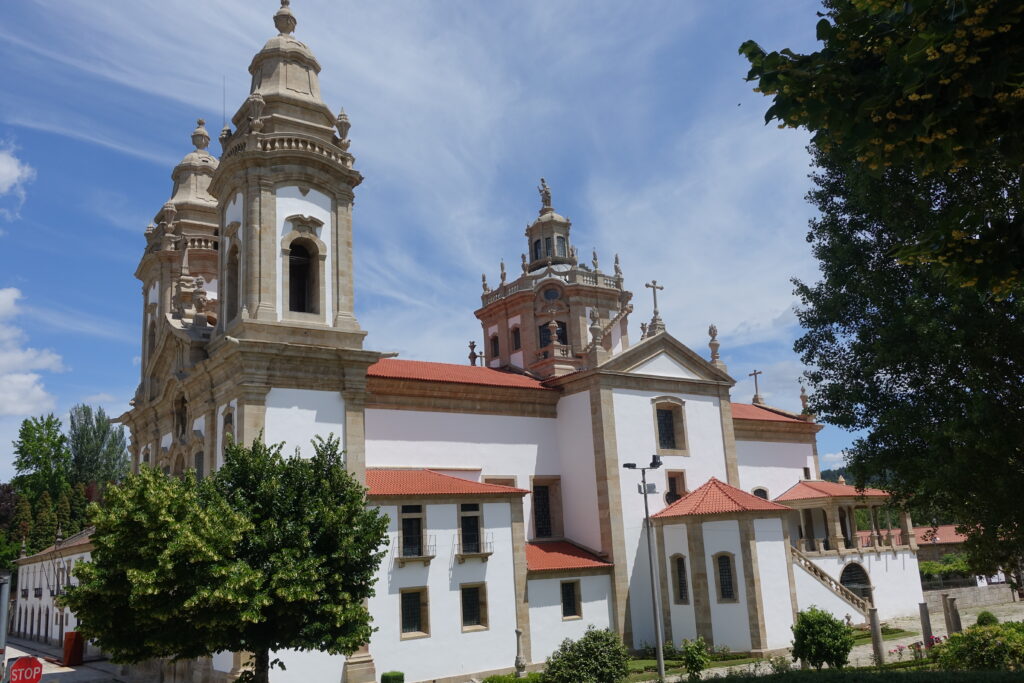
Seen from the square, the church shows its twin bell towers, built in grey granite and stacked in stages, each opening in a round-arched belfry and finished with a bulbous cap, a lantern and small pinnacles. Between and below them the walls are rendered white and framed by granite pilasters and cornices, the Minho way of drawing architecture in stone on a white ground. Red tile roofs run back along the nave.
Over the crossing rises the dome: a pinkish, rendered drum with a balustrade and stone pinnacles at the corners, carrying a smaller lantern and a statue at the very top, which the sources identify as the Archangel Michael, the church’s patron. The municipality gives the dome’s height as 36 metres. To the right, lower monastic blocks with the same white-and-granite treatment step down to an external stone stair and a small arcaded loggia. Inside, according to the descriptions, the church is entirely Baroque, with gilded woodwork, and a pair of organ cases facing each other across the nave.
Practical information
- The church is in religious use; the monastic wings are the town hall of Cabeceiras de Basto and are open on municipal business days.
- The Núcleo Museológico de Arte Sacra, the sacred art collection, is at the monastery, on Praça da República.
- Visits and opening times are handled by the municipal tourist office (Visit Cabeceiras).
- The restored organ is played in concerts; check the municipal programme.
Getting there
Cabeceiras de Basto is in the interior of the Minho, north-east of Guimarães and east of Braga, in the Basto hills of the Braga district. The monastery stands on Praça da República, the main square of the parish of Refojos de Basto, and is the landmark of the town centre. The nearest international airport is Porto.
Nearby
- The Cruzeiro da Praça, the stone wayside cross on Praça da República in front of the monastery.
- The Núcleo Museológico de Arte Sacra, at the monastery on the same square.
- The Jardim dos Arcebispos, a garden a short walk from the square.
Sources
- SIPA, national inventory record 1049 and DGPC record 74946: classification as Property of Public Interest (Decree 23 011, 31 August 1933). The SIPA server did not respond during our research; the classification is confirmed by the sources below.
- Conventos e Mosteiros de Portugal, Monastery of Saint Michael of Refojos: 1122, 1131, 1570, church of 1755–1766 possibly by André Soares, Vilaça’s interior, the dome and statue, 1834, the town hall.
- Wikipédia, Mosteiro de São Miguel de Refojos de Basto: the detailed chronology of the interior works (1764–1789), the organ by Francisco António Solha and its 2009 restoration.
- Município de Cabeceiras de Basto, Visit Cabeceiras: the Baroque church and the 36-metre dome.
- Espaço de Arquitetura, PFMJM Arquitectos: the rehabilitation completed in 2022.
- OpenStreetMap / Nominatim: position, returned as Mosteiro de São Miguel de Refojos, Praça da República, Refojos de Basto.
Find it on the map
See this place and what’s around it →📷 Become a Cultural Heritage Online photographer
Share your photos of places: they stay published under your name as the author. The more they're seen, the more you get noticed — and soon a contest will reward the most appreciated photos.
Log in or sign up free to add a photo