
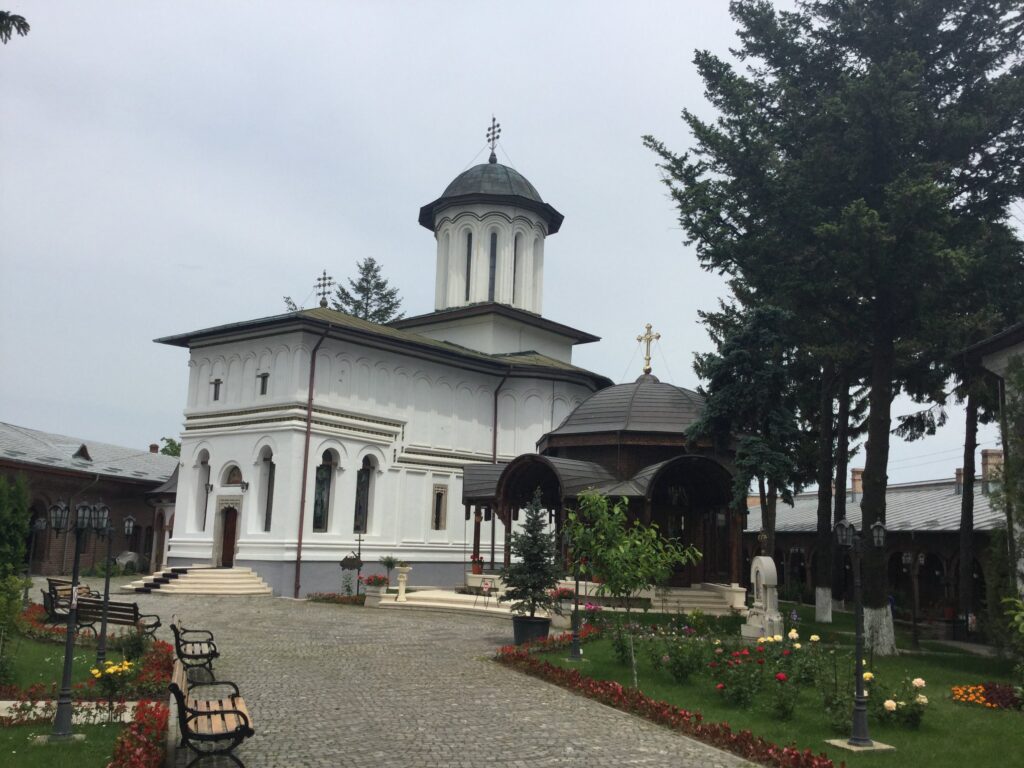

A sixteenth-century princely foundation on the edge of Bucharest, where the first books printed in the city came off the press in 1582. Burned, rebuilt, shaken by earthquakes and restored again, it is still a working monastery.
At a glance
Plumbuita stands in the Colentina district of north-east Bucharest, inside its own brick enclosure beside the park and lake that carry the same name. It was begun around 1560 by a Wallachian prince, finished by his successors and given to a monastery on Mount Athos in 1585. A printing press worked here in the 1570s and 1580s, and in 1582 it produced the first books printed in Bucharest. The present church is essentially the rebuilding ordered by Prince Matei Basarab in 1647. The whole ensemble — church, princely house, bell tower and monks’ cells — is a historic monument of national importance.
Key facts
- Where: Strada Plumbuita 58, Sector 2, Bucharest, Romania
- Heritage status: ensemble listed in the Romanian List of Historic Monuments as B-II-a-A-19419 (class A, national importance), dated 16th–20th century
- Listed components: church of the Nativity of St John the Baptist (B-II-m-A-19419.01, 16th century and 1647), princely house (19419.02, first half of the 18th century), bell tower (19419.03, 18th century), cells (19419.04, 18th–20th century)
- Founded: begun in 1560 under Petru cel Tânăr (ruled 1559–1568), completed under Alexandru II Mircea and Mihnea Turcitul
- Dedicated to Athos: by a charter of Mihnea Turcitul dated 21 October 1585, which placed the monastery under Xeropotamou
- Printing: a press set up here in 1573; in 1582 it issued the first books printed in Bucharest
- Rebuilt: 1647, by order of Prince Matei Basarab
- Coordinates: 44.472268, 26.135195 · open in Google Maps
History
According to the monastery’s own history, building began in 1560 under Petru cel Tânăr, son of Mircea Ciobanul and Lady Chiajna, and was carried to completion by two later princes, Alexandru II Mircea and Mihnea Turcitul. A second tradition, reported in the reference literature, attributes the first works to Vlad Înecatul in 1531 and explains the name — plumbuită, “sealed with lead” — as the unfinished building site closed after his death. The two accounts disagree, and neither can be settled from the surviving documents.
The earliest document that does survive is a charter of Mihnea Turcitul dated 21 October 1585, dedicating Plumbuita to the monastery of Xeropotamou on Mount Athos. For a long time it was known only through Romanian translations. In 2026 the Vasile Pârvan Cultural Association obtained a colour copy of the original Slavonic charter from the Xeropotamou archive, as reported by the Romanian Patriarchate’s news agency Basilica.ro.
The monastery’s place in cultural history comes from its press. The monks date its foundation to 1573, under Alexandru II Mircea, and record that in 1582 it produced the first books printed in Bucharest: two Tetraevangelia and a Psalter. A marble plaque on the enclosure wall still states the date.
The church suffered heavy damage in 1595 and again in a fire in 1614. The decisive rebuilding came in 1647, when Prince Matei Basarab re-founded the monastery. The monastery’s history places the princely house in this phase; the heritage list dates the house that stands today to the first half of the eighteenth century. The earthquake of 1802 struck the complex hard. Plumbuita lost its monastic status in the nineteenth century and served as a parish church; restoration in 1933–1940, resumed in 1953 and finished in 1955 under Patriarch Justinian, returned it to monastic life.
What you see
The church stands free in a paved courtyard, rendered entirely in white. It is a trefoil plan, as the monastery describes it, with a single tower over the nave: an octagonal drum pierced by tall, narrow arched windows and capped by a low grey-green dome and a cross. Around the upper walls runs the Wallachian band of blind arches, and a horizontal moulding divides the facade into two registers. The lower windows are round-headed, set in shallow arched recesses, and the entrance is reached by a short flight of steps on the west. The monks note that the walls are almost a metre thick.
To the right of the church stands a wooden open-air altar under a dark, faceted dome, with a portico of timber arches around it. The courtyard is laid out with benches, lamp posts and beds of roses. Behind the trees, on both sides, the long low wings of the enclosure show their grey metal roofs and red brick walls: these are the cells and service buildings that close the precinct.
Practical information
- Plumbuita is an active Orthodox monastery; visitors are welcome at services and in the courtyard, and should dress and behave accordingly.
- The patronal feast is the Nativity of St John the Baptist on 24 June; the summer altar is dedicated to the Protection of the Mother of God, kept on 1 October.
- The service schedule is published on the monastery’s website.
- Allow half an hour for the church and enclosure, longer with a walk in the park.
Getting there
The monastery is in Sector 2, in the Colentina district of north-east Bucharest, roughly five kilometres in a straight line from the historic centre around Piața Universității. The gate is on Strada Plumbuita, at number 58. The district is served by the city’s surface transport network; check current routes with the Bucharest transport operator. Henri Coandă international airport lies north of the city.
Nearby
- Plumbuita Park and lake, directly beside the monastery enclosure, part of the chain of lakes along the Colentina river.
- The Colentina lakes further along the river, with their lakeside paths.
Sources
- List of Historic Monuments of Bucharest, Sector 2 (after the Ministry of Culture’s LMI): codes B-II-a-A-19419 and 19419.01–.04, address and dating of each component.
- Mănăstirea Plumbuita, Istoric: foundation in 1560, the press of 1573, the books of 1582, the 1595 and 1614 damage, Matei Basarab’s rebuilding of 1647, the 1802 earthquake and the 20th-century restorations; the trefoil plan and wall thickness.
- Basilica.ro, 26 August 2026: the charter of Mihnea Turcitul of 21 October 1585 found in the Xeropotamou archive.
- Wikipedia, Plumbuita Monastery: the alternative foundation tradition (Vlad Înecatul, 1531) and the origin of the name.
- OpenStreetMap / Nominatim: position, returned as the church at 58 Strada Plumbuita, Colentina, Sector 2.
Find it on the map
See this place and what’s around it →📷 Become a Cultural Heritage Online photographer
Share your photos of places: they stay published under your name as the author. The more they're seen, the more you get noticed — and soon a contest will reward the most appreciated photos.
Log in or sign up free to add a photo