
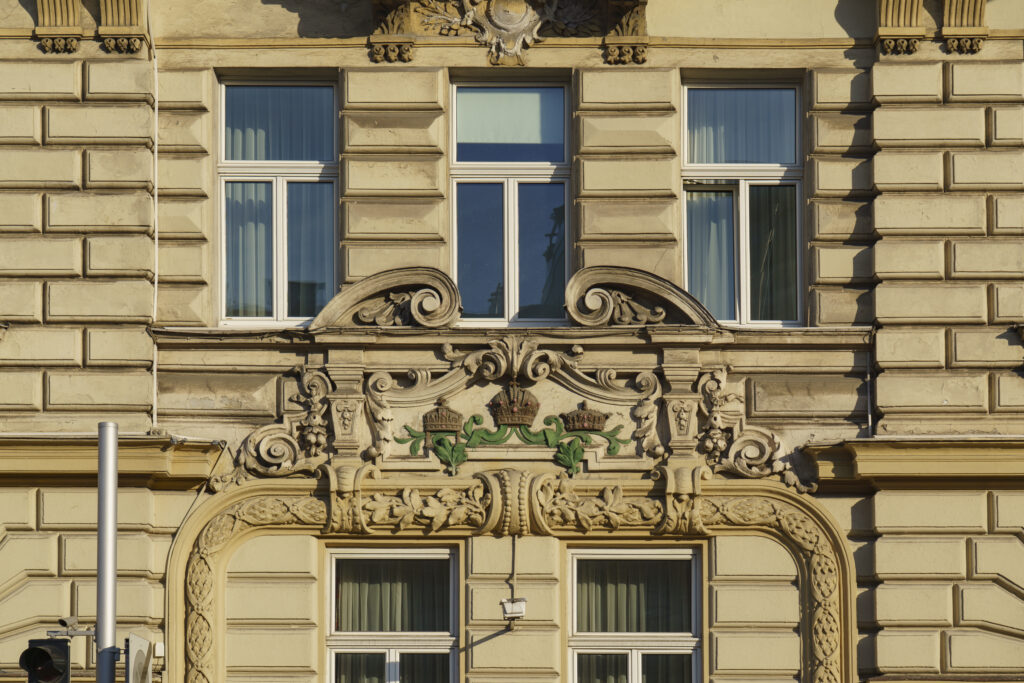

Three crowns above an arch give this corner house its name: the crowns of Austria, Hungary and Bohemia. The building went up in 1894 on the edge of the Naschmarkt, and the Viennese architects’ lexicon singles it out as far more elaborate than his usual fronts.
At a glance
The house stands at the corner of the Rechte Wienzeile and Schleifmühlgasse, facing the market stalls of the Naschmarkt and, across them, the Wienzeile houses of Otto Wagner. It was built in 1894 by the Viennese master builder and architect Ignaz Drapala (1834–1916). The Architektenlexikon Wien 1770–1945 describes it at length: giant pilasters, Baroque-style window frames, strong cornices and a deep two-storey loggia at the centre of the Wienzeile front. The City of Vienna’s history wiki records the ceramic reliefs of the three crowns, Rudolf’s, Stephen’s and Wenceslas’s. The building is now the Hotel Drei Kronen.
Key facts
- Where: Schleifmühlgasse 25 / Rechte Wienzeile 17 (formerly Wienstraße 19), 1040 Vienna (Wieden), Austria
- Architect and builder: Ignaz Drapala
- Built: 1894
- Style: late historicism with Baroque-revival detail
- Emblem: ceramic reliefs of the crowns of Rudolf II (Austria), St Stephen (Hungary) and St Wenceslas (Bohemia)
- Protection: not found in the list of individually protected monuments; the building is documented by the Architektenlexikon Wien and the Wien Geschichte Wiki
- Current use: hotel
- Coordinates: 48.19829, 16.36394 · open in Google Maps
History
Schleifmühlgasse takes its name from a grinding mill, and the street name is recorded from 1667. According to the hotel’s own history, a flour mill stood on the site of numbers 23–25 from 1417, and in 1570 Hans Grebl set up a mill here for grinding and polishing weapons; we have found these early dates only in the hotel’s account.
Ignaz Drapala was born in 1834 in Hranice in Moravia and was working in Vienna by 1872, when he acquired his master builder’s licence. Most of his buildings are apartment and commercial houses in the 6th district, and he often built to other architects’ designs as well as his own. The Architektenlexikon calls his usual facades symmetrical and very plain, with a few Baroque-style ornaments. The house on the Wienzeile, completed in 1894, is the exception: the lexicon describes it as “considerably more elaborate”, and quotes a contemporary review of 1895 on its roof cornice, whose triangular projection “capriciously juts out and strangely interrupts the straight line”.
The hotel states that the house was built for the publisher Carl Colbert as the home of his magazine Wiener Mode, with the Allgemeine Österreichische Baugesellschaft as developer, and that Koloman Moser worked for the magazine as an illustrator. Colbert did found Wiener Mode in 1887, according to the City of Vienna’s history wiki, but we have not found the link between the magazine and this building confirmed in an independent source, and we report it as the hotel’s account. The hotel dates its own foundation to the hotelier Alois Reinwein, after a short period as the Pension Vindobona.
What you see
The photograph is a close view of part of the Wienzeile front. The wall is rusticated, cut into long, deep horizontal bands of stone-coloured render. Over a wide arch framed with carved garlands of leaves and fruit sits a cartouche of stone scrolls and volutes. In its middle, on green ceramic laurel branches, stand the three crowns in brown and gold, the middle one slightly larger than the other two. Above the cartouche, the windows of the next floor sit in plain frames, and a further carved ornament is cut off by the top edge of the picture.
The photograph does not show the whole front. The Architektenlexikon describes the rest: giant pilasters along the main facade to the Wienzeile, Baroque-style window frames, strongly projecting cornices, and at the centre a loggia cut deep into the wall and rising through two storeys, with one straight and one curved balcony railing. We have not checked on site whether the roof cornice still keeps the triangular break that the 1895 reviewer found so capricious.
Practical information
- The building is a working hotel; the exterior is visible from the Rechte Wienzeile and Schleifmühlgasse at any time.
- The best view of the Wienzeile front is from the Naschmarkt side of the street.
- The pavement along the Naschmarkt is busy during market hours; early morning is the calmest time to look at the facade.
- Allow ten minutes for the exterior, more if combined with the Wagner houses across the market.
Getting there
Kettenbrückengasse station (line U4) is at the Naschmarkt, about five minutes’ walk away. Karlsplatz (U1, U2, U4) is about ten minutes on foot along the market. From the Secession, walk south-west along the Rechte Wienzeile to the corner of Schleifmühlgasse.
Nearby
- The Secession Building, about 300 metres to the north-east along the Wienzeile.
- The Majolikahaus, Otto Wagner’s tiled apartment house on the Linke Wienzeile, across the Naschmarkt.
- The Medallion House at Linke Wienzeile 38, Wagner’s corner house next to it.
- The Naschmarkt itself, Vienna’s best-known market, directly in front of the house.
Sources
- Architektenlexikon Wien 1770–1945, “Ignaz Josef Drapala”, Architekturzentrum Wien: biography, and the description of the “Hotel Drei Kronen, Wien 4, Rechte Wienzeile 17 (früher Wienstraße 19) / Schleifmühlgasse 25 (1894)”, with the 1895 quotation from the Wiener Bauindustrie-Zeitung.
- Wien Geschichte Wiki, “Schleifmühlgasse”, City of Vienna: the street name, and number 25 (Rechte Wienzeile 17) with its ceramic reliefs of the Rudolf, Stephen and Wenceslas crowns; and “Carl Colbert”, founder of Wiener Mode in 1887.
- Hotel 3 Kronen, “Geschichte”: the hotel’s account of the mill, the publisher and the hotel’s owners, reported here as such.
- OpenStreetMap / Nominatim: position and address, returned as Drei Kronen, 25, Schleifmühlgasse, Wieden, Wien.
Find it on the map
See this place and what’s around it →📷 Become a Cultural Heritage Online photographer
Share your photos of places: they stay published under your name as the author. The more they're seen, the more you get noticed — and soon a contest will reward the most appreciated photos.
Log in or sign up free to add a photoIs this page about you?
This page is read by travellers and heritage enthusiasts who find it on Google. Tell us how you are connected to this place and we will take it from there.