
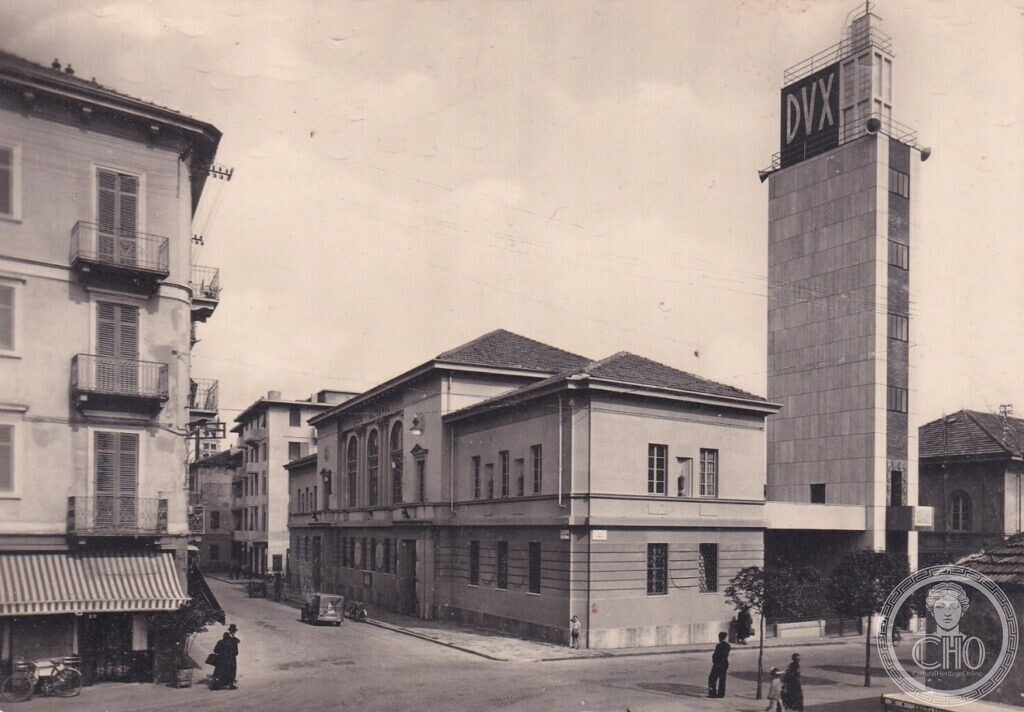
A thirty-metre tower of travertine and pale brick, built in less than a year beside the Casa del Fascio of Biella and topped with the letters DVX, so that Mussolini could climb it on the day of his visit, 18 May 1939.
At a glance
The Torre Littoria stands on Via Pietro Micca in Biella, between the former Casa del Fascio, now the offices of the Agenzia del Territorio, and the complex of the civic museum and library. The engineer Federico Maggia designed it in 1938; work began in June of that year and the tower was inaugurated by Mussolini on 18 May 1939, during his visit to the city. It rises thirty metres over six floors, faced in travertine and light ceramic brick, and it ended in a lattice of concrete and glass carrying the word DUX on both sides.
Key facts
- Designer: Federico Maggia (born 1901), engineer, a graduate of the Politecnico di Torino
- Built: work began in June 1938; contractor Giuseppe Tarabbo e Figli
- Inaugurated: 18 May 1939, by Mussolini, on the day of his visit to Biella
- Size: 30 metres from street level, six floors above ground, on a base of about 4 by 7 metres
- Materials: reinforced concrete, faced in travertine and light ceramic brick; at the top a lattice of concrete and glass
- Inscriptions: DUX on both sides of the top, framed in neon; the motto Credere, Obbedire, Combattere on the first-floor balcony; a marble stele over the door dedicating the tower to Mussolini, dated 18 May 1939
- Cost: 165,000 lire
- Address: Via Pietro Micca 40, Biella
- GPS: 45.56691, 8.05080 · Open in Google Maps
History
Many Italian towns built a torre littoria beside their Casa del Fascio in the 1930s: a tower from which to speak, to ring and to be seen. Biella’s came late and fast. It was designed in 1938 by Federico Maggia, an engineer, and built by the firm of Giuseppe Tarabbo and his sons from June 1938, with one fixed date to meet: Mussolini’s visit to Biella on 18 May 1939.
The tower was ready. On that day Mussolini inaugurated it and climbed to its highest balcony. The marble stele over the door recorded the fact in the regime’s own words: Benito Mussolini Duce del Fascismo Fondatore dell’Impero questa Torre inaugurava il 18 maggio 1939 XVII. The word DUX at the top, lit in neon at night, made the building a sign as much as a tower.
What you see
In the postcard the tower rises at a street corner beside a plain two-storey building with a pitched roof, a sheer pale shaft with small openings, a balcony near the top and above it the open frame carrying the letters DVX, written in the Roman way with a V. People walk in the street below and a car turns the corner. What survives of the inscriptions today is not recorded in our sources: if you know, tell us.
Sources
- Frammenti di storia biellese, La Torre Littoria (1939): Federico Maggia, 1938–1939, the height of 30 m, the materials, the inscriptions and the stele, the cost of 165,000 lire, the Casa del Fascio now seat of the Agenzia del Territorio, the inauguration of 18 May 1939
- Biella Club, Torre Littoria, via Pietro Micca 40: the address, the start of work in June 1938, the contractor Giuseppe Tarabbo e Figli, six floors, the base of 4 by 7 m, travertine and ceramic brick, the lattice of concrete and glass
Find it on the map
See this place and what’s around it →📷 Become a Cultural Heritage Online photographer
Share your photos of places: they stay published under your name as the author. The more they're seen, the more you get noticed — and soon a contest will reward the most appreciated photos.
Log in or sign up free to add a photoIs this page about you?
This page is read by travellers and heritage enthusiasts who find it on Google. Tell us how you are connected to this place and we will take it from there.