In 1925, in the Swabian town of Esslingen am Neckar, mechanical pioneers Albert Fezer and Gottlieb Stoll formed Fezer & Stoll (contracted as Festo) to manufacture specialized woodworking machinery and portable power tools. Evolving into the world’s foremost authority on industrial pneumatics and pneumatic automation, Festo transformed manufacturing lines across six continents while remaining an independent family enterprise renowned for bionic engineering.
The Swabian Workshop: From Woodworking Tools to Compressed Air
The Neckar valley in Württemberg was an epicenter of artisanal craftsmanship and mechanical engineering. In 1925, Albert Fezer and Gottlieb Stoll (1897–1971) established their workshop to modernize carpentry and joinery, patenting Europe’s first portable electric chainsaw for timber carpentry in 1927 and portable circular saws that eliminated cumbersome belt-driven line shafts in local workshops.
In the mid-1950s, under Kurt Stoll, Festo recognized that compressed air—clean, elastic, and fast—was the ideal medium for factory automation. Festo engineered standard pneumatic cylinders, directional valves, and pneumatic logic systems, effectively establishing the global discipline of industrial automation.
The Bionic Learning Network and the Esslingen Campus
Festo subsequently founded Festo Didactic, training millions of engineers and technical apprentices worldwide, and created the acclaimed Bionic Learning Network, which reverse-engineers principles from natural biology—bird flight, octopus tentacles, and manta ray propulsion—into ultra-efficient robotic grippers and collaborative automation.
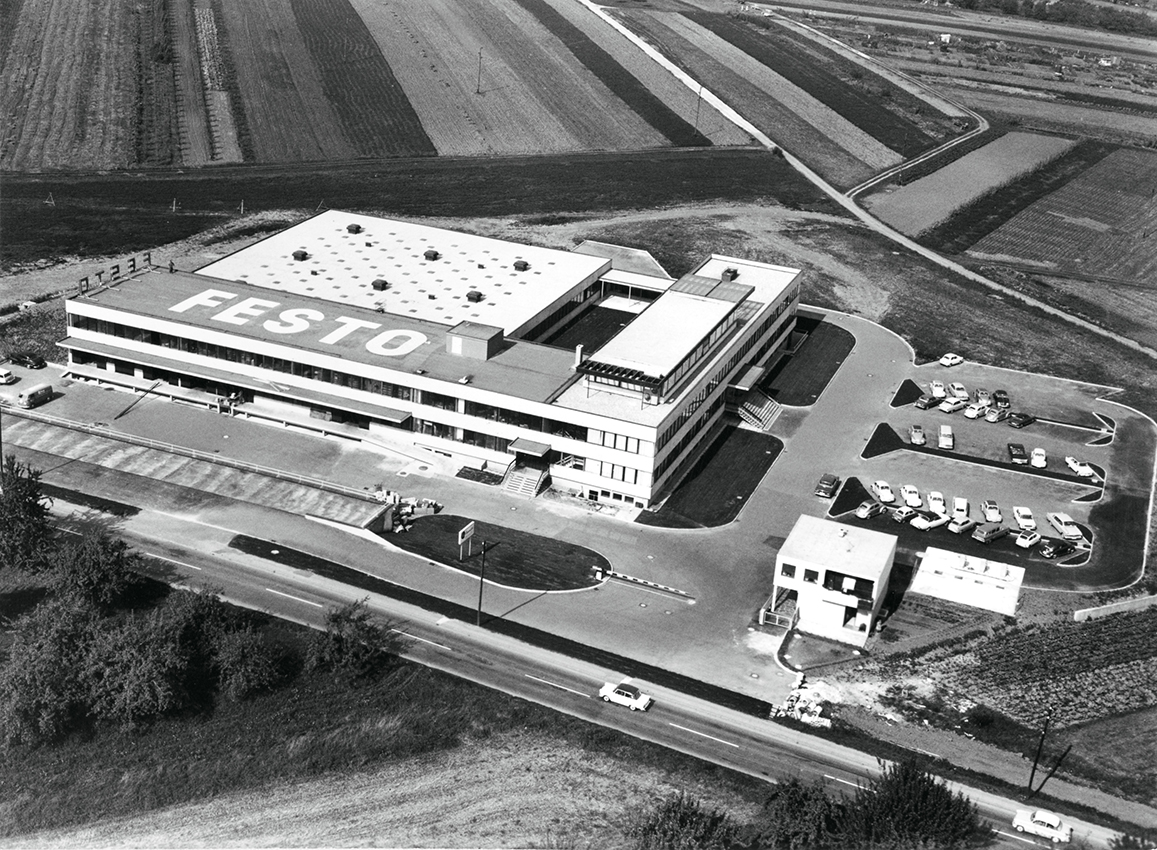
Operating from its modern headquarters and innovation center in Esslingen-Berkheim, Festo remains 100% owned by the Stoll family. Approaching a century of precision engineering, it stands as an enduring emblem of the German *Mittelstand* and industrial stewardship.
L'officina meccanica delle ferrovie: utensileria e precisione meccanica
Immagini d'archivio storico dell'Istituto Luce che testimoniano l'ingegneria meccanica, la forgia di precisione e la nascita dell'automazione negli stabilimenti industriali del primo Novecento. (Fonte: Archivio Storico Istituto Luce Cinecittà)
Interactive 360° Heritage View: Festo Global Headquarters & Historic Innovation Campus
Historical Location: Ruiter Straße 82, 73734 Esslingen am Neckar, Baden-Württemberg, Germany (Coordinates: 48.718, 9.3245)
Sources
- S1 — Festo AG. Faszination Automation: Festo Chronik. Esslingen, 2005. ISBN 978-3-00-016112-4.
- S2 — Westkämper, Engelbert. Einführung in die Organisation der Produktion. Springer-Verlag, 2006. ISBN 978-3-540-30743-3.
Spotted an error? Write to editorial@culturalheritageonline.com and we correct it the same day.