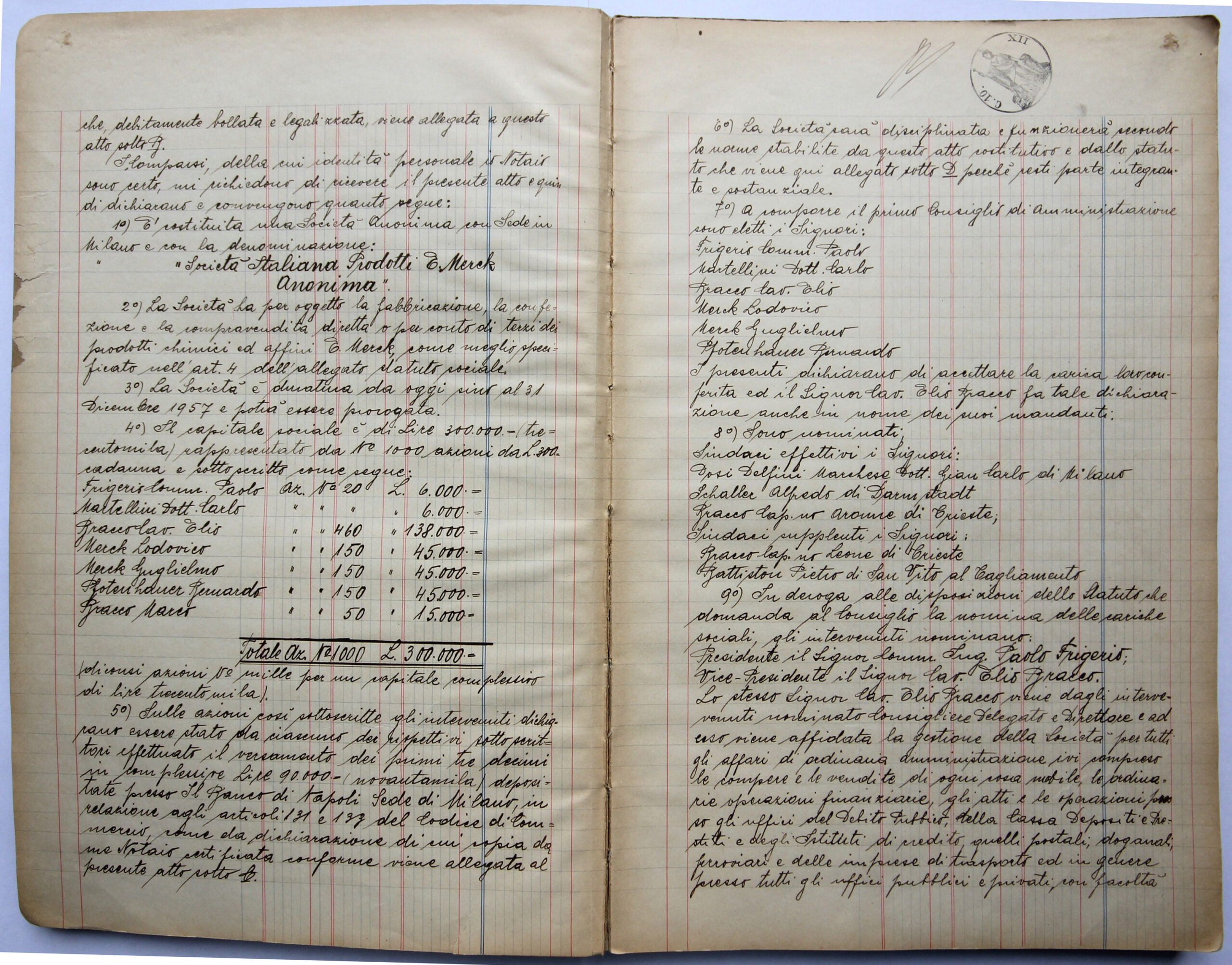
On June 1, 1927, in a notary office in central Milan, Istrian-born entrepreneur Elio Bracco signed the founding charter of the enterprise that would become the Bracco Group. From distributing high-purity chemical reagents to synthesizing groundbreaking non-ionic radiographic contrast agents in the industrial corridor of Lambrate, Bracco redefined the frontier of medical diagnostics, making the invisible workings of the human body visible to modern medicine.

From Pure Reagents to Chemical Synthesis in Lambrate
Elio Bracco (1884–1961), originally from Neresine on the island of Lussino, relocated to Milan with a profound appreciation for rigorous pharmaceutical standards. Partnering initially with Germany’s E. Merck to distribute pure laboratory reagents, Bracco quickly perceived that Italy’s clinical medical community needed native research and domestic manufacturing. In 1934, he oversaw the construction of a modern pharmaceutical and synthesis plant along Via Egidio Folli in Lambrate, then a dynamic industrial suburb traversed by the Lambro river.
During the 1930s, under the scientific leadership of Fulvio Bracco (1909–2007), Elio’s son and a brilliant chemistry graduate from the University of Pavia, the company transitioned into active pharmaceutical ingredient (API) synthesis, patenting sulfamidic antibacterial agents and vitamin preparations essential to public health.
The Diagnostic Revolution and Architectural Memory
Bracco’s seminal breakthrough arrived in the 1970s with the synthesis of *Iopamidol*, the world’s first non-ionic, ready-to-use radiological contrast medium with unprecedented patient safety and physiological tolerability. The discovery established Bracco as an unchallenged global titan in medical imaging (CT, MRI, ultrasound).
The Lambrate campus along Via Folli remains the physical and spiritual anchor of Bracco. Today, the Bracco Historical Archive and the restored industrial spaces of the Lambrate design district showcase original glass distillation vessels, historical laboratory logbooks, and 1930s advertising campaigns illustrated by master graphic artists, celebrating a lineage of scientific humanism born in 1927.
Istituti scientifici e laboratori farmaceutici a Milano negli anni Trenta
Cinegiornale dell'Archivio Luce che documenta i laboratori di ricerca chimica, le provette, i distillatori e la produzione di farmaci innovativi nella Milano industriale. (Fonte: Archivio Storico Istituto Luce Cinecittà)
Interactive 360° Heritage View: Historic Bracco Industrial Complex — Lambrate
Historical Location: Via Egidio Folli 50, 20134 Milano MI, Italy (Coordinates: 45.48552, 9.24576)
Historical Archive Gallery