

A room built for people with fifteen minutes to spare, panelled in pitchpine and painted with tulips. It survived a century of timetables and is now a museum you enter through the ticket gates.
At a glance
Haarlem station was rebuilt in the first years of the twentieth century and finished in 1908, and it is one of the few railway buildings in the Netherlands where the interiors were designed with the same seriousness as the facade. Each class of passenger had its own waiting room, and each was fitted out differently. The second-class room, on the island platform, kept its pitchpine joinery, its painted friezes and its glazed tiles. Since the restoration it has held MUTEK, the Museum voor Toegepaste Europese Kunst, whose subject — a century and a half of design for everyday objects — happens to be exactly what the room itself is an example of.
Key facts
- Where: island platform, Station Haarlem, Stationsplein 1, Haarlem, Noord-Holland — platforms 3 and 6
- Station completed: 1908, a national monument (rijksmonument)
- Design: the station is documented as the work of D. A. N. Margadant, railway architect, with interior work by Jac. van den Bosch of ’t Binnenhuis
- Original function of this room: second-class waiting room
- Now: MUTEK — Museum voor Toegepaste Europese Kunst, «150 years of design for everyday objects of European origin»
- Open: Wednesday to Sunday, 11:00–17:00
- Coordinates: 52.388078, 4.638579 · open in Google Maps
History
Haarlem had the first railway station in the Netherlands, at the end of the line from Amsterdam opened in 1839. The building standing today is its replacement, put up when the tracks were raised onto an embankment through the city and completed in 1908. It went up at the moment when Dutch architecture was arguing about ornament: the Nieuwe Kunst generation wanted decoration that came out of the construction rather than being applied to it, and a station — all iron, glass and repetition — was a good place to test that.
The interiors were divided by class, and the division was not subtle: first, second and third each had a waiting room, and the fittings told you which one you were in. Tiled tableaux went into the first- and third-class rooms. The second-class room took its character from wood: pitchpine screens and doors, glazed above, built as a single system of panelling that runs round the space.
What saved the room is that it was never gutted. The station remained in use continuously, and the monument listing protected the fabric; the waiting room came through in a condition good enough to restore rather than reconstruct. MUTEK moved into it as a museum of applied art, and the arrangement has an unusual consequence: the museum sits inside the fare-paid area, so visitors pass the ticket gates and check in and out at a post inside the museum itself.
What you see
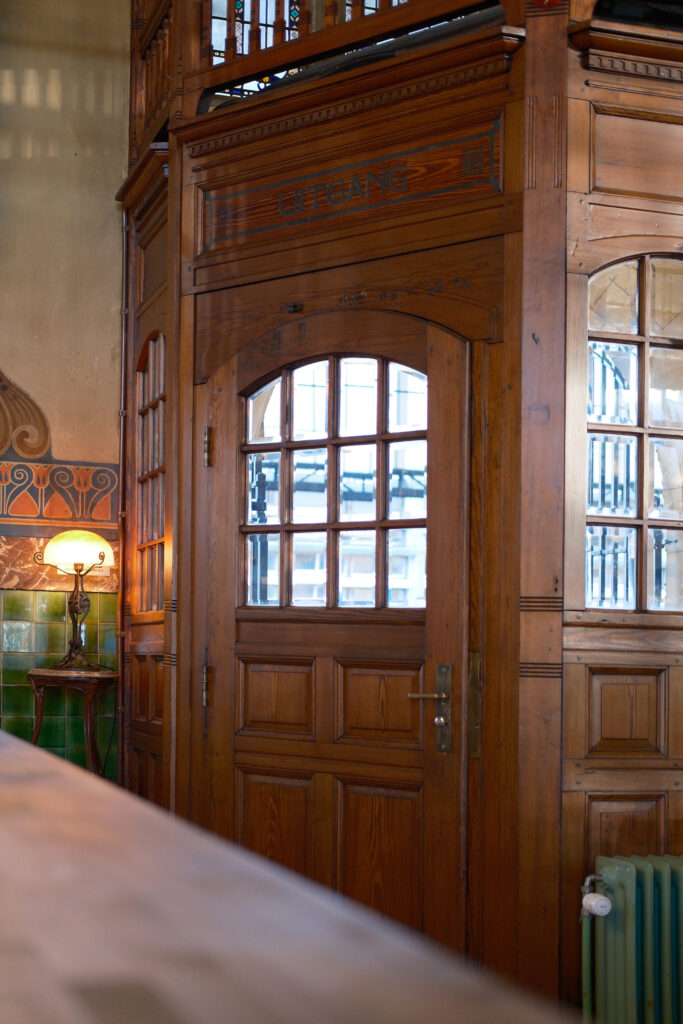
The room is built of honey-coloured pitchpine, worked into full-height screens with panelled bases and glazing above. The doorways are the set pieces. Over one of them the word Uitgang is lettered straight onto the wood in a flat green, inside a ruled panel with small square motifs at the corners — a station sign treated as joinery rather than as signage. Above the screens the glazing turns to coloured glass in a geometric leading.
Where the wood stops, the plaster carries a painted frieze: stylised tulips and scrolling stems in ochre, orange and blue-grey, the Nieuwe Kunst motif drawn flat and repeated. Below it, a band of glazed tiles in deep bottle green runs at shoulder height, and a marble-topped table stands against it under a lamp with a domed shade on a curling metal stem. An old sectional radiator, painted green, still sits under the panelling. The whole room is the argument of its period made in three materials: wood, tile and paint, each doing its own job and none imitating another.
Practical information
- The museum is inside the station’s fare-paid area, on the island platform between tracks 3 and 6: you go through the ticket gates to reach it.
- Open Wednesday to Sunday, 11:00–17:00. Check the museum’s own site before travelling.
- The room is small; an hour is generous.
- The first- and third-class tiled tableaux are elsewhere in the same station and are worth the detour.
Getting there
Haarlem is fifteen minutes by train from Amsterdam Centraal and about forty from Schiphol, with several trains an hour. The museum is on the platform, so no walking is involved once you arrive. The historic centre of Haarlem, with the Grote Markt and the Teylers Museum, is a ten-minute walk south of the station square.
Nearby
- The station’s own first- and third-class waiting rooms, with their tile tableaux.
- Teylers Museum, the oldest museum in the Netherlands, in the centre of Haarlem.
- The Grote Kerk on the Grote Markt, ten minutes on foot.
Sources
- MUTEK — Museum voor Toegepaste Europese Kunst: the museum’s own account of its name, its subject («150 years of design for everyday objects of European origin»), the room it occupies («the former second-class waiting room of Haarlem train station»), its hours and its platforms.
- Rijksdienst voor het Cultureel Erfgoed — Station Haarlem is a listed rijksmonument; the monument number 19786 is carried in the Wikimedia Commons monument templates on photographs of the building.
- The attribution of the station to D. A. N. Margadant, with interior work by Jac. van den Bosch, and the completion date of 1908, are the standard account in the reference literature on the building; we have not seen the primary building file.
- OpenStreetMap / Nominatim — position, returned as Haarlem, 1, Stationsplein.
Find it on the map
See this place and what’s around it →📷 Become a Cultural Heritage Online photographer
Share your photos of places: they stay published under your name as the author. The more they're seen, the more you get noticed — and soon a contest will reward the most appreciated photos.
Log in or sign up free to add a photoIs this page about you?
This page is read by travellers and heritage enthusiasts who find it on Google. Tell us how you are connected to this place and we will take it from there.