
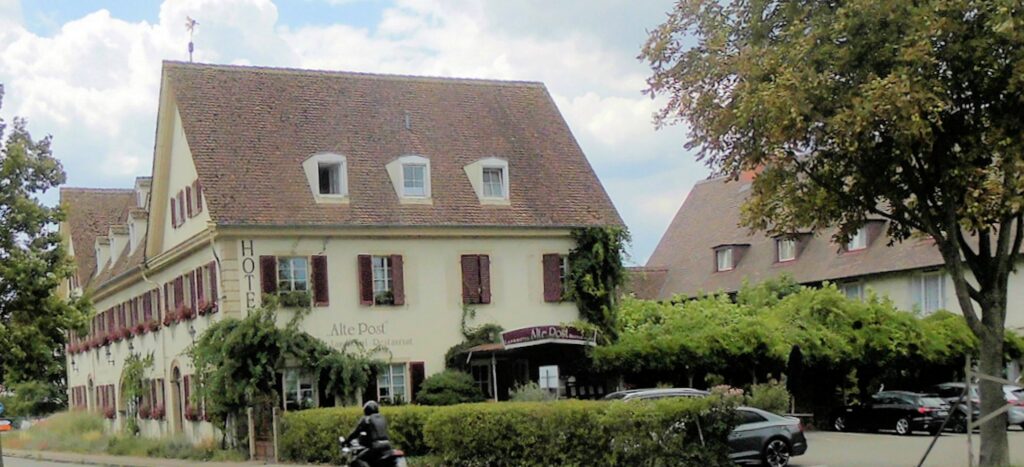

A post house on the road between Basel and Freiburg, and the one address in Baden that a poet chose to open a poem with. Two centuries later the road is still there, and so is the house.
At a glance
The Alte Post stands at the edge of Müllheim, on what is now the Bundesstraße 3, the road that has run north–south through the Markgräflerland since long before it had a number. It was a post station: the place where the mail coach changed horses and the passengers ate. In 1807 Johann Peter Hebel put it into the opening lines of one of his best-known dialect poems, and in doing so made a roadside stop into a landmark that people still recite. The building is a long, cream-rendered block under a steep tiled roof, and it is still an inn.
Key facts
- Where: Bundesstraße 3, Müllheim im Markgräflerland, Landkreis Breisgau-Hochschwarzwald, Baden-Württemberg
- Original function: Poststation — a staging post on the Basel–Freiburg road
- In literature: named in the first stanza of Der Schwarzwälder im Breisgau by Johann Peter Hebel (1760–1826), first printed in 1807
- Date of building: the house gives 1745; we have not found this confirmed in an independent source, and it is repeated here as the house’s own account
- Current use: country hotel and restaurant
- Coordinates: 47.812682, 7.610182 · open in Google Maps
History
Before the railway, a journey through the Markgräflerland was measured in horses. The corridor between Basel and Freiburg carried mail, wine and people, and a coach could only go as far as its team could pull it: every few hours there had to be a house with a stable, a kitchen and a fresh set of horses. The Alte Post was one of those houses, set at the edge of the village rather than in its centre, where a coach and four could turn.
What lifted it out of the ordinary was a poem. Johann Peter Hebel — Alemannic poet, later prelate of the Baden church, the writer Goethe admired and Kafka read — opened Der Schwarzwälder im Breisgau with this house. The poem first appeared in 1807 in the Freiburg paper, and the first stanza runs:
Z’Müllen an der Post,
Tausigsappermost!
Trinkt me nit e guete Wi!
Goht er nit wie Baumöl i,
z’Müllen an der Post!
It is dialect, and it resists translation: the sense is a traveller’s exclamation that at the Post in Müllheim the wine is good, and goes down like oil. What matters for the building is the grammar of the thing. Hebel did not describe the house; he used its name as a place everyone already knew, the way one names a crossroads. That is the strongest evidence of what the Alte Post was in 1807 — not a monument, but a fixed point on a road.
What you see
The house presents its long side to the road: a rendered wall in pale cream, two storeys, with a steep roof of old clay tiles whose colours have gone uneven with age, mottled brown and grey-pink. Three dormers sit in a row on the road slope, and a weathervane turns on the gable. Every window has a pair of shutters in a deep wine red, which against the cream is the whole colour scheme of the building and of half the Markgräflerland.
Vines and climbers are trained up the wall in several places, and where they meet the ground-floor windows the facade almost disappears behind them in summer. The name is painted directly onto the render, in a modest serif, at the height of a person standing. To the right a second, lower wing runs back from the road behind a hedge and a line of trees. The whole group reads as a working farmstead that grew rather than as a designed building, which is what a post station was.
Practical information
- The house is a working hotel and restaurant; the exterior is visible from the road at any time.
- The road front faces the traffic of the B3 — the quieter view is from the hedge side.
- Müllheim is the centre of the Markgräflerland wine district; the vineyards begin within walking distance.
- Fifteen minutes covers the building and its setting.
Getting there
Müllheim (Baden) is on the main line between Basel and Freiburg im Breisgau; the station is in the town and the walk from it is short. By road the house sits on the B3 itself. Basel is about forty minutes away by train, Freiburg about twenty-five. The nearest airport is Basel–Mulhouse–Freiburg.
Nearby
- Badenweiler, with its Roman bath ruins, six kilometres east in the foothills.
- The Markgräflerland vineyard slopes, immediately around the town.
- The Black Forest edge, rising directly behind Müllheim.
Sources
- Alemannische Seiten — Alte Post Müllheim: the house as eine ehemalige Poststation am Ortsrand von Müllheim, and Hebel’s 1807 stanza.
- Wikisource, Der Schwarzwälder im Breisgau — the text of the poem, from J. P. Hebels sämmtliche Werke. Hebel died in 1826 and the text is in the public domain.
- OpenStreetMap / Nominatim — position and address, returned as Alte Post, 3, Bundesstraße, Müllheim im Markgräflerland.
- The date 1745 is given by the hotel itself and is reported here as such; no independent confirmation was found.
Find it on the map
See this place and what’s around it →📷 Become a Cultural Heritage Online photographer
Share your photos of places: they stay published under your name as the author. The more they're seen, the more you get noticed — and soon a contest will reward the most appreciated photos.
Log in or sign up free to add a photoIs this page about you?
This page is read by travellers and heritage enthusiasts who find it on Google. Tell us how you are connected to this place and we will take it from there.