
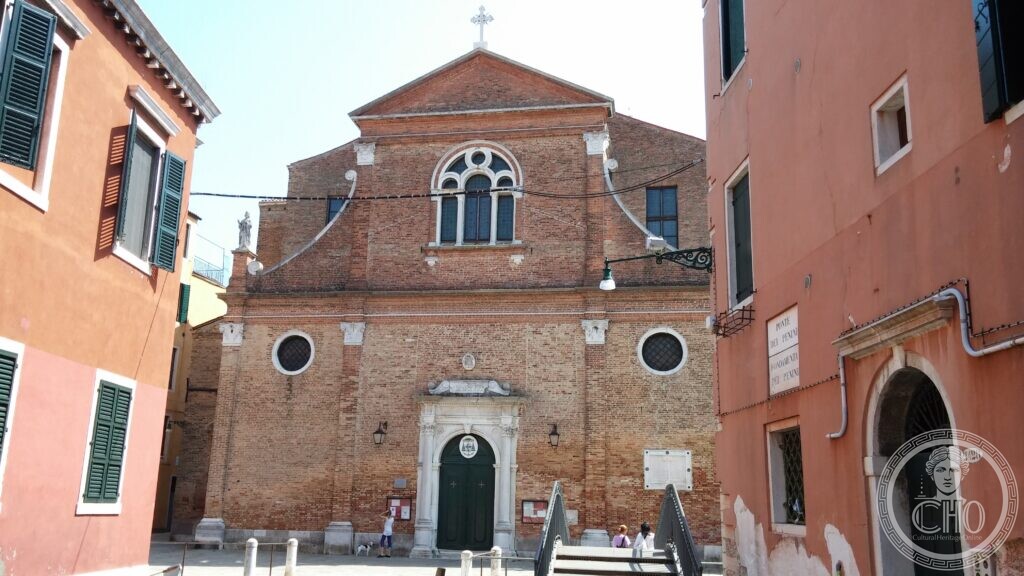
Sansovino turned the whole church ninety degrees and gave it a square plan. The result stands at the edge of the Arsenale, its brick front facing a campo that most visitors never cross.
At a glance
A parish church in eastern Castello, a few steps from the land gate of the Arsenale. Its origins are old and not securely documented: probably the middle of the eighth century, with a tradition that puts it earlier still. An earlier building was finished and consecrated in 932. What stands today is the sixteenth-century rebuilding begun in 1546 to a design by Jacopo Sansovino, who rotated the church through ninety degrees and laid it out on a square plan. The bell tower is older than the church around it.
Key facts
- Origins: probably mid-8th century; an earlier church completed and consecrated in 932
- Rebuilt: from 1546, to a design by Jacopo Sansovino (1486–1570)
- Plan: square, turned ninety degrees from the orientation of the older church
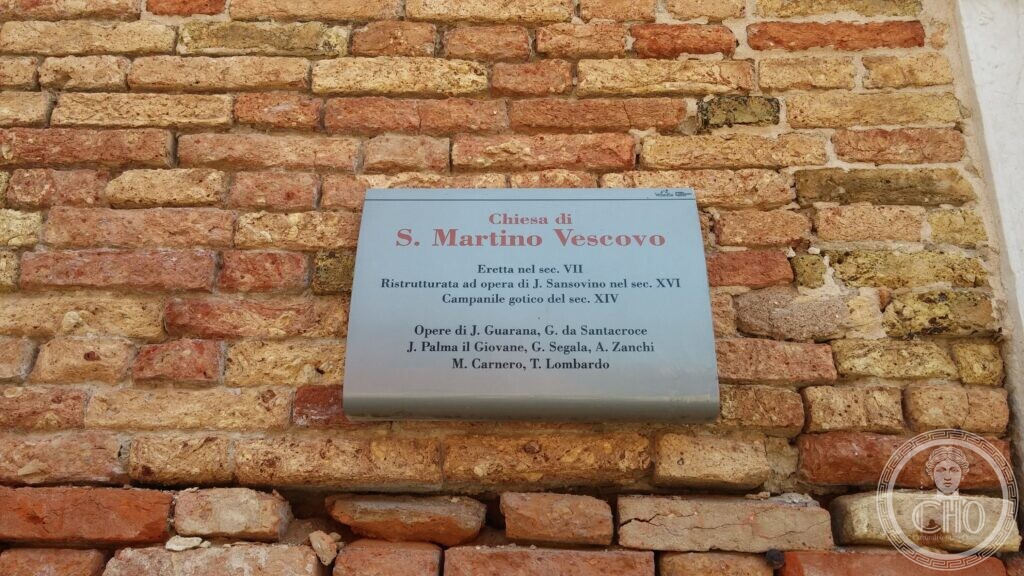
- Bell tower: Gothic, of the 14th century according to the plaque on the church wall
- Inside: ceiling frescoes by Domenico Bruni and Fabio Canal; the Cena di Cristo of 1549 by Gerolamo Santacroce on the organ parapet; an altarpiece by Giovanni Segala; works by Jacopo Palma il Giovane; the monument to Doge Francesco Erizzo (1633) by Mattia Carnero
- Where: Campo San Martino, Castello, beside the Arsenale
- GPS: 45.43473, 12.34897 · Open in Google Maps
History
The early history is the usual Venetian mixture of tradition and record. The tradition gives a foundation at the end of the sixth century or in the seventh, and credits the Vallaresso and Salonigo families with rebuilding it; the documented line begins later, with a church finished and consecrated in 932. Between the ninth and tenth centuries the building was raised again in the Venetian-Byzantine manner, and it stood in that form for some six hundred years.
In 1546 the parish began again, this time with Sansovino, then at the height of his Venetian career. His decision was radical for a church that had to fit an existing site: he turned the whole building a quarter turn and set it on a square plan, so that the front now faces the campo and the flank runs along the canal. The parish has kept a stone plaque on the wall that lists, in four short lines, what a visitor is supposed to know: the seventh century, Sansovino, the fourteenth-century Gothic bell tower, and the names of the artists whose work hangs inside.
What you see
Bare brick, and very little of anything else. The front carries a stone portal, a trefoil Gothic window above it, two round windows at the sides and a cross on the gable; the rest is wall. A footbridge crosses the canal immediately in front, so the approach is at an angle and you see the flank before the front. The houses that crowd the campo are painted ochre and dark red, which makes the brick look paler than it is.
Nearby
- War Memorial of the San Martino Parish — on this church’s own front, to the right of the door
- Ponte de l’Arsenal o del Paradiso — a minute away, at the gate of the Arsenale
Sources
- The stone plaque on the church wall, read from the contributed photograph: Chiesa di S. Martino Vescovo — eretta nel sec. VII, ristrutturata ad opera di J. Sansovino nel sec. XVI, campanile gotico del sec. XIV, with the list of artists
- Wikipedia (Italian), Chiesa di San Martino (Venezia, Castello): the probable eighth-century foundation, the consecration of 932, the rebuilding from 1546, Sansovino’s quarter turn and square plan, and the works inside with their artists
Gallery
Find it on the map
See this place and what’s around it →📷 Become a Cultural Heritage Online photographer
Share your photos of places: they stay published under your name as the author. The more they're seen, the more you get noticed — and soon a contest will reward the most appreciated photos.
Log in or sign up free to add a photoIs this page about you?
This page is read by travellers and heritage enthusiasts who find it on Google. Tell us how you are connected to this place and we will take it from there.