
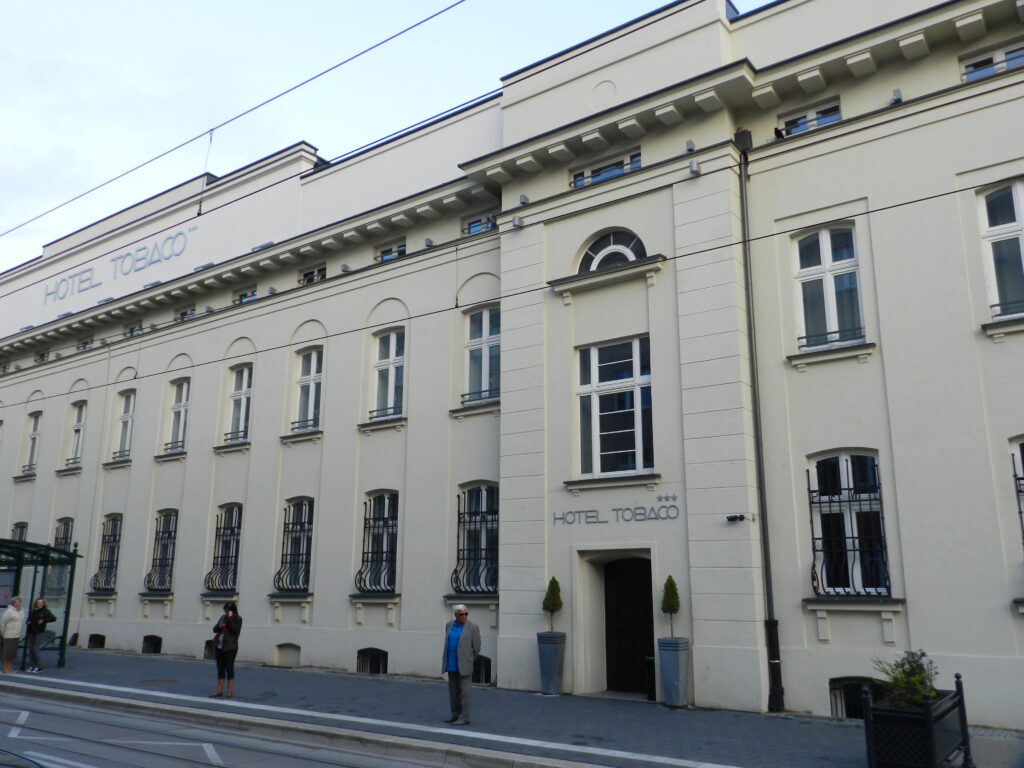

A steam weaving mill, then a state cigarette factory, then nothing for six years. The modernist block the tobacco monopoly added in the 1920s is on the register.
At a glance
The complex at ul. Kopernika 64 in Łódź began as industry and never stopped being it until 2001. A steam weaving mill started producing cords and woollen goods on the site in 1875; the Łódź industrialist Karol Kretschmer moved his spinning and weaving business to Kopernika in 1895. In 1925 the complex passed to the Polish State Tobacco Monopoly, which added modernist buildings the following year. It ran as the Łódź Cigarette Factory until 2001. Grupa Arche bought it in 2007 and converted it from 2010 into apartments and the Tobaco hotel, which opened in 2013. The 1925 modernist building is entered in the Łódź register of monuments.
Key facts
- 1875: a steam weaving mill begins producing cords and woollen goods on the site
- 1895: Karol Kretschmer moves his spinning and weaving business to Kopernika
- Peak employment: over 300 workers and 62 hand looms around 1910
- 1925: the complex becomes the property of the State Tobacco Monopoly
- 1926: modernist buildings added
- Until 2001: operating as the Łódź Cigarette Factory
- 2007–2013: bought by Grupa Arche, converted from 2010, hotel opened 2013
- GPS: 51.757977, 19.437559 — View on Google Maps
History
Łódź is the textile city of central Europe: it grew from a village of a few hundred people to a manufacturing centre of half a million within a century, and its architecture is almost entirely industrial and residential-industrial. Kopernika 64 is a normal example of that history, which is precisely what makes it useful.
The change of trade in 1925 is the interesting part. A newly independent Poland set up a state tobacco monopoly and needed premises; it took over a textile complex and added buildings in the modernist manner then arriving in Polish architecture. The result is a site where nineteenth-century brick mills and interwar modernism stand together because of a change of product, not a change of taste.
Production ended in 2001 and the buildings stood empty. The conversion from 2010 turned part of the complex into apartments and part into a hotel, and the whole is now marketed as Tobaco Park. That is the standard fate of a European industrial site, and here it was done without demolishing the listed 1925 block.
What you see
Two industrial languages side by side. The older buildings are red brick in the Łódź manner, with regular bays of tall windows sized for daylight over looms. The 1925 monopoly buildings are modernist: flatter, plainer, with horizontal emphasis and much less applied decoration.
The conversion has kept the industrial section visible rather than papering over it, so the depth of the window reveals, the structural bays and the brick are still the dominant experience. It is worth walking the whole of Tobaco Park rather than just the hotel entrance, because the sequence of buildings is the document.
Practical information
- A working hotel within a mixed complex of apartments and offices
- The site is walkable and the exteriors are the main heritage interest
- Łódź’s other converted mill complexes, above all Księży Młyn, are the natural comparison
Getting there
Ul. Kopernika runs west from the centre of Łódź, about fifteen minutes on foot from Piotrkowska street. Łódź Fabryczna station has fast trains from Warsaw in just over an hour; trams serve the street.
Nearby
- Księży Młyn — the great Scheibler mill settlement, the other side of the city
- Pałac Komierowo — a Polish country house of the same interwar decade
Sources
- Wikipedia (Polish), « Fabryka Państwowego Monopolu Tytoniowego w Łodzi » — the 1875 weaving mill, Karol Kretschmer’s move in 1895, the employment figures, the 1925 transfer to the tobacco monopoly and the modernist buildings of 1926, production until 2001, the Arche purchase and the 2013 hotel opening, and the entry in the register of monuments
- Regionalny Katalog Zabytków Województwa Łódzkiego — the protected complex
- OpenStreetMap Nominatim — coordinates verified against ul. Kopernika 64
Find it on the map
See this place and what’s around it →📷 Become a Cultural Heritage Online photographer
Share your photos of places: they stay published under your name as the author. The more they're seen, the more you get noticed — and soon a contest will reward the most appreciated photos.
Log in or sign up free to add a photoIs this page about you?
This page is read by travellers and heritage enthusiasts who find it on Google. Tell us how you are connected to this place and we will take it from there.