
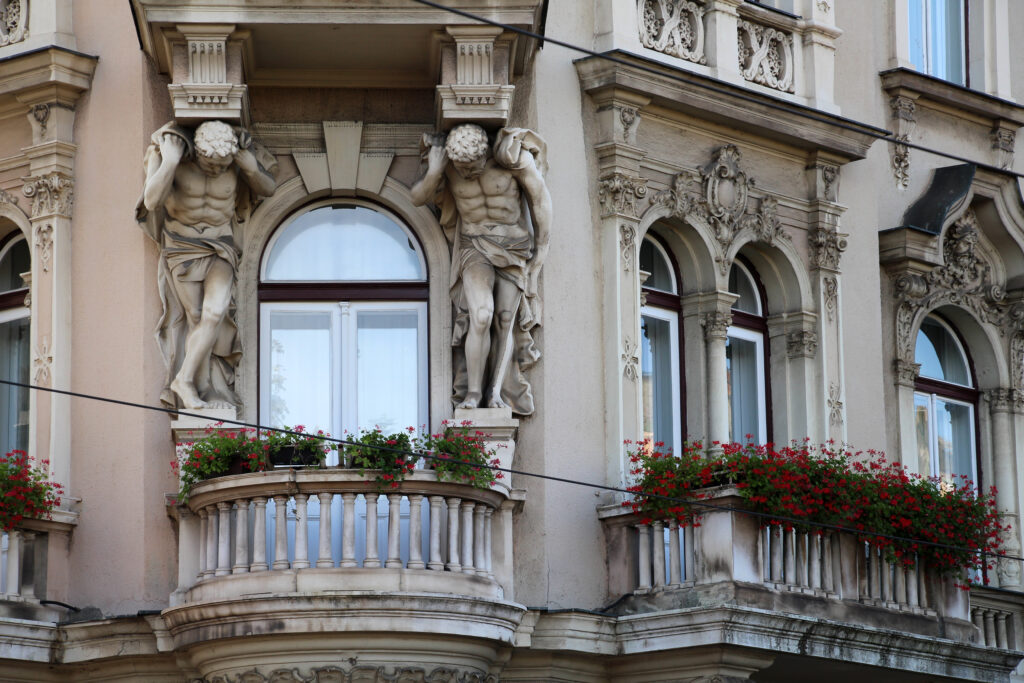
.jpg)
Built as a musician’s palace in 1891 and turned into a hotel sixteen years later. A glass and copper time capsule from the foundations came to light during a restoration.
At a glance
The Palace stands on Strossmayer Square, in the belt of parks and public buildings that Zagreb laid out as its lower town in the late nineteenth century. The palace was built in 1891 for Carl Schlesinger, a musician, to designs by the studio of Hönigsberg & Deutsch — Leo Hönigsberg and Julio Deutsch, who between them put up more than ninety buildings in the city. It opened as a hotel in 1907, among the first professionally run hotels in Zagreb. The exterior is neo-Rococo; the interior holds one of the region’s few Art Nouveau schemes. It received the Croatian Heritage Hotel designation in 2012.
Key facts
- Built: 1891, for Carl Schlesinger, musician
- Architects: Hönigsberg & Deutsch — Leo Hönigsberg and Julio Deutsch
- Opened as a hotel: 1907, one of the first professionally managed hotels in Zagreb
- Style: neo-Rococo outside; Art Nouveau interior, rare in the region
- Designation: Heritage Hotel, 2012
- Found in restoration: a 40-centimetre glass and copper time capsule from the foundations, with texts in Croatian and German
- Address: Trg J. J. Strossmayera 10, Zagreb
- GPS: 45.808513, 15.977540 — View on Google Maps
History
Zagreb’s lower town was planned in the 1880s as a sequence of squares and gardens — the Green Horseshoe — lined with institutions and private palaces. Schlesinger’s house belongs to that programme, and Hönigsberg & Deutsch were the practice that built much of it. Their output ran to more than ninety buildings, which makes them the firm that gave modern Zagreb its texture.
The conversion to a hotel in 1907 was early. Zagreb at that point had inns and guest houses but few hotels run as a business in the modern sense, and the Palace was among the first. The Art Nouveau interior belongs to that moment rather than to the 1891 house, and it is the reason the building matters beyond its facade: complete Secession interiors are scarce in Croatia.
The time capsule found during restoration is the kind of detail that makes a building’s history concrete. Forty centimetres of glass and copper, buried in the foundations in 1891, with texts in Croatian and German — the two languages of the city’s educated class under Austria-Hungary, and a precise record of who the builders thought they were.
What you see
A neo-Rococo palace front facing the square: pale, symmetrical, with the ornament concentrated around the windows and at the roofline in the eighteenth-century manner the nineteenth century liked to revive for private grandeur. It reads as a residence turned to public use, which is what it is.
The interest is inside, where the Art Nouveau scheme of the hotel conversion survives. Look at the glass, the metalwork and the decorative detail in the public rooms: that is 1907 sitting inside 1891, and in this part of Europe very little of it is left.
Practical information
- A working hotel; the café and public rooms are the way to see the interior without staying
- The facade is on a public square and visible at any hour
- The Green Horseshoe of squares runs from here to the station and is best walked in sequence
Getting there
Strossmayer Square is in Donji Grad, the lower town, about five minutes on foot from Zagreb Glavni Kolodvor, the main station, and ten from Ban Jelačić Square. Trams serve the surrounding streets.
Nearby
- Evangelical Church, Zagreb — in the same lower-town quarter
- Hotel Paříž — the Prague equivalent, built a few years later
Sources
- Wikipedia, « Palace Hotel, Zagreb » — the 1891 construction for Carl Schlesinger, the architects Hönigsberg & Deutsch, the 1907 conversion and the styles
- Visit Zagreb, official city tourism — the Heritage Hotel designation of 2012 and the time capsule found in restoration
- Palace Hotel Zagreb, own pages — the building and its use
- OpenStreetMap Nominatim — coordinates verified against Trg J. J. Strossmayera 10
Find it on the map
See this place and what’s around it →📷 Become a Cultural Heritage Online photographer
Share your photos of places: they stay published under your name as the author. The more they're seen, the more you get noticed — and soon a contest will reward the most appreciated photos.
Log in or sign up free to add a photoIs this page about you?
This page is read by travellers and heritage enthusiasts who find it on Google. Tell us how you are connected to this place and we will take it from there.