
.jpg)
Britain’s last surviving news theatre still showing films. It was built to run newsreels on a loop, and its decoration is, of all things, ancient Persian.
At a glance
The Tyneside opened on 1 February 1937 as the News Theatre, showing newsreels, documentaries, shorts and cartoons in continuous programmes. It was the project of Dixon Scott, a Newcastle film exhibitor and the great-uncle of the directors Ridley and Tony Scott, and it was built to designs by George Bell, of the Newcastle practice Dixon and Bell. The interior decoration is in an ancient Persian manner with Art Deco touches, and the entrance and circle foyers have intricate mosaic floors. It was listed Grade II in 2000 and is the only news theatre in Britain still operating as a cinema.
Key facts
- Opened: 1 February 1937, as the News Theatre
- Founder: Dixon Scott, Newcastle film exhibitor
- Architect: George Bell, of Dixon and Bell, Newcastle
- Decoration: ancient Persian manner with Art Deco elements; mosaic floors in the entrance and circle foyers
- Closed as a news theatre: March 1968, when cinema newsreels ended
- Reopened: 17 March 1968 as the Tyneside Film Theatre, with British Film Institute support; as the Tyneside Cinema from 1976
- Protected: Grade II listed, 2000
- GPS: 54.973903, -1.612254 — View on Google Maps
History
The news theatre was a building type with a life of about thirty years. Between the wars, city-centre audiences wanted news before television existed to give it to them, and a small auditorium running a continuous loop of newsreels suited people with an hour between appointments. Dixon Scott opened this one in February 1937, and the family name would become better known two generations later.
Television killed the form. Newsreel production ended and the News Theatre closed in March 1968 — then reopened a fortnight later, on 17 March, as the Tyneside Film Theatre, a repertory house backed by the British Film Institute. That closed in 1975; new operators reopened it in 1976 as the Tyneside Cinema, which is what it has been since.
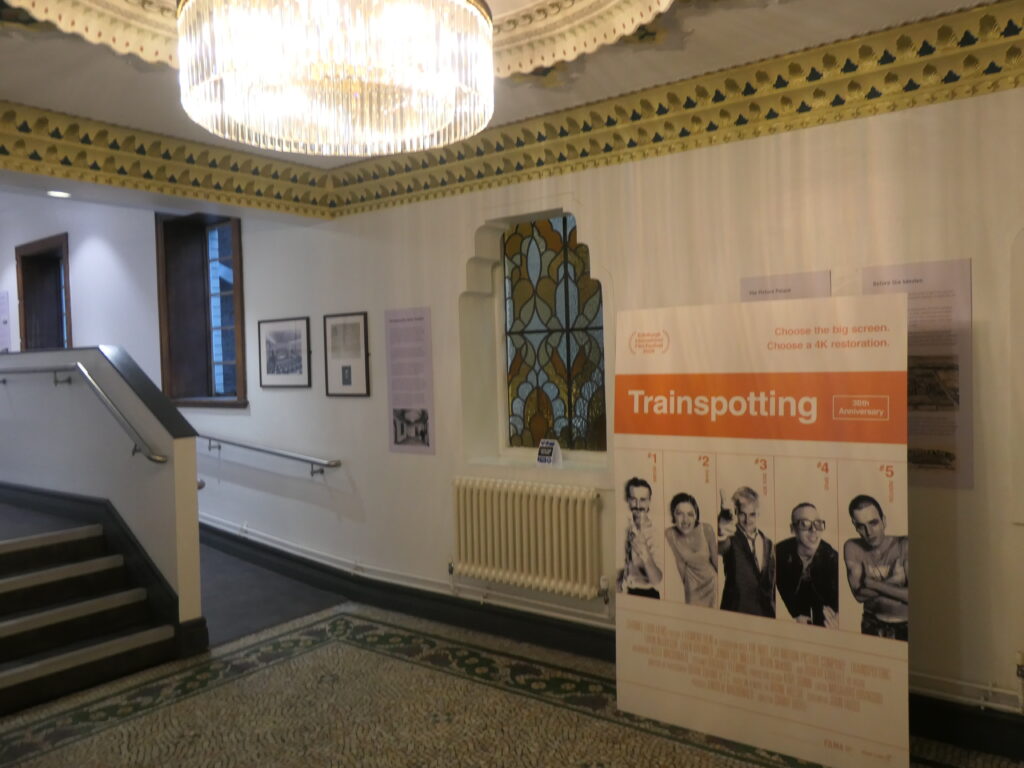
English Heritage listed the building Grade II in 2000. The citation matters because the interest is largely interior: the auditorium, the foyers and the mosaic floors are the reason the building is protected, and they survive because the cinema never had the money to modernise them away.
What you see
From Pilgrim Street the front is modest, as news theatres were — they were entered in passing, not approached as an event. The interest begins in the entrance foyer, where the mosaic floor starts and the Persian scheme announces itself.
That choice of decoration is worth thinking about. In 1937 a Newcastle cinema could have been Egyptian, Moorish, Chinese or straightforwardly Art Deco; Bell reached for ancient Persia, and the ornament runs through the plasterwork, the light fittings and the colour. It is exotic revivalism applied to the most contemporary building type in Britain, and the mismatch is exactly what makes interwar cinemas interesting.
Practical information
- A working cinema with several screens, a café and a bar — buy a ticket, or come for coffee and look at the foyer
- Guided heritage tours run periodically and are the way to see the parts the public does not normally reach
- Central: the whole of Grainger Town is within ten minutes on foot
Getting there
Pilgrim Street runs through the centre of Newcastle upon Tyne. Monument metro station is three minutes on foot, and Newcastle Central station about ten. The cinema entrance is on Pilgrim Street, with a second entrance from High Friar Lane.
Nearby
- Kinema in the Woods — the 1922 Lincolnshire cinema that still projects from behind the screen
- Cinéma Eldorado — the listed Art Deco picture house in Dijon
Sources
- Wikipedia, « Tyneside Cinema » — the opening of 1 February 1937, Dixon Scott, the architect George Bell, the Persian and Art Deco decoration, the closure and reopening in 1968, the Grade II listing of 2000
- Historic England, list entry 1385094, Tyneside Cinema — designation and description
- Cinema Treasures, entry for the Tyneside Cinema — operating history
- OpenStreetMap Nominatim and Wikipedia coordinates, cross-checked — location
Find it on the map
See this place and what’s around it →📷 Become a Cultural Heritage Online photographer
Share your photos of places: they stay published under your name as the author. The more they're seen, the more you get noticed — and soon a contest will reward the most appreciated photos.
Log in or sign up free to add a photoIs this page about you?
This page is read by travellers and heritage enthusiasts who find it on Google. Tell us how you are connected to this place and we will take it from there.