
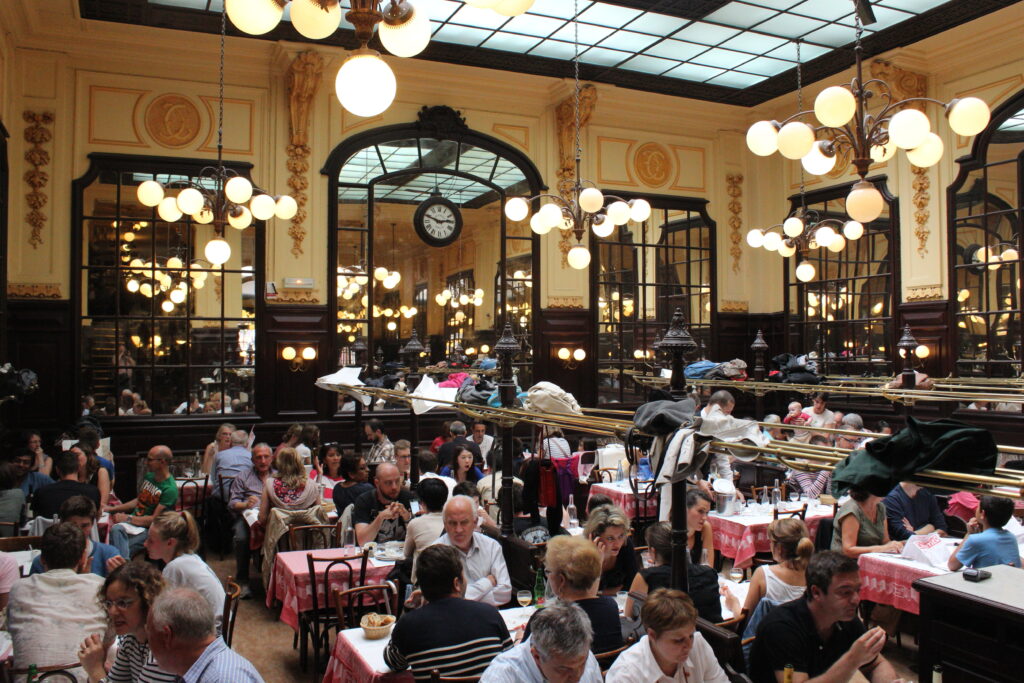

It was built to feed working people cheaply and quickly, and it has never stopped. The brass racks above the tables are where regulars once kept their own napkins.
At a glance
The Chartier brothers, Frédéric and Camille, opened this bouillon in 1896 near the Grands Boulevards, on a street chosen for the number of manual workers living around it. The bouillon was a Parisian invention: a large, fast, inexpensive restaurant serving broth and plain dishes to people who had no kitchen. The dining room, by the architect Jean-Marie Bouvier, seats about 350 under a wide Art Nouveau glass ceiling, with carved wooden panelling around the walls and a mezzanine above. It was listed as a monument historique in 1989 and still trades at modest prices without taking bookings.
Key facts
- Opened: 1896
- Founded by: Frédéric and Camille Chartier
- Architect: Jean-Marie Bouvier
- Room: about 350 covers, with a mezzanine and an Art Nouveau glass ceiling
- Decoration: carved wooden panelling, mirrors and brass
- Type: a bouillon — the Parisian cheap-eating house of the late nineteenth century
- Protected: monument historique since 1989
- GPS: 48.871936, 2.343014 — View on Google Maps
History
The bouillons were a response to a specific problem. Industrial Paris had filled with workers who lived in rooms without cooking facilities and needed to eat at speed, at a price they could pay. Pierre-Louis Duval had started the model in the 1850s; by the 1890s it was an industry, with vast rooms, fixed low prices and a service designed for turnover. The Chartier brothers put theirs on the rue du Faubourg Montmartre precisely because of who lived there.
What preserved it was its own economics. Grand restaurants of the 1890s were refitted every generation to stay fashionable; a cheap eating house had no reason to spend money on its room, so the room survived. By the time anyone thought of it as heritage, the panelling, the glass ceiling and the fittings were the last complete example of a building type that had once been everywhere in Paris. The listing followed in 1989.
The brass racks running above the banquettes are the detail that gives the game away. Regular customers kept a numbered napkin there between visits, because buying a clean one every day was an expense. That is not decoration. It is a piece of working-class economy that happens to have survived inside a listed monument.
What you see
One tall room, much larger than the street front suggests, running back under a glazed roof that throws even daylight down onto the tables. The panelling is carved but not fussy, the mirrors are set to extend the room lengthways, and the mezzanine gallery gives the space its section. Everything is arranged for one purpose: to get a great many people fed at once without anybody feeling herded.
Look for the racks, the numbered drawers, the coat hooks, and the way the waiters still write the bill on the paper tablecloth. These are not revivals. They are the original working arrangements of an 1896 bouillon, kept because they work.
Practical information
- A working restaurant, open every day, and it does not take bookings — expect a queue at meal times
- Quietest in the middle of the afternoon, which is also the best time to look at the room
- Prices remain deliberately low; this is still a cheap eating house, not a museum with a menu
Getting there
Rue du Faubourg Montmartre runs north from the Grands Boulevards in the 9th arrondissement. Grands Boulevards is the nearest metro station, on lines 8 and 9, less than two minutes away; Gare du Nord is about fifteen minutes on foot.
Nearby
- Petit Palais — the 1900 exhibition building, now the city’s fine arts museum
- Centre Pompidou — across the river of boulevards, the other end of Parisian architectural argument
Sources
- Wikipedia, « Bouillon Chartier » — the 1896 foundation by the Chartier brothers, the architect Jean-Marie Bouvier, the capacity, the panelling and glass ceiling, the listing of 1989
- Bouillon Chartier, own history pages — the choice of street and the bouillon model
- Wikipedia, « Bouillon (restaurant) » — the origin and economics of the Parisian bouillon
- OpenStreetMap Nominatim — coordinates verified against the address
Find it on the map
See this place and what’s around it →📷 Become a Cultural Heritage Online photographer
Share your photos of places: they stay published under your name as the author. The more they're seen, the more you get noticed — and soon a contest will reward the most appreciated photos.
Log in or sign up free to add a photoIs this page about you?
This page is read by travellers and heritage enthusiasts who find it on Google. Tell us how you are connected to this place and we will take it from there.