
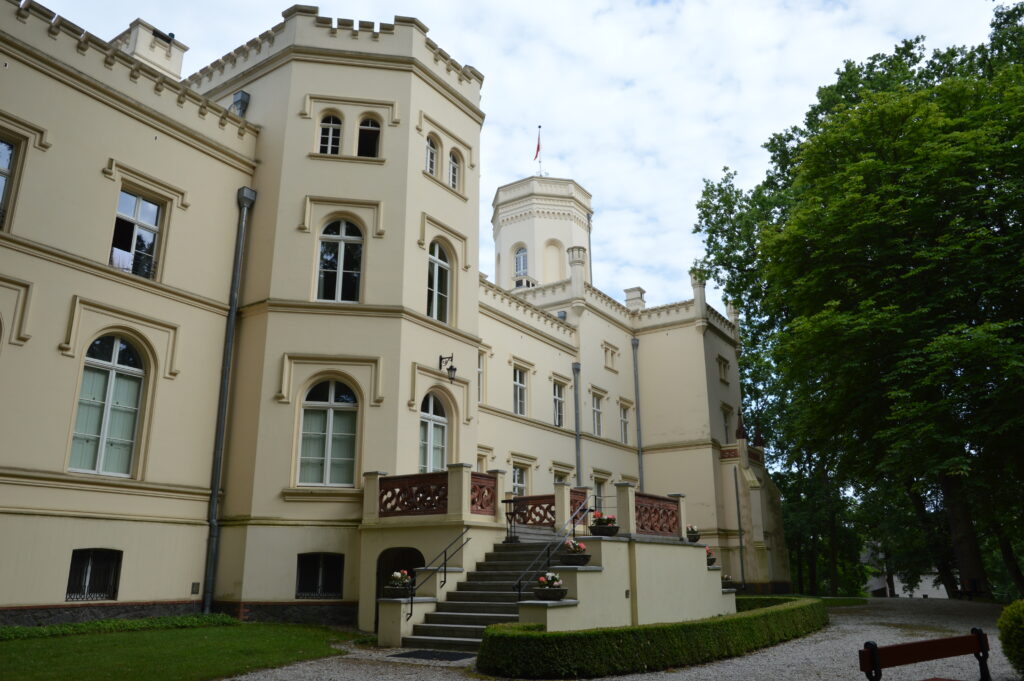

A Prussian landowner built himself an English castle above a small river in 1861. The vines on the slope below it were planted in 2004, and they are now among the largest in Poland.
At a glance
Mierzęcin stands in the Lubusz region of western Poland, on the terraced bank of the Mierzęcinka, inside a park. It was built between 1861 and 1863 for Robert Friedrich von Waldow, in the English neo-Gothic that Prussian landowners used when they wanted romance rather than authority; the design is attributed, but not firmly, to the Berlin architect Georg Heinrich Hitzig. The von Waldow family enlarged the estate into the early twentieth century, adding a distillery and a farm complex. The house is a hotel today, and the estate carries a vineyard planted in 2004 and a stud.
Key facts
- Built: 1861–1863
- Built for: Robert Friedrich von Waldow
- Architect: attributed to Georg Heinrich Hitzig, of Berlin — the sources say probably, not certainly
- Style: English neo-Gothic, a romantic country residence
- Setting: terraced bank of the river Mierzęcinka, within a park
- Estate buildings: distillery and farm complex, added in the early twentieth century
- Vineyard: first planted 2004; about 8.75 hectares
- GPS: 52.957145, 15.834769 — View on Google Maps
History
The von Waldow family acquired the Mierzęcin estate and built the present house in the early 1860s, when this was Brandenburg rather than Poland and the border lay far to the east. English neo-Gothic was a deliberate choice: it signalled cultivation and a certain liberal Anglophilia, and it sat more lightly on a landscape of water meadows than a classical block would have done.
The attribution to Georg Heinrich Hitzig is worth handling carefully. Hitzig was a significant Berlin architect of the period, and the regional literature records the attribution as probable rather than documented. We repeat it as an attribution and leave it at that.
The estate reached its widest extent in the early twentieth century, with new industrial and farm buildings. After 1945 it passed, like the rest of the region, into Polish hands and then into decline. The present owners restored the house and grounds and reopened them as a hotel with a spa, and in 2004 planted the first vines on the slope — an unusual second life for a Prussian country house, and one that has made the estate a reference point for Polish wine.
What you see
A compact, asymmetrical house in pale render with a tower, pointed openings and the crenellated skyline of a small English castle. The asymmetry is the point: the romantic manner wanted a building that looked as though it had grown over centuries, and the tower exists to break the roofline rather than to serve a room.
The terracing matters as much as the facade. The house is set above the river so that the ground falls away in front of it, which gives a modest building a commanding line and gives the park its structure. The vineyard now occupies part of that slope, so the composition reads differently from the way von Waldow intended, and arguably better.
Practical information
- A working hotel and spa — the park, the vineyard and the stud are part of the estate
- The winery offers tastings; check opening before travelling, as the season matters
- Quietest outside the Polish holiday weekends, when the estate is busy with events
Getting there
Mierzęcin lies in the commune of Dobiegniew, in Lubusz province, roughly midway between Gorzów Wielkopolski and Piła in western Poland. Dobiegniew has a railway station on the Poznań–Szczecin line; the estate is a short drive from there and is easiest reached by car.
Nearby
- Pałac Wojanów — the Prussian royal house in the Jelenia Góra valley, further south
- Książ Castle — Silesia’s largest castle
Sources
- Pałac Mierzęcin, own history pages — construction dates, Robert Friedrich von Waldow, the attribution to Georg Heinrich Hitzig, the early twentieth-century estate buildings
- Lubuski Wojewódzki Konserwator Zabytków (regional heritage office), entry for the Mierzęcin palace — protected status
- Ziemia Lubuska, regional tourism board — the vineyard, planted from 2004, and its extent
- OpenStreetMap Nominatim — coordinates verified against the palace
Note for the record: the design is attributed to Georg Heinrich Hitzig by the regional literature, which states it as probable. We have not asserted it as fact.
Find it on the map
See this place and what’s around it →📷 Become a Cultural Heritage Online photographer
Share your photos of places: they stay published under your name as the author. The more they're seen, the more you get noticed — and soon a contest will reward the most appreciated photos.
Log in or sign up free to add a photoIs this page about you?
This page is read by travellers and heritage enthusiasts who find it on Google. Tell us how you are connected to this place and we will take it from there.