
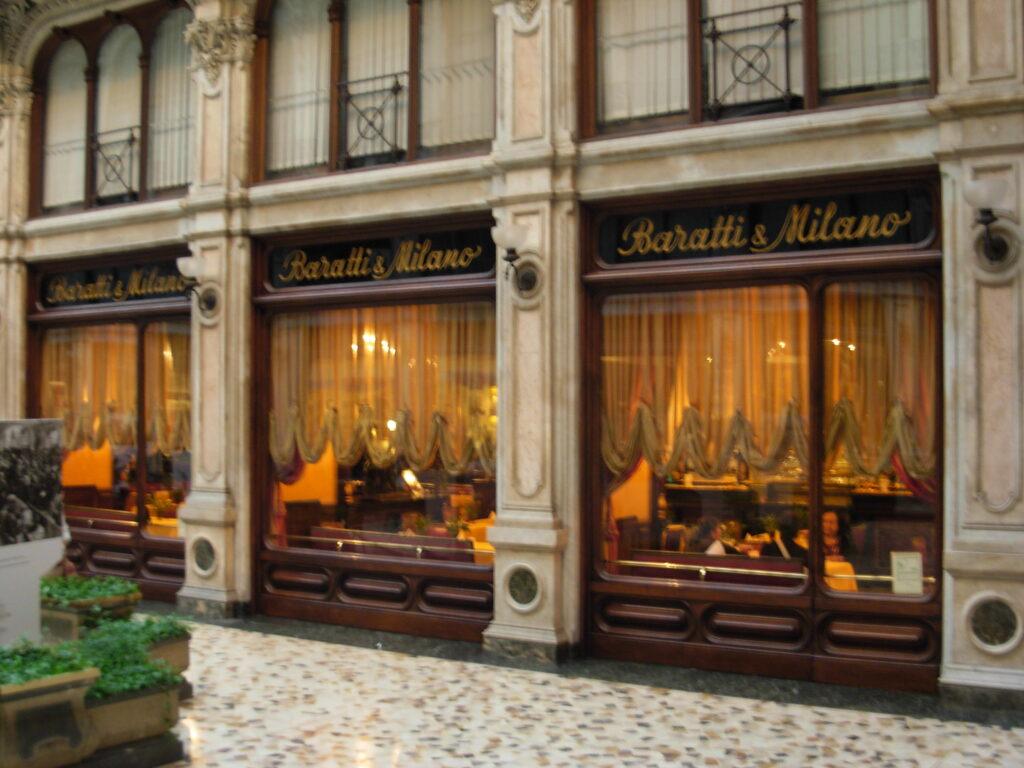

Two confectioners from the Canavese hills opened a workshop in 1858. Fifty years later their shop was rebuilt by the architect who gave Turin its Liberty, and the state now protects the furniture as well as the walls.
At a glance
Baratti & Milano sits inside the Galleria Subalpina, the glazed arcade off Piazza Castello. Ferdinando Baratti and Edoardo Milano began in 1858 with a confectionery workshop on what is now via Garibaldi, and moved into the newly opened arcade in 1875. What visitors see today is not that shop but its enlargement of 1909, designed by the architect Giulio Casanova with the engineer Pietro Fenoglio and the sculptor Edoardo Rubino. In 1985 the Italian heritage ministry placed a protection order on the premises — and, unusually, on the furnishings inside them.
Key facts
- Founded: 1858, as a confectionery workshop on via Dora Grossa, today via Garibaldi
- Founders: Ferdinando Baratti, of Piverone, and Edoardo Milano, of Bollengo
- Moved to the Galleria Subalpina: 1875, the year the arcade opened
- Rebuilt: 1909, by Giulio Casanova (architect) and Pietro Fenoglio (engineer), with Edoardo Rubino (sculptor)
- Materials: mirrors, marble, bronze, gilding, stucco and mosaic
- War: damaged in the bombing of Turin in 1944; reopened in 1948
- Protected: heritage order of 1985, covering the premises and the furnishings
- GPS: 45.069466, 7.686463 — View on Google Maps
History
Baratti and Milano came down from the Canavese, the hill country north of Turin, and set up as confectioners in 1858 in a city that was about to become, briefly, the capital of Italy. The move into the Galleria Subalpina in 1875 put them inside the newest piece of Turinese urbanism: a covered arcade of glass and iron linking Piazza Castello to the financial quarter. Politicians and writers followed — the house remembers Massimo d’Azeglio, Giovanni Giolitti and Luigi Einaudi among its regulars.
The 1909 rebuilding is what makes the place architecturally serious. Pietro Fenoglio was the dominant figure of Turinese Liberty, the architect of Casa Fenoglio-Lafleur and of much of the city’s Art Nouveau; Giulio Casanova was a decorator and teacher of the applied arts; Edoardo Rubino was among the best sculptors working in Piedmont. Between them they turned a successful shop into a room.
Bombs fell on Turin in 1944 and the Galleria Subalpina was hit. The café reopened in 1948 after restoration. The protection order of 1985 is the part worth noticing: Italian listings normally protect a building, and here the ministry extended the protection to the fittings, which is why the room has not been modernised out of existence like most of its contemporaries.
What you see
The room works by reflection. Mirrors face each other across the space and multiply the gilding, the bronze and the carved wood, so that a relatively small interior reads as much larger and much busier than it is. Marble runs along the counters, stucco and mosaic carry the decoration up and over, and Rubino’s sculpture gives the scheme its figures.
Look up at the junction between the wall panelling and the ceiling, where the 1909 hands did their most concentrated work, and then out through the doorway into the Galleria Subalpina itself — glass roof, iron ribs, daylight from above. The contrast between the warm, enclosed, gilded box and the cool engineered arcade outside it is the whole point of the arrangement.
Practical information
- A working café and confectioner — you go in, sit down and order
- Quietest in the mid-afternoon; the mirrors read best when the arcade above is bright
- The Galleria Subalpina is a public passage and is free to walk through
- Turin’s gianduiotto tradition is part of the house history; the shop counter is not a tourist addition
Getting there
The Galleria Subalpina opens off Piazza Castello, in the centre of Turin, with its other end on Piazza Carlo Alberto. Porta Nuova station is about ten minutes on foot down via Roma; the nearest metro stop is Porta Nuova or Re Umberto.
Nearby
- Casa Fenoglio-Lafleur — Pietro Fenoglio’s best-known Turin house
- Turin — Pietro Fenoglio and the Italian Liberty Capital — the CHO city guide
- Teatro Carignano — a minute away, on the far side of the arcade
- Mole Antonelliana — Turin’s landmark, fifteen minutes on foot
Sources
- Wikipedia (Italian), « Caffè Baratti & Milano » — founders and their towns, the 1858 workshop, the 1875 move, the 1909 rebuilding and its authors, the materials, the 1944 damage and 1948 reopening, the 1985 protection order
- Turismo Torino e Provincia, historic cafés — the café in the Galleria Subalpina
- MuseoTorino, entries for Baratti & Milano — the confectionery and liquor business
- OpenStreetMap Nominatim — coordinates verified against the Galleria Subalpina
Find it on the map
See this place and what’s around it →📷 Become a Cultural Heritage Online photographer
Share your photos of places: they stay published under your name as the author. The more they're seen, the more you get noticed — and soon a contest will reward the most appreciated photos.
Log in or sign up free to add a photoIs this page about you?
This page is read by travellers and heritage enthusiasts who find it on Google. Tell us how you are connected to this place and we will take it from there.