

Campo Santi Giovanni e Paolo — known in Venetian as Campo San Zanipolo — is one of the grandest and most monumental open public squares in Venice. Dominated by the soaring brick Gothic mass of the Dominican Basilica dei Santi Giovanni e Paolo and the dazzling marble Renaissance facade of the Scuola Grande di San Marco, the campo serves both as a pantheon of Venetian history and as a daily crossroads beside the historic Rio dei Mendicanti canal.
At a glance
- Type
- Public square (campo civico e monumentale)
- Period
- Urban formation 13th–15th century
- Style
- Venetian Gothic and Early Renaissance urban ensemble
- Location
- Castello sestiere, 30122 Venice, Italy
- Coordinates
- 45.43934° N, 12.34132° E
- Key Monuments
- Basilica dei Santi Giovanni e Paolo, Scuola Grande di San Marco, Equestrian Monument to Bartolomeo Colleoni
Overview
Second only to Piazza San Marco in civic prominence and architectural gravity, Campo Santi Giovanni e Paolo brings together three defining institutions of Venetian civilization within a single open space: religious power in the monumental Dominican friary church, civic fraternity and healthcare in the Scuola Grande di San Marco (now the civic hospital Ospedale Civile SS. Giovanni e Paolo), and martial glory in Andrea del Verrocchio’s bronze equestrian statue of the condottiero Bartolomeo Colleoni.
Paved in grey volcanic trachyte with white Istrian stone geometric marker bands, the square opens eastwards onto the tranquil Rio dei Mendicanti, crossed at the campo’s edge by the stepped Ponte del Cavallo, offering picturesque perspectives down the canal towards the northern lagoon.
History & Urban Evolution
The square took shape after 1234, when Doge Jacopo Tiepolo granted a tract of swampy peripheral land to the Dominican Order. Over the next two centuries, the Preaching Friars erected their colossal brick basilica, which became the preferred burial ground for twenty-five Doges of Venice, senators, and naval heroes.
In 1437, the confraternity of the Scuola dei Battuti relocated here, building the Scuola Grande di San Marco alongside the basilica. Following a disastrous fire in 1485, the confraternity rebuilt its hall with an astonishing polychrome marble facade designed by Pietro Lombardo and Mauro Codussi, featuring pioneering perspective reliefs in trompe-l’œil by Tullio and Antonio Lombardo.
In 1496, the square was further consecrated by the unveiling of the Equestrian Monument to Bartolomeo Colleoni. Colleoni, captain-general of the Venetian land forces, had bequeathed a vast fortune to the Republic on condition that a bronze equestrian statue of him be erected “in front of Saint Mark’s”. The pragmatic Venetian Senate sidestepped placing a military monument in Piazza San Marco by erecting it here, in front of the Scuola Grande di San Marco.
What you see
Standing in the center of the campo, the spatial contrast between the sober, vertical Gothic brickwork of the Basilica and the luminous, white-and-coloured marble veneer of the Scuola Grande creates one of the most memorable architectural juxtapositions in Europe. Colleoni’s bronze horse and rider stride proudly atop an elevated marble pedestal sculpted with Corinthian pilasters and coats of arms by Alessandro Leopardi.
Along the southern perimeter of the square, historic Venetian cafés, pasticcerie (including the legendary Rosa Salva, operating since 1879), and gelaterie offer open-air seating where residents, medical staff from the hospital, and travelers pause beneath fabric awnings.
Practical information
- Access
- Free public square, open at all times
- Hospitality
- Historic cafés and outdoor terraces active daily from early morning to evening
- Bridge
- Ponte del Cavallo crosses Rio dei Mendicanti directly from the campo
Nearby
- Basilica dei Santi Giovanni e Paolo — Facing the campo directly
- Scuola Grande di San Marco — On the northern edge of the campo
- Palazzo Widmann Rezzonico Foscari — 90 m west
- Teatro Malibran — 150 m southwest
Getting there
Take vaporetto line 4.1, 4.2, 5.1, or 5.2 to the Ospedale landing on the northern waterfront. From the vaporetto stop, walk south through Calle Larga Berlendis or along Fondamenta dei Mendicanti straight into Campo Santi Giovanni e Paolo (approx. 3 minutes). Alternatively, walk northeast from the Rialto Bridge across Campo Santa Maria Formosa (approx. 7 minutes).
Sources & resources
- Basilica dei Santi Giovanni e Paolo — Wikipedia
- Scuola Grande di San Marco — Wikipedia
- Cultural Heritage Online — Venice Architecture Directory
Photo gallery
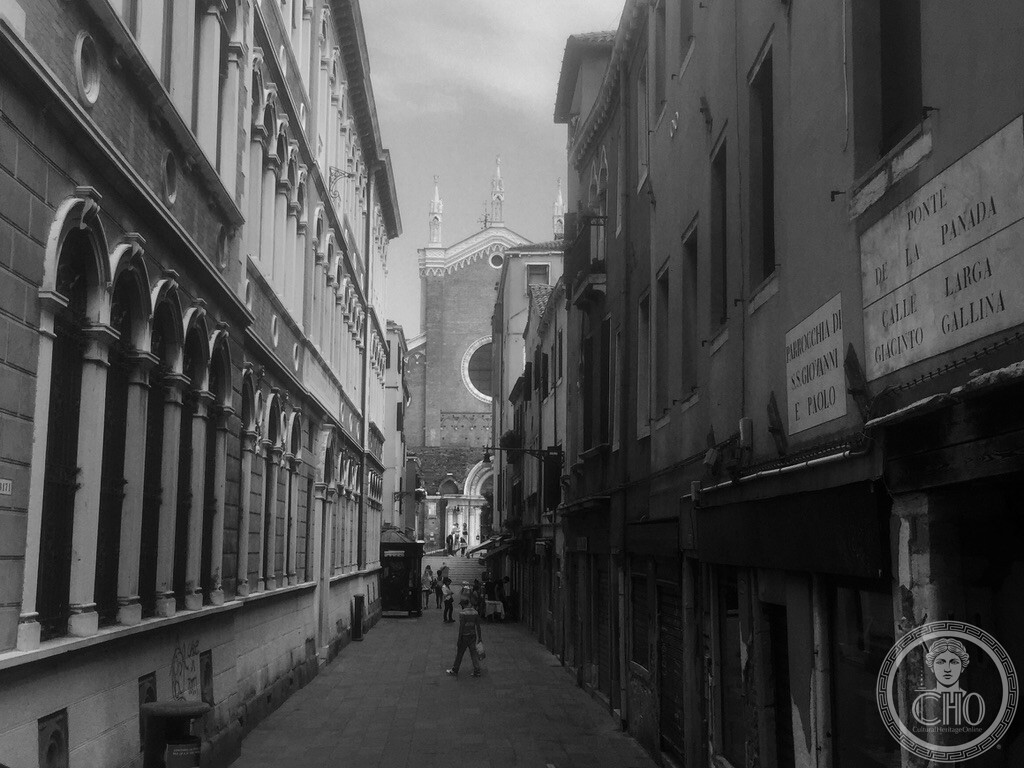
Photographs contributed by a Cultural Heritage Online member.
Find it on the map
See this place and what’s around it →Record researched and written by Carla Szathvary for Cultural Heritage Online, 2026.
📷 Become a Cultural Heritage Online photographer
Share your photos of places: they stay published under your name as the author. The more they're seen, the more you get noticed — and soon a contest will reward the most appreciated photos.
Log in or sign up free to add a photoIs this page about you?
This page is read by travellers and heritage enthusiasts who find it on Google. Tell us how you are connected to this place and we will take it from there.