

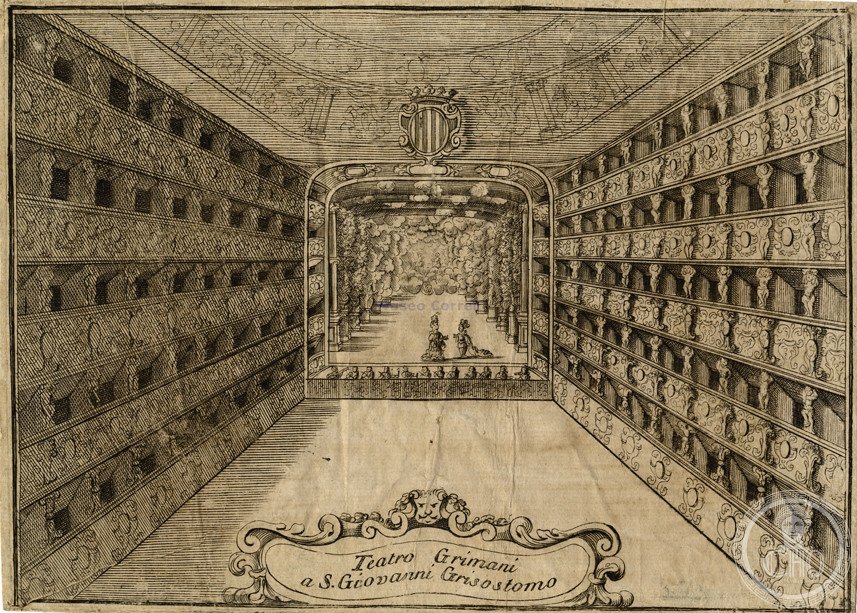
Built by the Grimani on the site of the Polo family houses, which burned in 1597, and opened during the carnival of 1678. It takes its name from a singer who refused her fee.
At a glance
- Opened
- Carnival 1678, as Teatro di San Giovanni Grisostomo
- Built for
- The Grimani family, their third theatre in Venice
- Architect
- Tommaso Bezzi, called lo Stucchino
- Renamed
- Emeronittio in 1834, Malibran in 1835
- The hall you see
- Rebuilt by Mario Felice Donghi in 1918, ceiling by Giuseppe Cherubini, 1919
- Today
- Owned by the Comune di Venezia, run by the Fondazione Teatro La Fenice
Overview
The theatre stands where the houses of the Polo family stood until fire destroyed them in 1597. The identification is worth stating carefully, because it is usually stated badly: it does not rest on the name of the nearby Corte del Milion, since a place name proves nothing. It rests on archival documents describing the layout of the Ca’ Polo, whose reliability was confirmed when the Soprintendenza archeologica excavated the site during the restoration of the 1990s and found the foundations of the thirteenth-century houses — with occupation levels of the tenth, eighth and sixth centuries beneath them.
It opened during the carnival of 1678 as the Teatro di San Giovanni Grisostomo, named for the parish, with Vespasiano, libretto by Giulio Cesare Corradi and music by Carlo Pallavicino. The architect was Tommaso Bezzi, known as lo Stucchino, who worked for the Grimani as designer, stage engineer and painter. It was the family’s third theatre, after San Giovanni e Paolo and San Samuele.
History
The Grimani sold in 1819 to Facchini and Gallo, and the house reopened with Rossini’s La gazza ladra. In 1834 Giovanni Gallo renovated it completely and renamed it Emeronittio, «open day and night», reopening in December with Donizetti’s L’elisir d’amore.
The name it carries now arrived the following year. Gallo engaged Maria García Malibran, the most celebrated singer of the day, who sang here on 8 April 1835 and — by the theatre’s own account — refused to be paid. Gallo renamed the house after her.
A radical restoration in 1890 gave it Egyptian-style decoration. The hall a visitor sees today, however, is neither eighteenth- nor nineteenth-century: in 1918 Mario Felice Donghi combined the traditional Italian horseshoe with deep galleries on two levels in front of the stage, and Giuseppe Cherubini decorated the ceiling in 1919.
The Comune di Venezia bought the theatre in 1992. The restoration, designed by the architect Antonio Foscari, was accelerated after the fire that destroyed La Fenice on 29 January 1996, and the Malibran reopened on 23 May 2001.
What you see
A horseshoe hall of about nine hundred seats, with the two deep galleries that Donghi added facing the stage, and Cherubini’s ceiling above. The entrance is on a small campiello behind the church of San Giovanni Grisostomo, in a quarter of narrow calli that gives no hint of the volume inside.
The Corte del Milion is a few steps away. It is worth walking through — not because it proves anything about Marco Polo, but because the medieval fabric around it is the oldest domestic architecture in this part of the city.
Practical information
- Address: Campiello del Teatro, Cannaregio 5873, 30131 Venezia
- There is no daytime tour of the Malibran. The guided visit and audioguide sold in Venice cover La Fenice only: the Malibran can be entered only with a ticket for a performance
- Box office: +39 041 272 2699, Monday to Friday 09:00–18:00
- Programme: published by the Fondazione Teatro La Fenice
Nearby
- Cicchetteria Al Pesce Rosso — Bar, 34 m away
- Church of Santa Maria dei Miracoli — Church, 105 m away
- Scuola Grande di San Marco — 121 m away
- Fondaco dei Tedeschi — 137 m away
Sources
- Fondazione Teatro La Fenice, history of the Malibran — teatrolafenice.it
- Insula SpA (Comune di Venezia), Quaderni Q16, Barbara Del Vicario, on the restoration and the archaeological excavation of the Ca’ Polo site
- Regione Veneto, culturaveneto.it, entry on the theatre (architect, name changes, 1835)
- La Biennale di Venezia, venue page for the Teatro Malibran
Find it on the map
See this place and what’s around it →Historical events at this place (2)
- 2021 Natale di Luce 2021
- 2021 VeneziaInDanza2021
📷 Become a Cultural Heritage Online photographer
Share your photos of places: they stay published under your name as the author. The more they're seen, the more you get noticed — and soon a contest will reward the most appreciated photos.
Log in or sign up free to add a photoIs this page about you?
This page is read by travellers and heritage enthusiasts who find it on Google. Tell us how you are connected to this place and we will take it from there.