
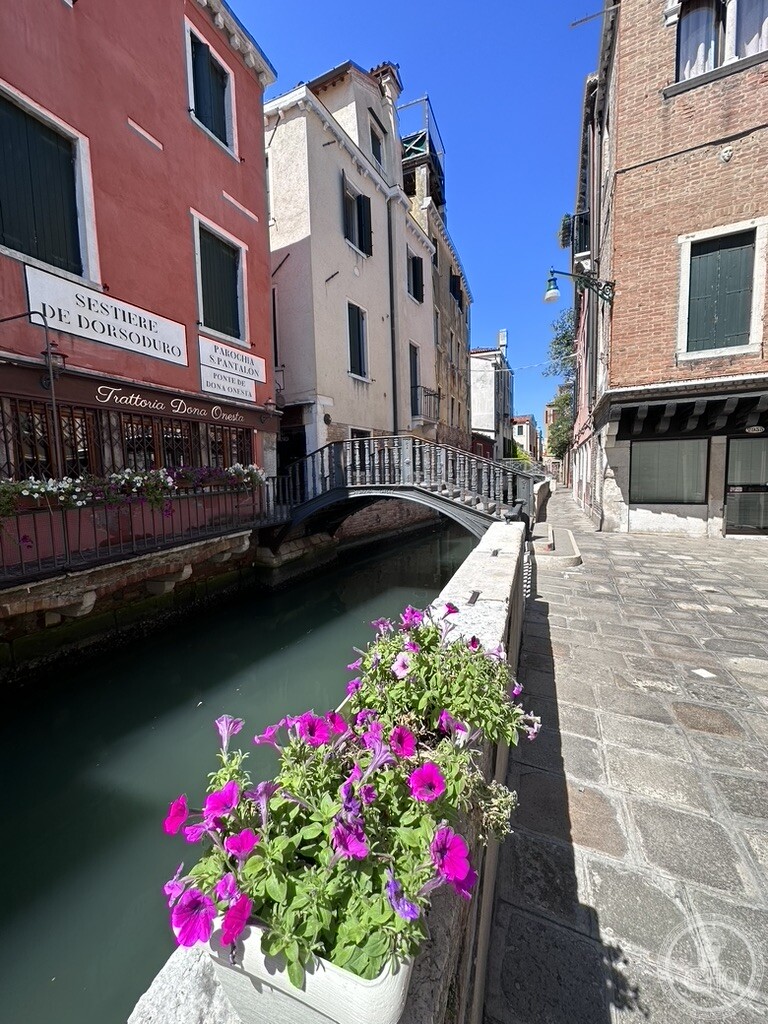
The bridge of the honest woman has been called that since at least 1537. Venice has produced three explanations for the name over the centuries, and the record supports none of them.
At a glance
A small bridge over the Rio de la Frescada, joining Dorsoduro to San Polo on a route that most people cross without stopping. Its name is old: a Venetian notification of 1537 already locates a house “at the bridge called of Donna Onesta”. What the name means has been argued about ever since, and the three standard answers — a joke, a suicide, a courtesan — are folklore rather than history. The bridge itself is younger than all of them. It was rebuilt in cast iron in 1871.
Key facts
- Crosses: the Rio de la Frescada, between the sestieri of Dorsoduro and San Polo
- Name first recorded: 1537, in a notification by Zuane Querini letting a house “ad potem vocatum di Donna Onesta”
- Present structure: cast iron, 1871, cast with the marks FONDERIA LAYET and VENEZIA 1871 on the flanks of the arch
- Parish: San Pantalon, on the Dorsoduro side, as the nizioleto on the corner records
- Legends attached to the name: three, none supported by any document
- GPS: 45.43583, 12.32643 · Open in Google Maps
History
Venetian street names were not assigned; they accumulated. A trade, a family, a shop sign or an incident stuck to a calle, and by the time anyone wrote it down the reason had usually been forgotten. The Dona Onesta is one of those names. The earliest known record is administrative and entirely flat: in 1537 sier Zuane Querini notified the authorities that he was letting a house in the district of San Tomà ad potem vocatum di Donna Onesta — at the bridge called of the honest woman. The name was already in ordinary use.
Three stories grew up to explain it. In the first, two men argue about whether any woman is faithful, and one of them points sarcastically at a small carved female head on a nearby wall: there, the only honest woman in Venice. In the second, a swordsmith’s wife is pursued by a patrician and kills herself with a dagger rather than live dishonoured. In the third, the honest woman is a courtesan — honest in the sense of fair dealing, which is how the word was often used of women in that trade.
Local historians have gone looking for evidence for all three and found none. The bridge kept the name regardless, through the fall of the Republic and into the Austrian and Italian city, and in 1871 the old structure was replaced with a cast-iron one from the Layet foundry, part of the wave of iron bridges that Venice installed in the second half of the nineteenth century.
What you see
A shallow iron arch with a plain balustrade, low enough that a boat has to duck, crossing a canal about five metres wide. On the far bank the buildings come straight out of the water; on the near bank a narrow fondamenta runs along the rio, wide enough for one person and a planter of petunias. The crossing takes six steps up and six down.
The interest is at the corner, where three nizioleti — the painted white panels Venice uses instead of street plates — are stacked one above the other on a red wall: SESTIERE DE DORSODURO, PAROCHIA S. FANTALON, PONTE DE DONA ONESTA. Sestiere, parish, bridge. It is the whole Venetian addressing system in one glance, and it is the reason the bridge is photographed far more often than its size would suggest. A trattoria on the ground floor has taken the name for itself.
Practical information
- A public bridge, crossable at any hour, free
- It is on the direct walking route between the Frari and Campo Santa Margherita
- The rio is narrow and the fondamenta is a single file: step aside for residents with trolleys
- Five minutes
Getting there
From the San Tomà vaporetto stop the walk is about four minutes, from the Frari about five. Campo Santa Margherita is seven minutes to the west.
Nearby
- The Basilica of Santa Maria Gloriosa dei Frari, five minutes north-east
- The Scuola Grande di San Rocco, six minutes north
- Campo Santa Margherita and the Scuola dei Varoteri, seven minutes west
Sources
- Conoscere Venezia, Ponte de la Dona Onesta sul Rio de la Frescada — conoscerevenezia.it: the position between Dorsoduro and San Polo, the 1537 notification by Zuane Querini naming the bridge, the three legends and the author’s explicit conclusion that history accepts none of them for lack of proof or document, and the cast-iron rebuilding of 1871 with the FONDERIA LAYET and VENEZIA 1871 marks
- The sestiere, parish and bridge names transcribed from the nizioleti visible in the photograph published here
- Coordinates taken from the photograph’s own GPS record and cross-checked against OpenStreetMap, which returns the Fondamenta del Forner on the Rio de la Frescada
Find it on the map
See this place and what’s around it →Record researched and written by Carla Szathvary for Cultural Heritage Online, 2026.
📷 Become a Cultural Heritage Online photographer
Share your photos of places: they stay published under your name as the author. The more they're seen, the more you get noticed — and soon a contest will reward the most appreciated photos.
Log in or sign up free to add a photo