
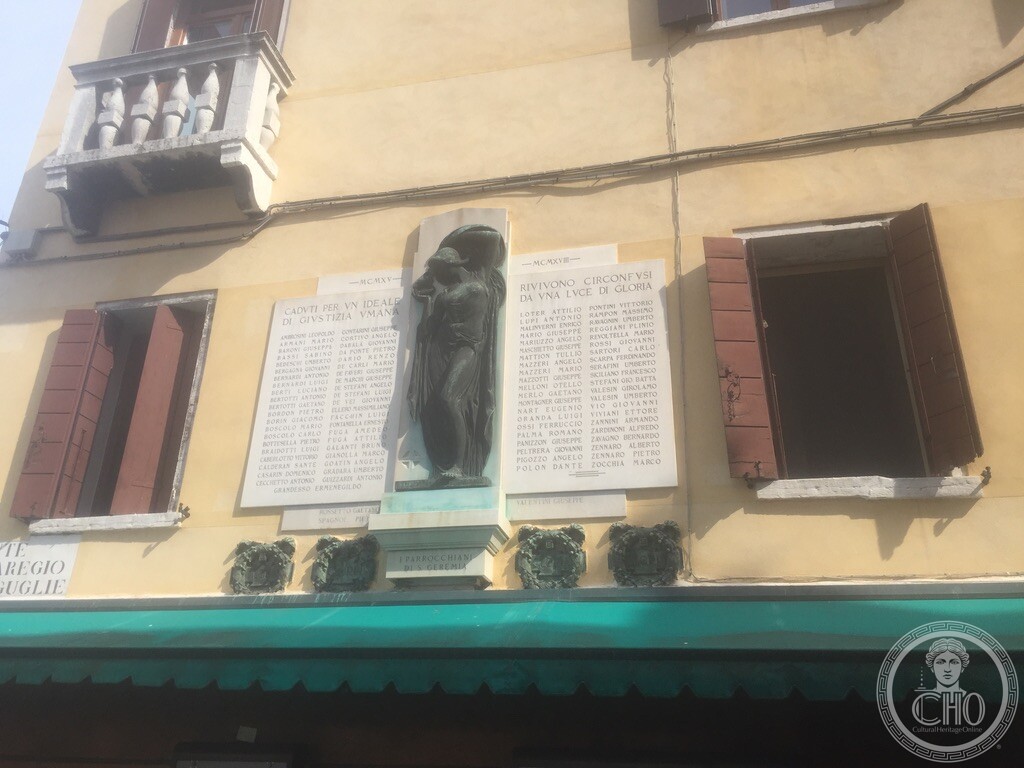
More than ninety names from one Venetian parish, set on the wall of an ordinary house beside the Ponte delle Guglie, where the crowd walking to the station passes underneath them every few seconds.
At a glance
Venice has no single monument to its First World War dead. It has dozens of parish ones, and this is among the largest. Put up in 1923 by the parishioners of San Geremia, it carries over ninety names in two columns of Istrian stone, with a bronze figure of the Patria between them and four bronze laurel wreaths below. It is not in a square or a cemetery. It is fixed to the front of a private house on the Salizada San Geremia, at the foot of the bridge, above a shop awning.
Key facts
- Erected: 1923, by the parishioners of San Geremia
- Materials: bronze for the central figure and the four wreaths, Istrian stone for the rest
- Signature: G.MO ROSSI, on the base of the bronze; recorded in the Pietre della Memoria census as the sculptor Gaetano Rossi
- Names: more than ninety, in two columns, with four added later beneath the base of the figure
- Dedication: I PARROCCHIANI DI S. GEREMIA
- Address: Cannaregio 326, Salizada San Geremia, at the foot of the Ponte delle Guglie
- GPS: 45.44370, 12.32526 · Open in Google Maps
History
Italy came out of the First World War with more than half a million dead and a decade of monument-building ahead of it. In Venice the work was done parish by parish. Each congregation raised its own money, chose its own sculptor and found its own wall, which is why the city’s memorials are scattered through the calli rather than gathered in one place, and why they differ so sharply in scale and tone. The San Geremia memorial went up in 1923, five years after the armistice, at the point where its parish meets the busiest walking route in Cannaregio.
The wording was chosen with care, and it is not triumphal. On the left tablet, above the first column of names: CADVTI PER VN IDEALE DI GIVSTIZIA VMANA — fallen for an ideal of human justice. On the right, above the second: RIVIVONO CIRCONFVSI DA VNA LVCE DI GLORIA — they live again, surrounded by a light of glory. The Roman dates MCMXV and MCMXVIII sit on either side of the figure’s head, marking Italy’s war rather than the war as a whole.
Four more names were added below the base after the monument was finished. The census of Italian war memorials kept by Pietre della Memoria records the addition without dating it — the common pattern for men who died of wounds or in captivity after the fighting stopped, or whose deaths were confirmed late.
What you see
The centre is a bronze relief of a woman in classical dress, standing in a narrow vertical panel. Her head is bowed and her eyes are closed. In her right hand she holds a votive lamp with its flame; her left arm is raised, holding the fabric of her cloak above her head, so that the whole figure reads as a mourner rather than a victory. She stands on a carved capital, and the dedication of the parishioners is cut into the base beneath her feet.
Either side, the two stone tablets are set flush into the plaster of the house, their names cut small and close in the Roman lettering that Italian memorials of the 1920s used almost without exception — V for U throughout. The four bronze wreaths run along the bottom in a line, just above a green shop awning. The memorial is at first-floor height, which means most people below never look up; the shutters of the flats open on either side of it.
Practical information
- Outdoors, on a public street, visible at any hour and free
- It is on the wall of a private house — the flats around it are lived in
- Best light in the morning, when the sun reaches the facade; the bronze reads badly against a bright afternoon sky
- Five minutes is enough, ten if you read the names
Getting there
From Venezia Santa Lucia station, walk east along the Rio Terà Lista di Spagna for about six minutes; the memorial is on the left just before the Ponte delle Guglie. The nearest vaporetto stops are Ferrovia and Guglie.
Nearby
- The church of Santi Geremia e Lucia, which holds the body of Saint Lucy, two minutes west
- The Ponte delle Guglie itself, and the entrance to the Ghetto, three minutes north-east
- Palazzo Labia, with Giambattista Tiepolo’s Antony and Cleopatra frescoes, on the same campo
Sources
- Pietre della Memoria, the Italian census of war memorials, record Lapide ai Caduti della parrocchia di San Geremia – Venezia — pietredellamemoria.it: the address at Cannaregio 326, the 1923 date, the bronze and Istrian stone, the signature G.MO ROSSI and the attribution to Gaetano Rossi, the description of the figure of the Patria with the votive lamp, the two columns of over ninety names and the four added later
- The inscriptions and the dedication to the parishioners of San Geremia transcribed from the photograph published here
- Coordinates cross-checked against OpenStreetMap Nominatim, which places the Ponte delle Guglie eighteen metres from the point recorded in the photograph
Find it on the map
See this place and what’s around it →Record researched and written by Carla Szathvary for Cultural Heritage Online, 2026.
📷 Become a Cultural Heritage Online photographer
Share your photos of places: they stay published under your name as the author. The more they're seen, the more you get noticed — and soon a contest will reward the most appreciated photos.
Log in or sign up free to add a photoIs this page about you?
This page is read by travellers and heritage enthusiasts who find it on Google. Tell us how you are connected to this place and we will take it from there.