
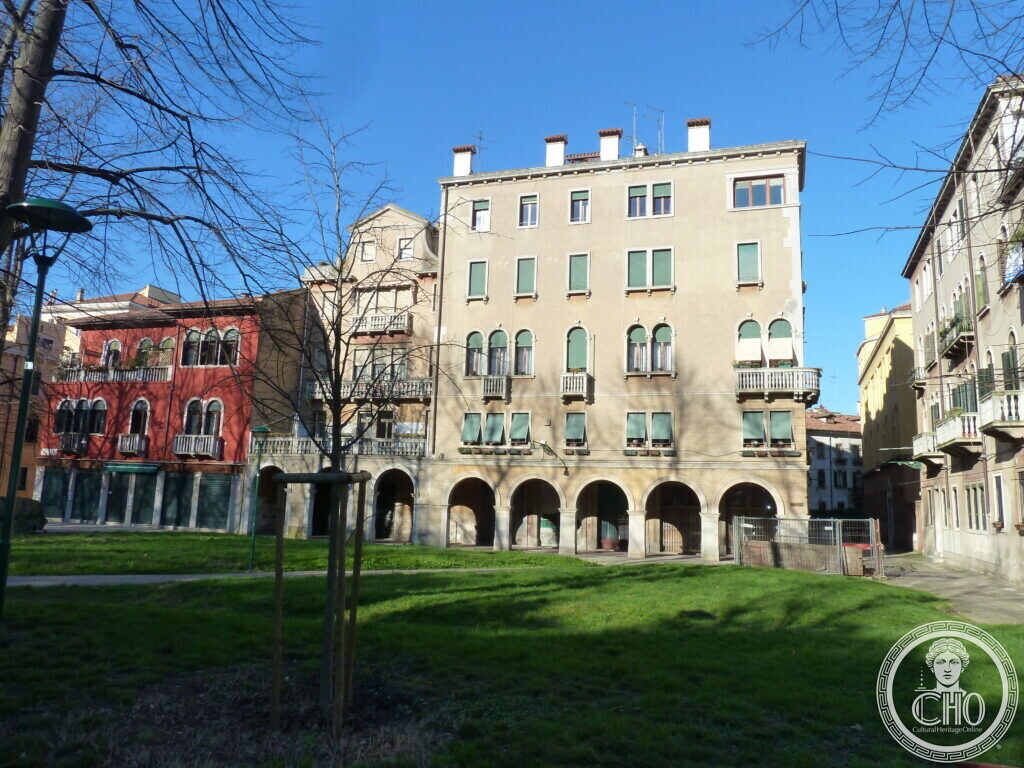
A curved, arcaded corner block on the garden park that gives Venice’s youngest quarter its edge — named for a wartime naval raid, not for any noble family.
At a glance
Ca’ Buccari stands where Calle Buccari meets the Parco delle Rimembranze, its ochre-yellow facade curving around the corner in a double tier of loggias above a ground-floor arcade. It is part of the wave of building that turned the reclaimed island of Sant’Elena into a planned residential quarter through the 1920s, under the overall direction of architect Duilio Torres and, on this building, his brother and regular collaborator Giuseppe Torres.
Key facts
- Built: 1926
- Architects: Duilio Torres, with his brother Giuseppe Torres
- Location: corner of Calle Buccari and the Parco delle Rimembranze, Sant’Elena, Venice
- Street name: Calle Buccari commemorates the Beffa di Buccari, an Italian naval raid on the Austro-Hungarian base at Buccari (Bakar) in February 1918 — one of several Sant’Elena streets named for episodes of the First World War
- GPS: 45.42618, 12.36225 · Open in Google Maps
History
Sant’Elena was, until the early twentieth century, little more than a monastery island and a stretch of reclaimed marsh at the eastern tip of Venice. In 1911 the city commissioned Duilio Torres to lead the design of a new residential quarter here — at first named for Vittorio Emanuele III — laid out with wide streets and garden parks unlike anything in the historic centre. Building continued through the 1920s in phases, much of it, like Ca’ Buccari, designed by Torres with his brother Giuseppe as a close collaborator.
The street names the quarter chose tell their own story: rather than saints or noble families, Sant’Elena named its calli after the naval and military actions of the war just fought — Buccari among them, the daring raid led by Gabriele D’Annunzio and the Italian navy on the Austro-Hungarian fleet sheltering at Buccari (today Bakar, in Croatia) in February 1918. Ca’ Buccari, with its curved arcaded corner facing the park, takes its name from the calle it stands on rather than from any family that lived there.
Sources
- Duilio Torres, Wikipedia — en.wikipedia.org: his 1911 commission from the City of Venice to design the Sant’Elena masterplan
- Comune di Venezia, urban planning archive (Fascicolo A) — comune.venezia.it: the naming of Sant’Elena’s streets after First World War episodes, including the Beffa di Buccari
- Vigolo, Stefano, contributed research on the building’s date and attribution — verified only in part against the sources above; treat the exact 1926 construction date as reported, not independently confirmed against an archival source
- Coordinates cross-checked against OpenStreetMap Nominatim for Calle Buccari, Sant’Elena
Find it on the map
See this place and what’s around it →Record researched and written by Carla Szathvary for Cultural Heritage Online, 2026.
📷 Become a Cultural Heritage Online photographer
Share your photos of places: they stay published under your name as the author. The more they're seen, the more you get noticed — and soon a contest will reward the most appreciated photos.
Log in or sign up free to add a photoIs this page about you?
This page is read by travellers and heritage enthusiasts who find it on Google. Tell us how you are connected to this place and we will take it from there.