
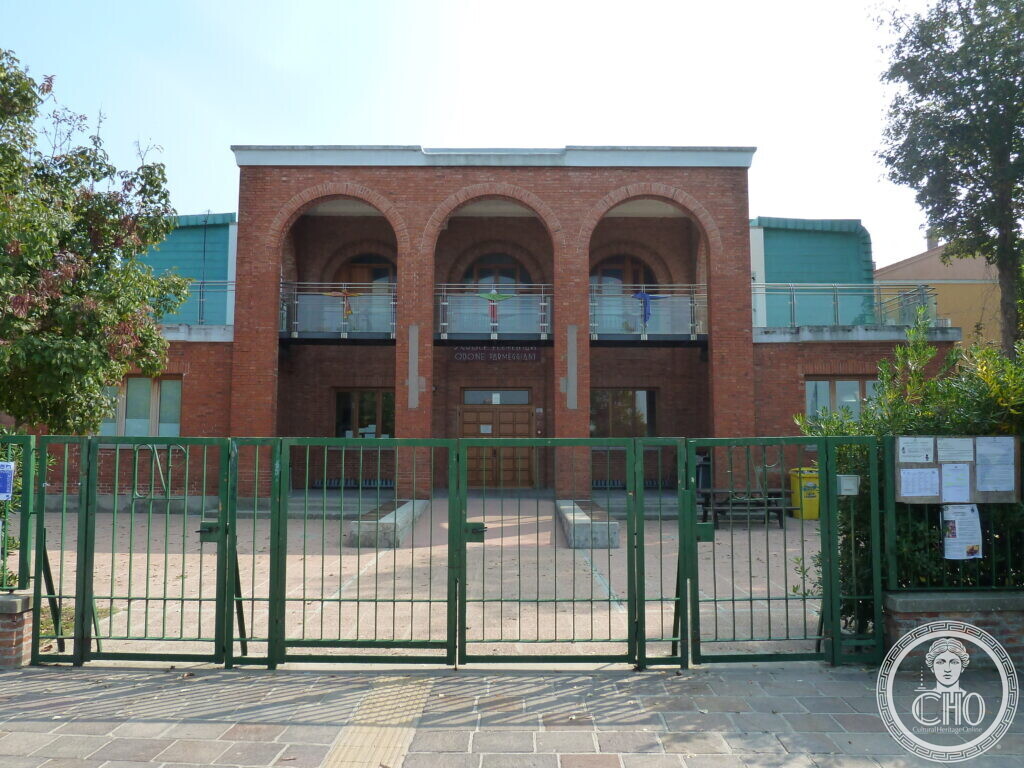
A brick building with a triple arch on the front, opened in 1934 as a training hall for Fascist Italy’s boys’ youth organisation. It has been an elementary school for longer than it was ever anything else.
At a glance
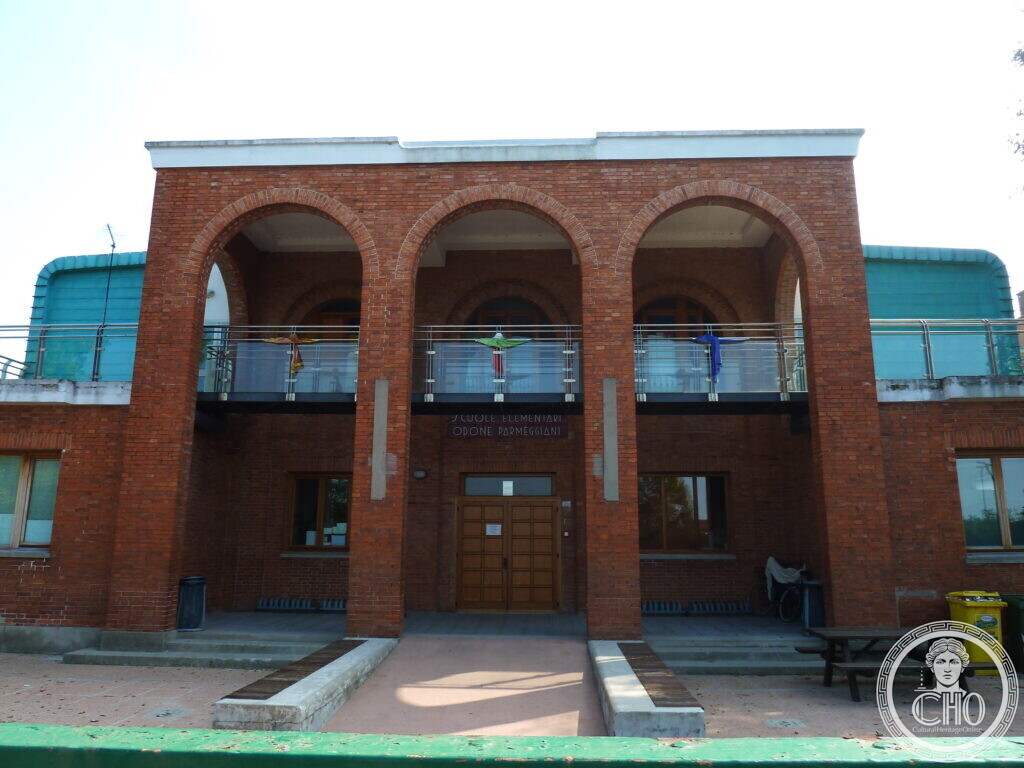
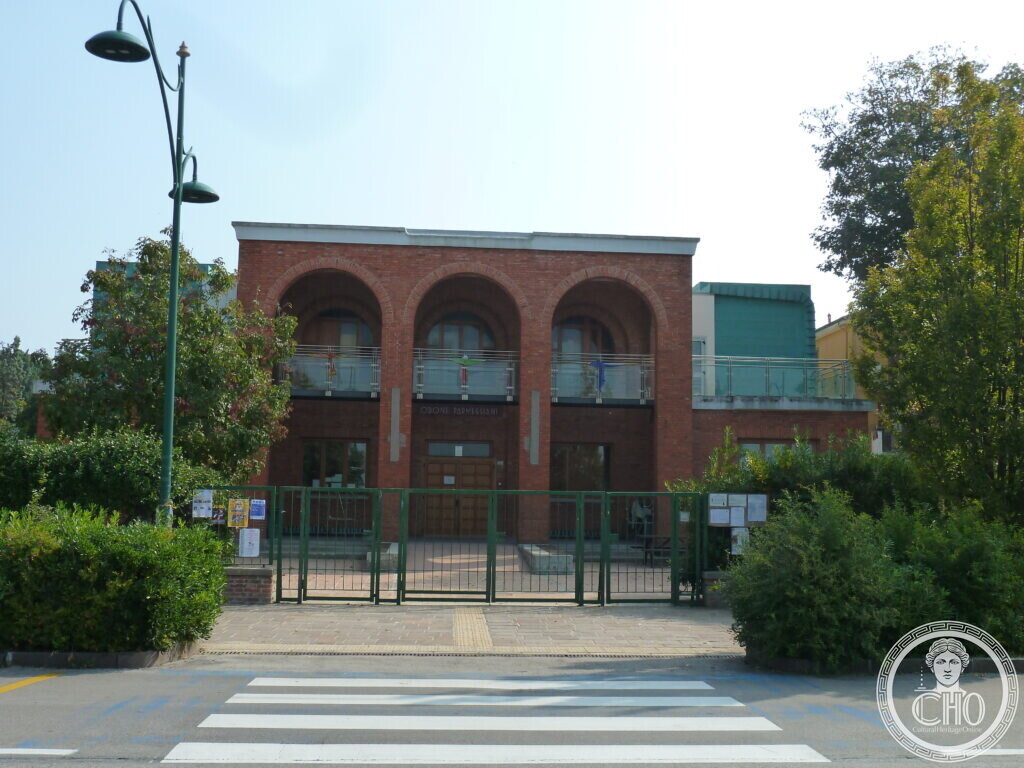
On a residential street of the Lido stands a two-storey brick building with a loggia of three round arches across the front, and a balcony running the width of the upper floor behind a modern glass rail. A stone plaque under the arches reads SCUOLE ELEMENTARI ODONE PARMEGGIANI. It opened as a Casa del Balilla — a training hall for the boys’ section of the Fascist youth movement — on 13 May 1934, with a government minister present. It has been a primary school for far longer than it was ever a Casa del Balilla.
Key facts
- Where: a residential street on the Lido di Venezia
- Opened: 13 May 1934, as a Casa del Balilla
- Today: the Odone Parmeggiani primary school
- The front: a triple-arched brick loggia, with a balcony above it
- Attributed by the contributor to: the architects Francesco Mansutti and Gino Miozzo — see the note below
A hall for the Balilla
The Casa del Balilla was the local branch of the Opera Nazionale Balilla, the state organisation that trained Italian boys in gymnastics, drill and Fascist doctrine outside school hours. Newsreel footage from the Istituto Luce archive records the opening of this one on 13 May 1934, with young avanguardisti and balilla marching past in review, sailors’ cadets on parade, and a separate reel showing boys swimming in the building’s pool. The minister of national education, Francesco Ercole, attended the ceremony; he held that post from July 1932 to January 1935, which fits the date.
After the war the building was given over entirely to primary schooling and took the name it carries today, Odone Parmeggiani. The one biographical trace we have found of Parmeggiani himself is a single line in the Italian Wikipedia article on the scientist and university rector Oddone Longo (1938–2018): Longo, it says, was named after his maternal grandfather Odone Parmeggiani, “to whom an elementary school on the Lido di Venezia is still named today.” Beyond that we have not been able to find who Parmeggiani was, what he did, or when the school took his name.
What you see
The front is built entirely of exposed brick, with three round arches carried on brick piers forming an open loggia at ground level. Above it runs a continuous balcony behind a steel-and-glass railing, clearly a later replacement of whatever balustrade was there originally. The name of the school is set in raised lettering on a stone band between the arches and the balcony. Two shallow stone pilasters flank the entrance doors, which are modern timber. The building is otherwise plain, with round-headed windows repeating the arch motif of the loggia at both ends of the front.
Do you know more?
Our contributor names Francesco Mansutti and Gino Miozzo as the architects. Both men were real, active architects of the period — but every list of their work we could find, including the archival inventory of their joint studio, covers projects in Padua, Bolzano, Ferrara and elsewhere and does not mention a building on the Lido di Venezia. We have not been able to confirm the attribution, and have not been able to find an alternative name either. We have also not found who Odone Parmeggiani was, beyond the one line above. If you know the source for the architects’ names, or anything about Parmeggiani, write to Sofia, who looks after these pages.
Write to Sofiaor send a message on WhatsApp
Please start your message with the title of this page, so it reaches the right file. Every contribution is checked against independent sources before it goes on the page, and we always say where a piece of information came from.
Getting there
The building is on a residential street of the Lido, a working primary school and seen from the pavement outside.
Sources
- Istituto Luce historical archive, newsreel footage of the opening of the Casa del Balilla on the Lido di Venezia, 13 May 1934, with Minister Francesco Ercole present.
- Camera dei Deputati, historical portal, and Treccani, Dizionario Biografico — on Francesco Ercole’s term as Minister of National Education, July 1932 to January 1935.
- Wikipedia, “Oddone Longo” — the one sentence identifying Odone Parmeggiani as Longo’s maternal grandfather.
- SIUSA, the Italian state archives’ inventory of the Mansutti–Miozzo studio, and other published lists of their work — consulted, and found not to mention this building.
- Stefano Vigolo, who photographed the building and supplied the names of the architects.
Gallery
Photographs by Stefano Vigolo, 2014.
Find it on the map
See this place and what’s around it →Record researched and written by Stefano Vigolo for Cultural Heritage Online, 2026.
📷 Become a Cultural Heritage Online photographer
Share your photos of places: they stay published under your name as the author. The more they're seen, the more you get noticed — and soon a contest will reward the most appreciated photos.
Log in or sign up free to add a photo