
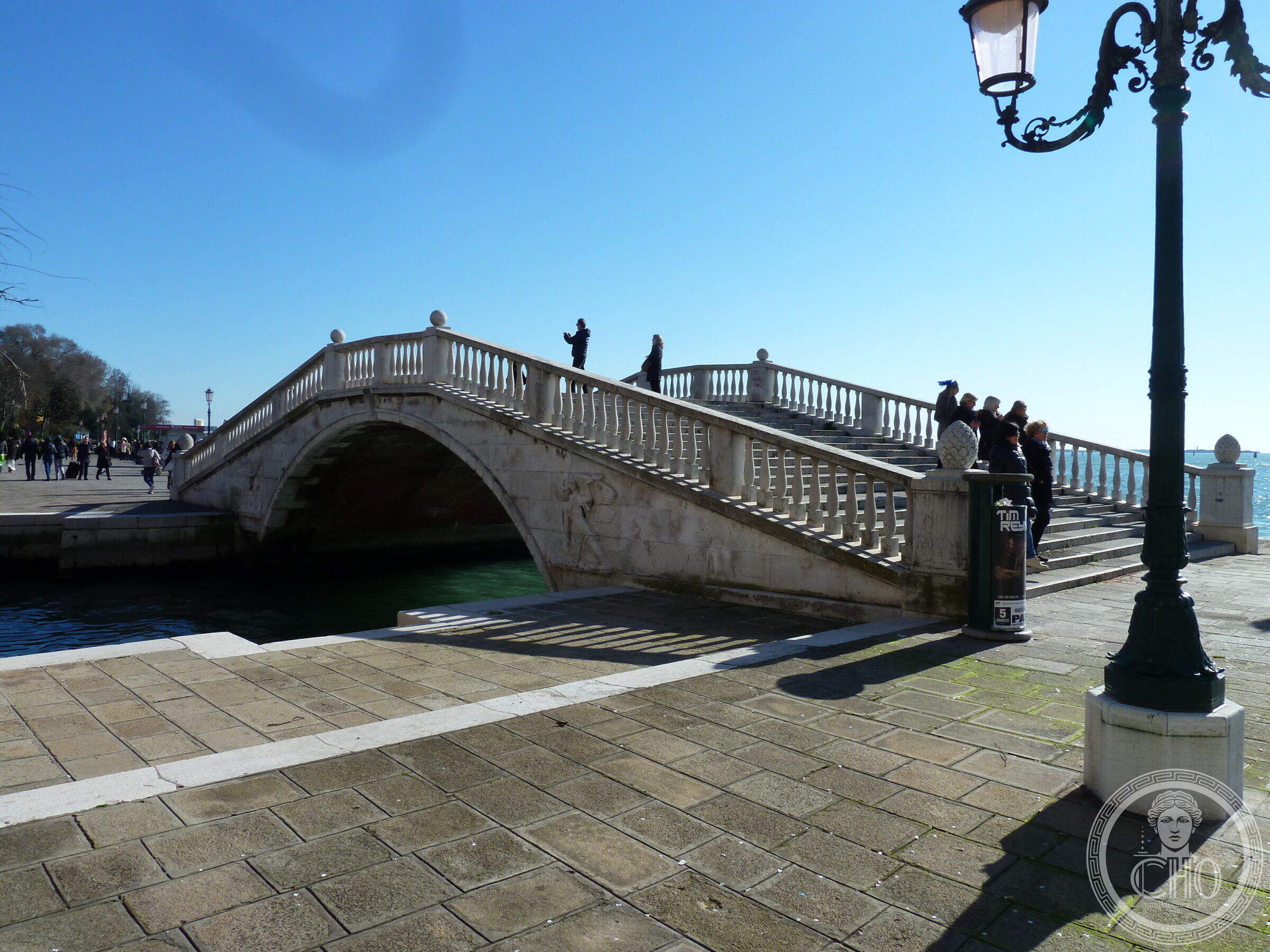
Turner drew this crossing in 1840. Duilio Torres rebuilt it for the new waterfront of the 1930s, with two winged Victories on its flanks. At its foot, on 3 August 1944, seven prisoners were shot.
At a glance
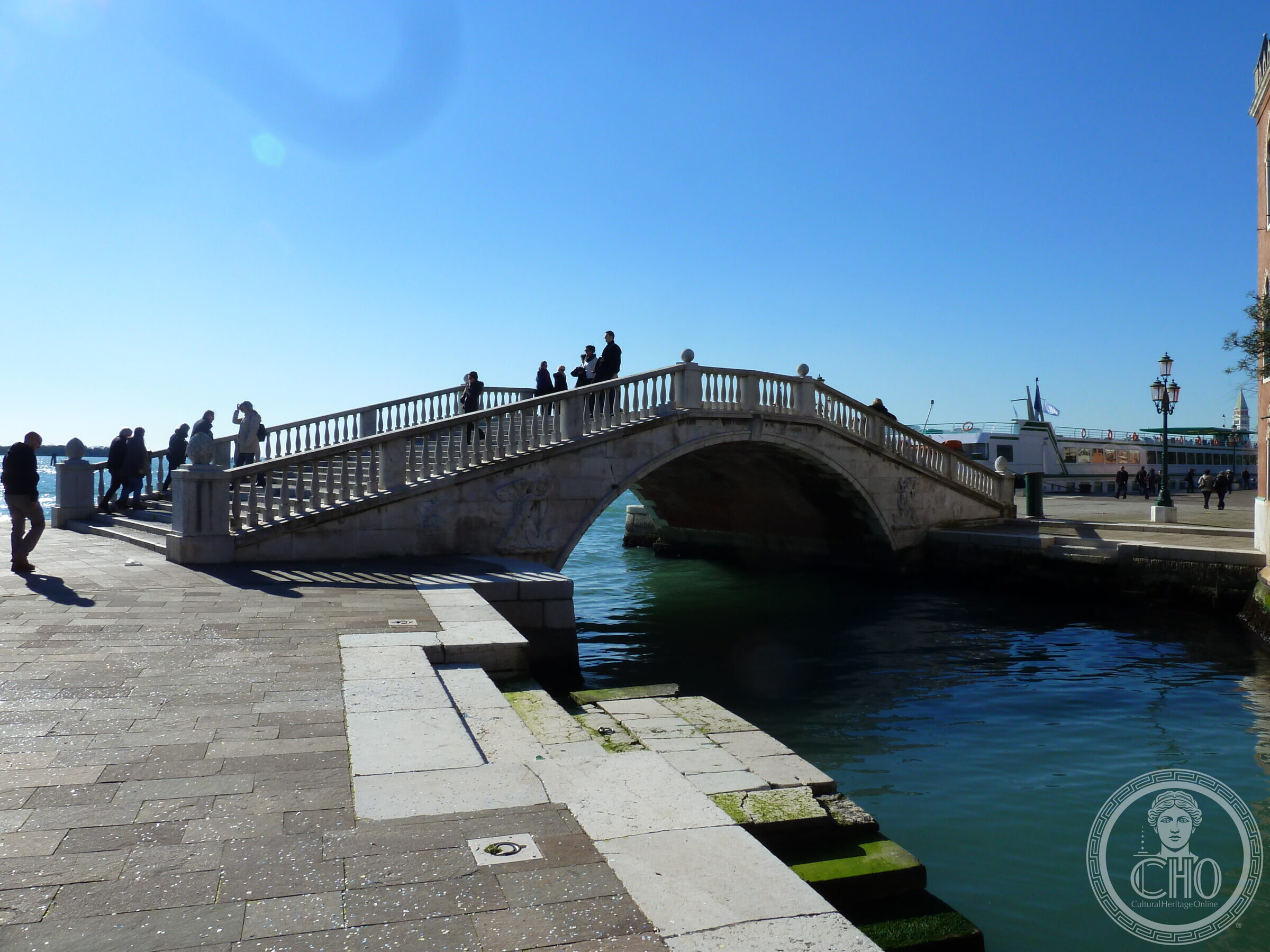
The Ponte de la Veneta Marina crosses the Rio de la Tana at the point where the Riva San Biagio ends and the Riva dei Sette Martiri begins. There has been a bridge here for centuries — a wooden one that opened in the middle to let boats out of the Arsenal, held up by chains, which is why Venetians also call it the Ponte de le Cadene. The one you walk over now is stone, and belongs to the great rebuilding of this waterfront in the 1930s.
Key facts
- It spans: the Rio de la Tana, joining Riva San Biagio to Riva dei Sette Martiri, Castello
- Architect of the present bridge: Duilio Torres, within the Riva dell’Impero works of 1936–38
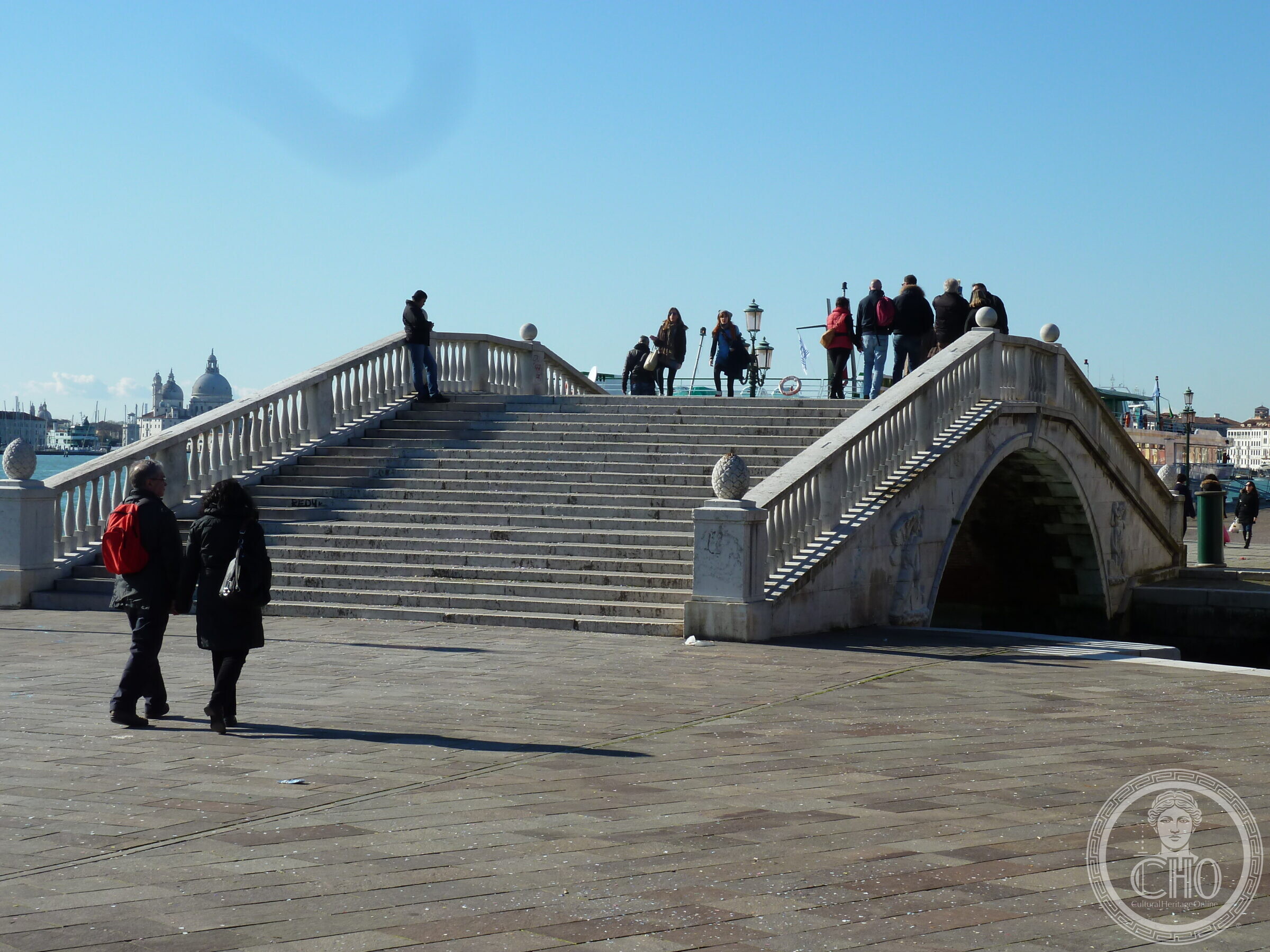
- Structure: brick and Istrian stone, one arch; thirty steps, fifteen each side; about 8.4 metres wide at the crown
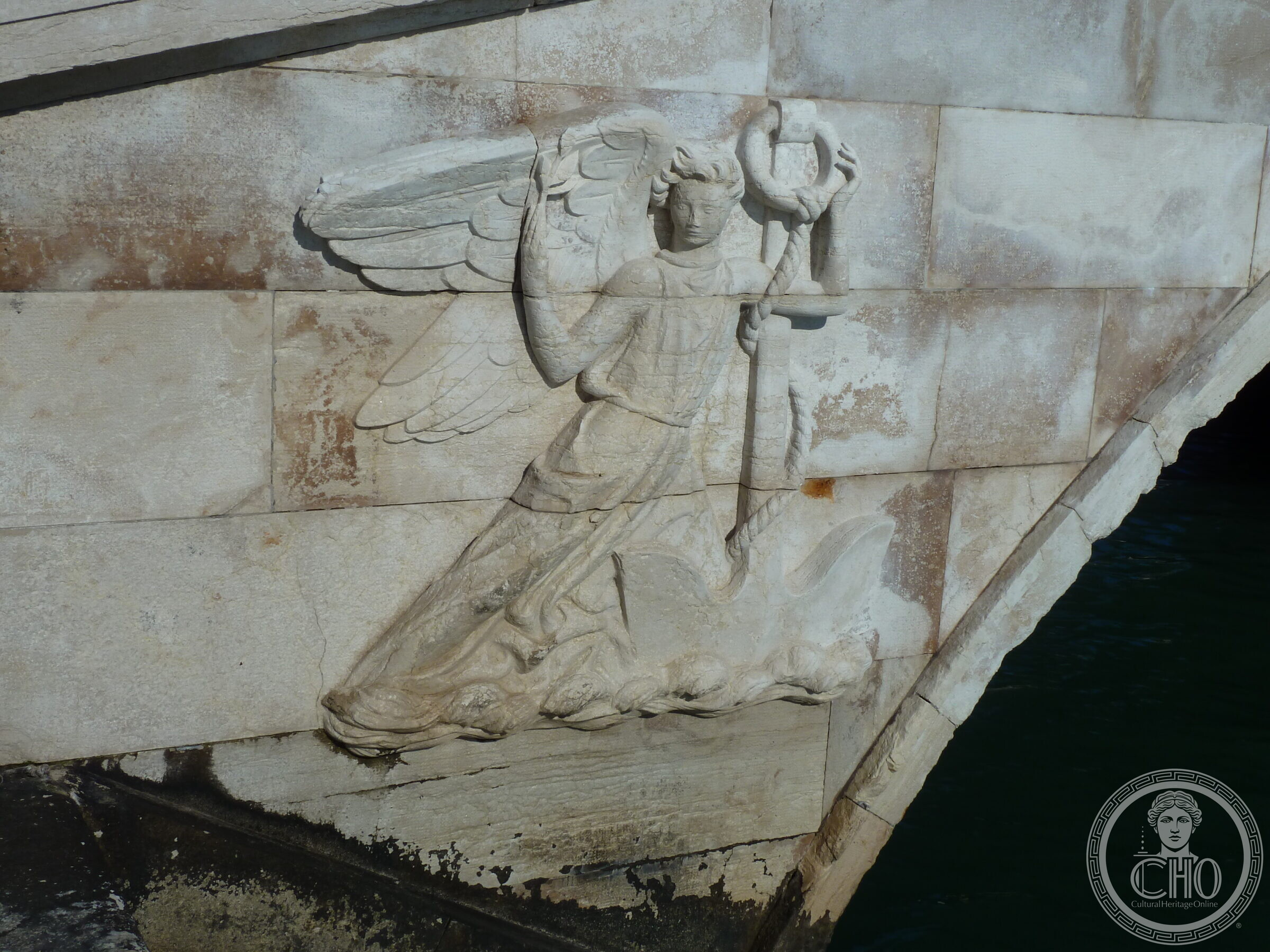
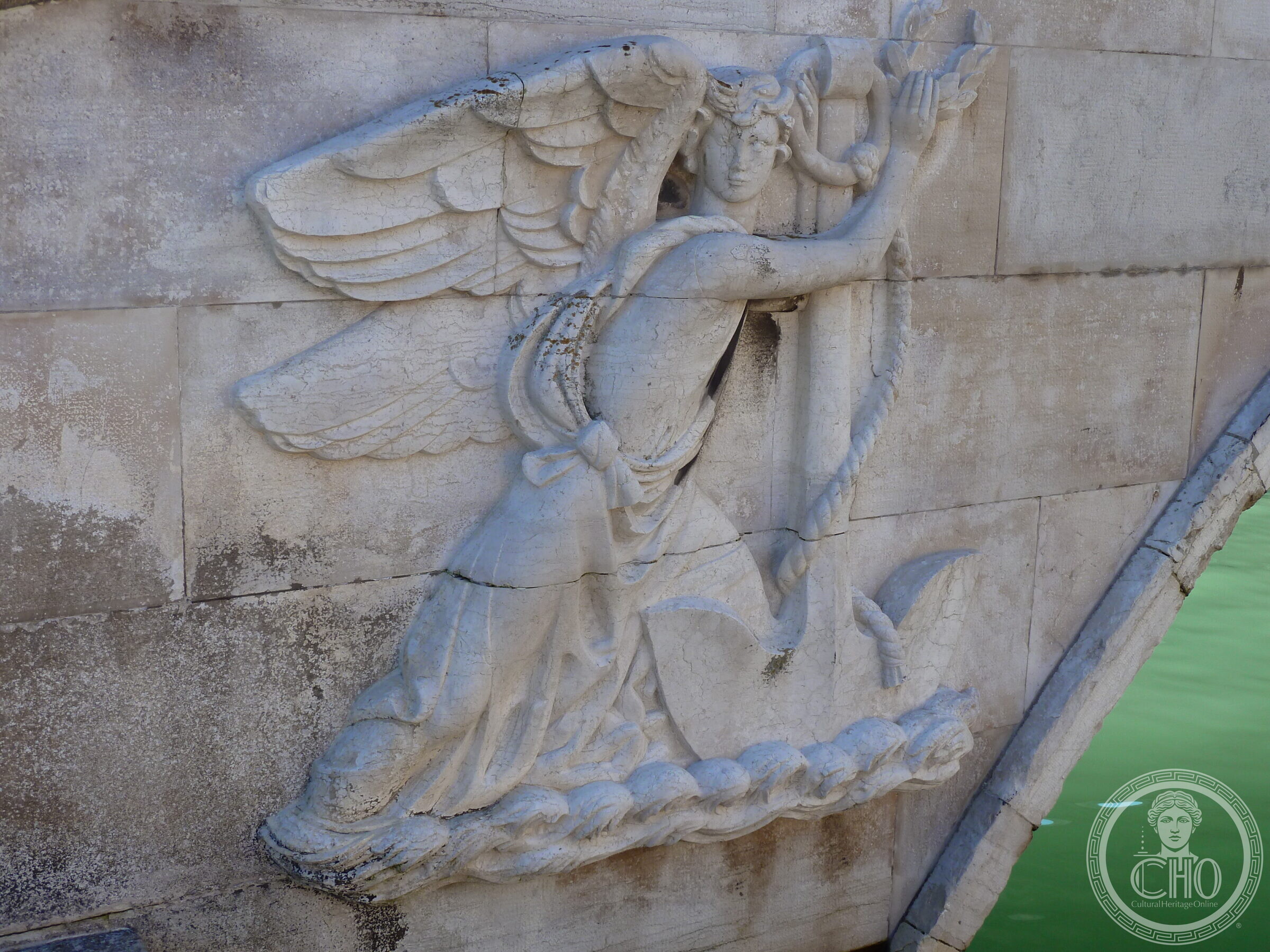
- Sculpture: two winged Victories in low relief on the spandrels, standing on stylised waves. No sculptor is named in the sources we consulted
- Earlier bridges: wooden and opening in the middle; it fell on 8 December 1720, killing four people; rebuilt in 1871
- Other name: Ponte de le Cadene, or de le Catene, from the chains that held it on both sides
- Painted by: J. M. W. Turner, 1840, in the Turner Bequest at Tate
History
Giuseppe Tassini, who spent his life tracing where Venetian street names come from, gives two explanations for this one: the sign of a nearby café, or the boats of the Veneta Marina that came out of the Arsenal here when the wooden bridge was raised in the middle. The chains that held the two halves are drawn in a book printed in Venice in 1686, G. Matteo Alberti’s account of the regatta and the festivities held for the Duke of Brunswick. On Sunday 8 December 1720 the bridge gave way under the crowd walking towards Castello and four people died. It was rebuilt in 1871, Tassini says, in a form more convenient and more decorous.
Turner came this way in 1840 and drew the bridge from the water, from the canale di San Marco, looking into the mouth of the Rio de la Tana. The sheet is in the Turner Bequest at Tate.
The bridge standing today belongs to the 1930s. When the city cleared the boatyards along this shore and built the 850-metre quay it called the Riva dell’Impero — begun in 1933, inaugurated 23 March 1937 — Duilio Torres designed the crossing at its head. The Dizionario Biografico degli Italiani lists the work as the arrangement of the riva dell’Impero with its bridge, 1936–38.
On the morning of 3 August 1944 the German command in Venice took seven political prisoners out of the Santa Maria Maggiore jail in reprisal for a missing soldier — who was later found to have fallen drunk into the water and drowned. The seven were tied to one another between the first two lampposts of the riva, at the foot of this bridge, and shot. Over five hundred people from the neighbourhood had been rounded up and made to watch. The bodies were left where they fell for several days, under guard, as a warning. After the war the city renamed the waterfront after them: Aliprando Armellini, Gino Conti, Bruno De Gasperi, Alfredo and Luciano Gelmi, Girolamo Guasto, Alfredo Vivian.
What you see
A single wide arch in Istrian stone, with a flight of shallow steps on each side — thirty in all — and a parapet of turned balusters ending in stone finials. It is a broad bridge, more than eight metres across at the top: built for crowds, not for a calle. From the eastern side, looking back over it, the dome of the Salute closes the view; from the western side you see the campanile of San Marco.
On each spandrel, flanking the arch, a winged Victory is carved in low relief: one holds a staff with a wreath at its head, the other a staff and a streaming ribbon, and both stand on stylised waves. The stone has cracked across the drapery and lost material at the wing tips. They are worth looking at closely, and nobody we could find has written down who carved them.
See the place
Do you know more?
On this page we have published what can be seen and what we were able to verify. About the two winged Victories carved on the flanks of this bridge we could not find a reliable source: no sculptor is named in the works we consulted. If you know something — a name, a date, a document, an old photograph, a book that mentions them — write to Sofia, who looks after these pages.
Write to Sofia or send a message on WhatsApp
Please start your message with the title of this page, so it reaches the right file. Every contribution is checked against independent sources before it goes on the page, and we always say where a piece of information came from.
Practical information
- A public crossing, open at all hours, in the open air on the lagoon front.
- Thirty steps, fifteen on each side, and no ramp: this is the bridge that decides whether a walk along this waterfront is possible for someone who cannot manage stairs.
- The reliefs are best seen from the fondamenta at water level, not from the bridge.
Getting there
Fifteen minutes on foot east from Piazza San Marco along the Riva degli Schiavoni and the rive that follow it; the Arsenale and Giardini vaporetto stops are either side of it.
Nearby
- Ponte San Biasio delle Catene, the next bridge west, by the same architect and of the same campaign.
- Ponte de l’Arsenal o del Paradiso, the wooden bridge at the Arsenal gate.
- The Santa Maria Maggiore prison, at the other end of the city, from which the seven were taken.
- The Venice Arsenal, whose boats once passed under the opening bridge.
Sources
- Conoscere Venezia, Ponte de la Veneta Marina o de le Cadene, sul Rio de la Tana — Duilio Torres as architect, the materials, and Tassini’s account of the names, the chains in Alberti’s book of 1686, the collapse of 8 December 1720 and the rebuilding of 1871.
- Giuseppe Tassini, Curiosità veneziane, ovvero Origini delle denominazioni stradali di Venezia, Venice, Tipografia Grimaldo, 1872 — cited there.
- Treccani, Dizionario Biografico degli Italiani, s.v. Duilio Torres — the arrangement of the riva dell’Impero with its bridge, 1936–38.
- Italian Wikipedia, Riva dei Sette Martiri — the construction of the quay from 1933 and its inauguration on 23 March 1937, its length, the bridge at its head, and the reprisal of 3 August 1944 with the names and ages of the seven, citing the Comune di Venezia.
- Tate, The Ponte della Veneta Marina at the Entrance to the Rio della Tana, Venice, from the Canale di San Marco, J. M. W. Turner, 1840, Turner Bequest.
- Venipedia / cityknowledge bridge survey — thirty steps and the width at the crown.
- OpenStreetMap — coordinates.
Gallery
Photographs by Stefano Vigolo, 2014.
Find it on the map
See this place and what’s around it →Record researched and written by Stefano Vigolo for Cultural Heritage Online, 2026.
📷 Become a Cultural Heritage Online photographer
Share your photos of places: they stay published under your name as the author. The more they're seen, the more you get noticed — and soon a contest will reward the most appreciated photos.
Log in or sign up free to add a photo