

German troops plundered it in 1944 to punish the politics of the man who owned it. Fifty-five years later it was on the list of the hundred most endangered sites in the world. Today people come here to learn how to save buildings like it.
At a glance
Bánffy Castle stands at Bonțida, a village near Cluj-Napoca in Transylvania. Its building phases run from the Renaissance through the Baroque, the Neoclassical and the Neogothic, and the estate has belonged to the Hungarian Bánffy family since the fourteenth century; the present owner is Katalin Bánffy. Since 2001 it has housed the Built Heritage Conservation Training Centre of the Transylvania Trust, where restoration is taught on the ruin itself.
Key facts
- What it is: a castle of the Bánffy family, under restoration, and a training centre in built heritage conservation
- The estate: granted in 1387 by Sigismund of Luxembourg to Dénes, son of Tamás Losonci, ancestor of the Bánffy of Losonc
- Fortified: 1668–1674 by Dénes Bánffy II, with curtain walls, corner towers and a seven-storey gatehouse
- Rebuilt in Baroque: from 1747 by Dénes Bánffy IV, with a U-shaped cour d’honneur added 1747–1751
- 1944: used as a field hospital, then plundered and devastated by German troops in reprisal against Count Miklós Bánffy
- 1999: placed on the World Monuments Watch list of the hundred most endangered sites
- 2008: Europa Nostra prize to the training centre, for education, training and awareness-raising
History
The Bonțida estate came to the Bánffy of Losonc family in 1387, by a grant from Sigismund of Luxembourg. A manor house of the fifteenth and sixteenth centuries preceded the castle. After 1640 the property passed to Dénes Bánffy II (1638–1674), governor of Doboka and Kolozs counties and counsellor to Prince Michael I Apafi, who between 1668 and 1674 enclosed the building in curtain walls with massive round towers at the corners, entered through a gatehouse seven storeys high on the eastern side. His successor György Bánffy III carried the work on. The Renaissance ensemble was caught in Rákóczi’s war of independence between 1704 and 1711 and needed repair.
In the eighteenth century Dénes Bánffy IV, home in 1747 after a period at Maria Theresa’s court in Vienna, began rebuilding in Austrian Baroque. Between 1747 and 1751 a U-shaped cour d’honneur went up on the eastern side, holding the riding school, the stables, the carriage rooms and the servants’ quarters.
The twentieth century nearly finished it. In 1944 the castle served as a field hospital and was then plundered and devastated by German troops, in reprisal for the political stand of Count Miklós Bánffy. Under communism it was a driving school, a cooperative farm and a children’s hospital, and a fire during a film shoot in 1963 did further damage. In 1999 it was put on the World Monuments Watch list of the hundred most endangered sites.
The Transylvania Trust took it on that same year, signed a long-term lease with the authorities in 2003 — resigned to Katalin Bánffy in 2008 — and from 2001 ran its Built Heritage Conservation Training Programme here. In 2008 the centre received the Europa Nostra prize for education, training and awareness-raising.
What you see
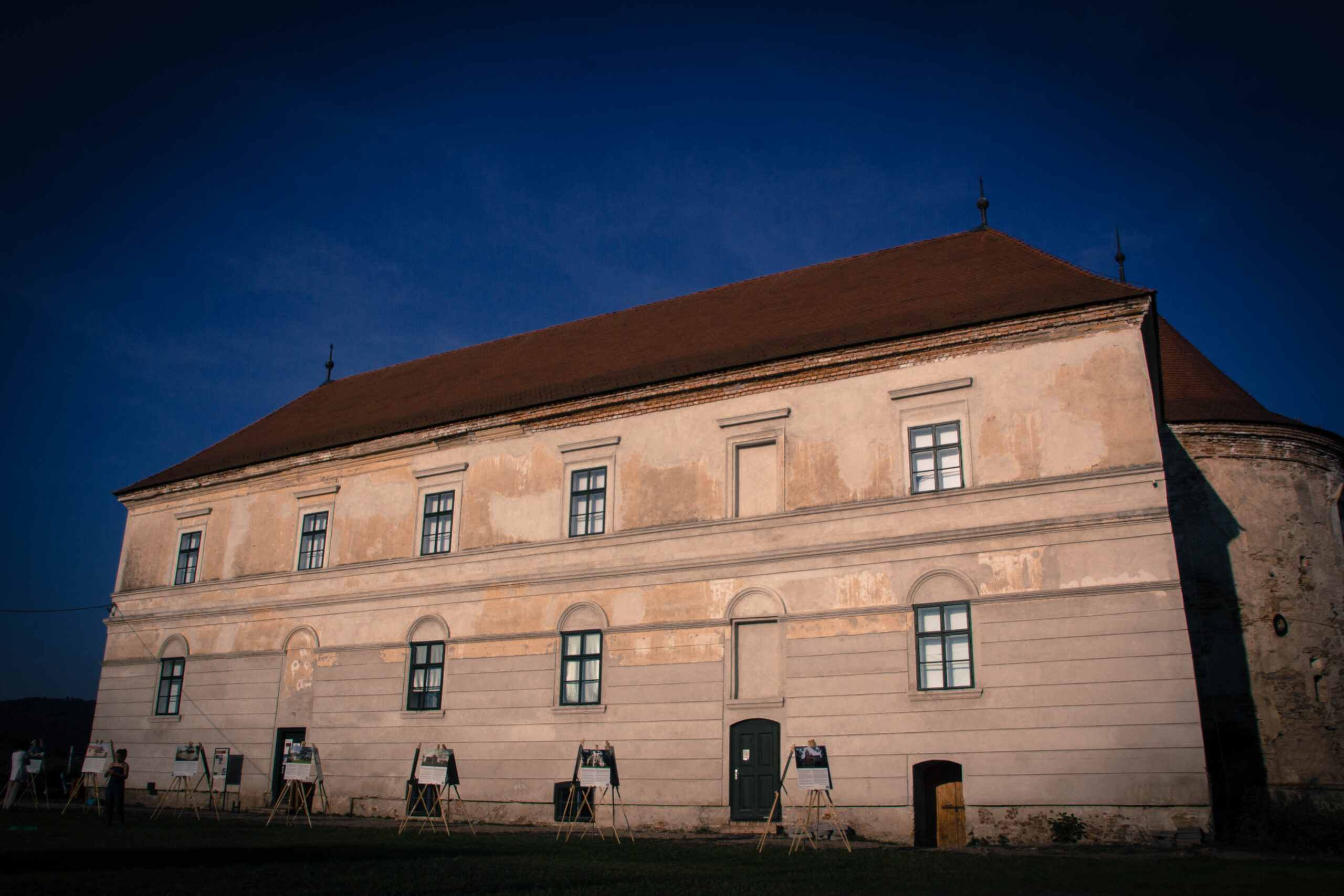
A long two-storey range under a tiled roof, rendered in pale plaster with the window surrounds and the string courses picked out, and a round tower at one end — the corner of the seventeenth-century enclosure. Repair is visible everywhere: this is a building being put back together, not one that has been finished.
That is the interest of the place. The restoration is the curriculum: students work on the fabric, and what they do stays up.
Practical information
- The castle is open to visitors and hosts events; the Electric Castle music festival has been held on the domain each year since 2013.
- The Transylvania Trust’s conservation programmes are taught on site; applications are handled by the Trust.
- Check current opening hours before travelling: work on the buildings continues.
Getting there
Bonțida is about thirty kilometres north-east of Cluj-Napoca, on the road towards Dej; the village has its own railway station.
Nearby
- The Art Museum of Cluj-Napoca, in the Bánffy Palace in the city.
- Cluj-Napoca, the capital of Transylvania, half an hour away.
- The Someș valley, north-east towards Dej.
Sources
- English Wikipedia, Bonțida Bánffy Castle — the grant of 1387, the fortification of 1668–1674 by Dénes Bánffy II and the seven-storey gatehouse, the Baroque rebuilding from 1747 and the cour d’honneur of 1747–1751, the field hospital and the plundering of 1944, the uses under communism and the fire of 1963, the World Monuments Watch listing of 1999, the Transylvania Trust’s lease of 2003, the training programme from 2001 and the Europa Nostra prize of 2008.
- English Wikipedia, Electric Castle — the festival held on the Bánffy domain at Bonțida since 2013.
- Wikidata (Q843132) and OpenStreetMap — coordinates.
Find it on the map
See this place and what’s around it →Events here — now on & upcoming
- Built heritage conservation in Transylvania: applications for the 15th cohort01 Sep 2026 — 21 Sep 2026See the event →
📷 Become a Cultural Heritage Online photographer
Share your photos of places: they stay published under your name as the author. The more they're seen, the more you get noticed — and soon a contest will reward the most appreciated photos.
Log in or sign up free to add a photoIs this page about you?
This page is read by travellers and heritage enthusiasts who find it on Google. Tell us how you are connected to this place and we will take it from there.