

Twenty-seven rooms of a Mediterranean port told from the inside: lace headdresses, ship models, votive paintings left by sailors who came home.
At a glance
The Musée agathois is Agde’s municipal museum of popular arts and traditions, with a substantial fine arts section. It stands in the historic centre, in a Renaissance hôtel on the rue de la Fraternité where Monsignor Louis Fouquet had installed a charitable foundation in the seventeenth century. Twenty-seven rooms on three floors, refitted in 2011 and 2012, run from antiquity to the present day.
Key facts
- What it is: the municipal museum of Agde — popular arts and traditions, and fine arts
- Founded: 1932, from a collection assembled by the association Escolo daù Sarret at the initiative of Jules Baudou, its first curator
- The building: a Renaissance hôtel, seat of a seventeenth-century charitable foundation
- Layout: 27 rooms on three floors, refurbished 2011–2012
- Where: 5 rue de la Fraternité, 34300 Agde
- In the city: the Musée de l’Éphèbe, Agde’s other museum, covers underwater archaeology
History
From antiquity to the eighteenth century Agde was one of the more important trading ports of the Mediterranean, and the fishing and the trade have not stopped. The museum was made to hold what that produced: a collection gathered by the Escolo daù Sarret association and opened in 1932, with Jules Baudou as first curator.
The maritime past is the strongest part of the display — ship models in quantity, and a fine collection of ex-votos, several of them by Antoine Roux (1765–1835), the Marseille painter whose family made a business of recording ships and the storms they survived. The fine arts section turns on three brothers born in Agde: Louis Azéma, who was also an opera singer, Ernest Azéma and Auguste Azéma.
Tradition is not only in the cases. The women of Agde still wear the sarret, the fine lace headdress that gave the founding association its name.
What you see
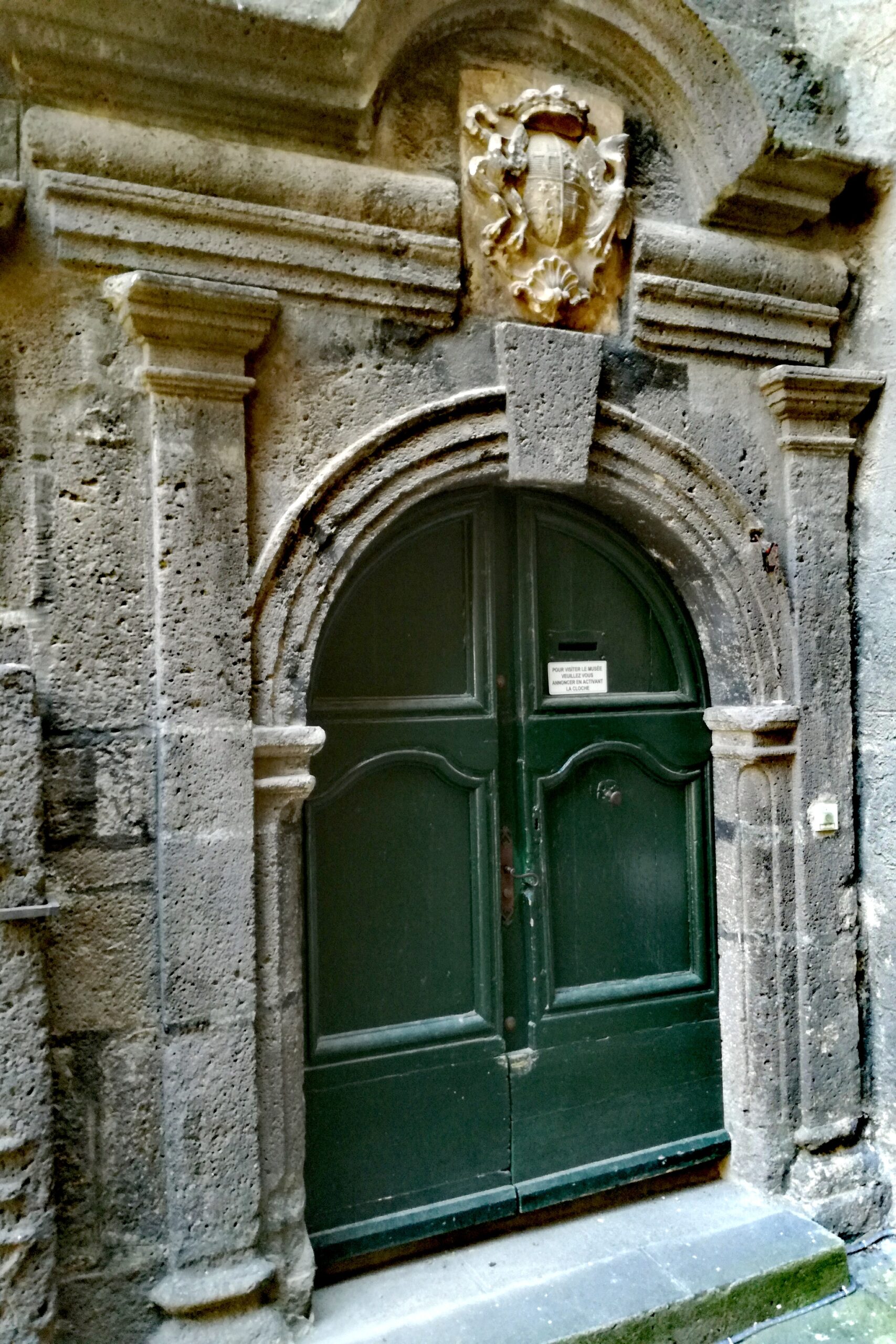
The doorway sets the tone: a round arch in dark, pitted stone, framed by pilasters and crowned with a carved coat of arms, opening off a narrow street in the old town. Inside, the hôtel’s three floors have been fitted out room by room rather than opened up — which suits a collection of small things.
Practical information
- Check the museum’s hours with the town of Agde before travelling; they vary by season.
- The Musée de l’Éphèbe, on underwater archaeology, is the natural second visit.
Getting there
Agde is on the Hérault, just inland from the Mediterranean, on the Bordeaux–Marseille railway line; the museum is in the pedestrian centre, a few minutes from the cathedral.
Nearby
- The cathedral of Saint-Étienne, the fortified church of the old town.
- The Canal du Midi, which reaches the sea a few kilometres away.
- The Musée de l’Éphèbe at Cap d’Agde.
Sources
- French Wikipedia, Musée agathois Jules-Baudou — the founding collection of the Escolo daù Sarret and Jules Baudou as first curator, the Renaissance hôtel and Monsignor Louis Fouquet’s charity, the 27 rooms refitted in 2011–2012, the Azéma brothers, the ex-votos of Antoine Roux and the sarret. The same article gives two dates for the foundation, 1932 and 1935; the first is used here, as it is the one accompanied by the detail of the association and the first curator.
- Wikidata (Q3329407) — coordinates and address.
Find it on the map
See this place and what’s around it →Events here — now on & upcoming
- L'Espérance 1881, histoire d'une renaissance — Musée agathois Jules Baudou, Agde10 Jul 2026 — 31 Dec 2026See the event →
📷 Become a Cultural Heritage Online photographer
Share your photos of places: they stay published under your name as the author. The more they're seen, the more you get noticed — and soon a contest will reward the most appreciated photos.
Log in or sign up free to add a photoIs this page about you?
This page is read by travellers and heritage enthusiasts who find it on Google. Tell us how you are connected to this place and we will take it from there.