
.jpg)
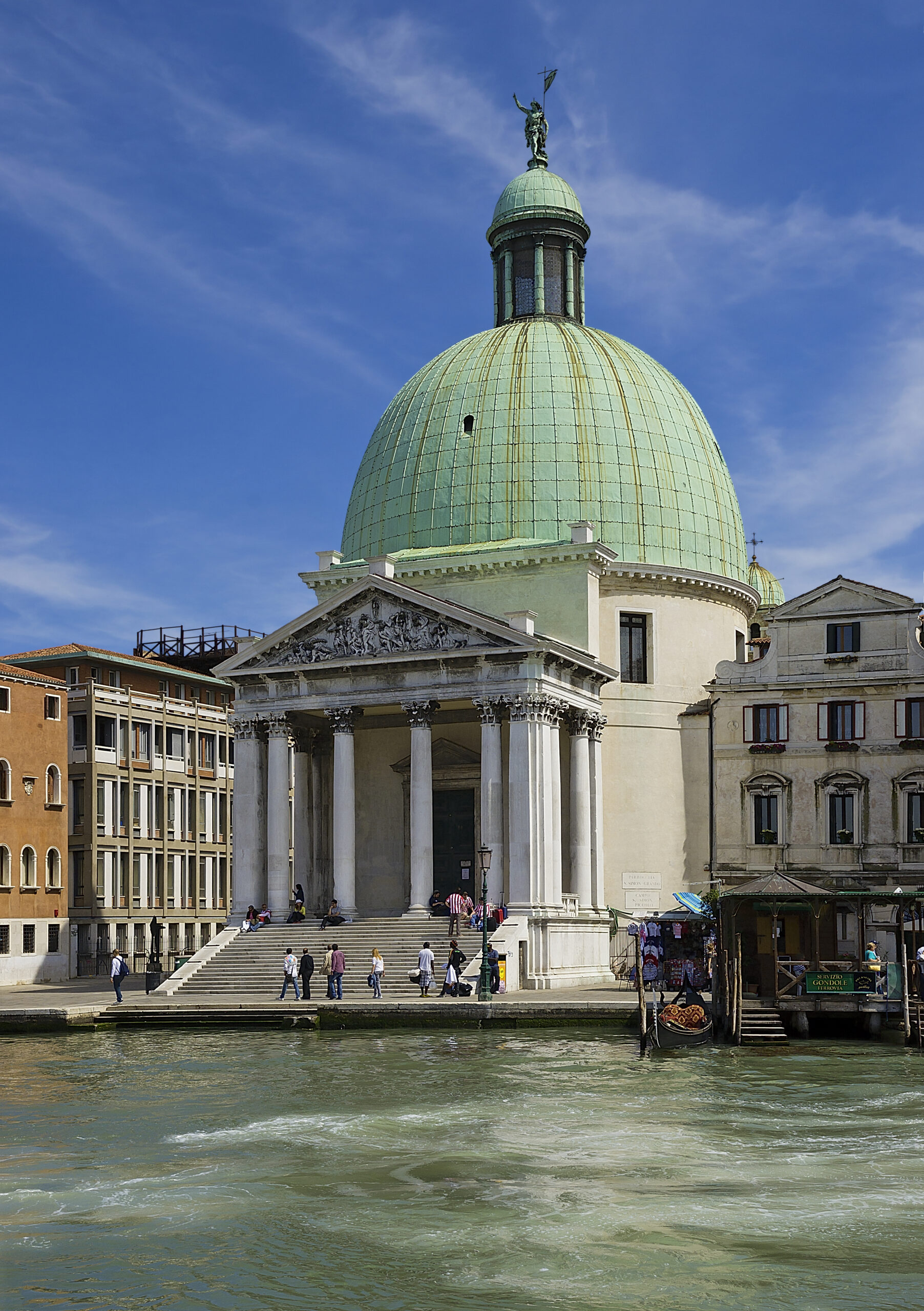
Step out of Venice’s railway station and this is what faces you across the water: a Roman temple front, a flight of steps into the canal, and a copper dome gone green. Most visitors photograph it before they know its name.
At a glance
San Simeone Piccolo — also called San Simeone e Giuda — stands in the sestiere of Santa Croce, directly opposite the Santa Lucia terminal. Giovanni Antonio Scalfarotto built it between 1718 and 1738, and it was one of the last churches raised in Venice, in one of the poorer quarters of the city. Mass is celebrated here according to the 1962 Roman Missal by the Priestly Fraternity of St Peter.
Key facts
- What it is: a parish church of the eighteenth century, still in use
- Architect: Giovanni Antonio Scalfarotto, 1718–1738
- Model: the Pantheon — a circular church behind a temple-front pronaos
- On the pediment: a marble relief of the Martyrdom of the Saints by Francesco Penso, called il Cabianca
- Where: Campo San Simeon Piccolo, Santa Croce, Venice, on the Grand Canal opposite the station
- Liturgy: the 1962 Missal, served by the Priestly Fraternity of St Peter
History
Scalfarotto began work in 1718, at a moment when Venetian architecture was reaching for academic quotation rather than invention — the same years that produced the Karlskirche in Vienna, and the same habit of mind. Rudolf Wittkower, in his study of the period, read the church as modelled on the Pantheon, with its circular plan and temple-front portico, while the raised dome answers Longhena’s Santa Maria della Salute further down the canal.
The centralised circular plan and the metal dome also recall Byzantine models and San Marco; the ring of chapels around the interior belongs instead to the churches built after the Council of Trent. It was among the last churches built in Venice, and it went up in a sestiere without money.
What you see
Six Corinthian columns carry a pediment filled with Cabianca’s relief, and the whole portico sits on a flight of steps that ends in the water: the church is entered from the canal as much as from the campo. Behind it the drum rises into an oval dome sheathed in copper, with a lantern and a bronze figure at the top.
Inside, the dome is shaped to make the church seem larger than it is. The building also goes below ground, into a crypt with painted decoration, and the altars around the rotunda carry work by Antonio Marinetti, Francesco Polazzo and others.
Practical information
- The church is two minutes from Venezia Santa Lucia station, across the Ponte degli Scalzi or straight along the fondamenta.
- It is a working parish: opening depends on the liturgy, and services follow the older rite.
- The steps on the canal are a meeting point for guided walks; the campo behind is quieter than the station side.
Getting there
Vaporetto to Ferrovia or Riva de Biasio; on foot, cross the Ponte degli Scalzi from the station and turn right along the water.
Nearby
- Venezia Santa Lucia station, the modernist terminal directly opposite.
- The Ponte degli Scalzi and the Grand Canal.
- The sestiere of Santa Croce, behind the church, away from the station crowds.
Sources
- English Wikipedia, San Simeone Piccolo — the dates 1718–1738 and Scalfarotto’s authorship, Wittkower’s reading of the Pantheon model and the Salute, the Cabianca relief, the interior altars and painters, and the liturgy of the Priestly Fraternity of St Peter.
- Wikidata (Q185910) — coordinates and the 1718 date.
Find it on the map
See this place and what’s around it →Events here — now on & upcoming
- Heritage Walk — What Holds Venice Up26 Sep 2026 — 27 Sep 2026See the event →
📷 Become a Cultural Heritage Online photographer
Share your photos of places: they stay published under your name as the author. The more they're seen, the more you get noticed — and soon a contest will reward the most appreciated photos.
Log in or sign up free to add a photoIs this page about you?
This page is read by travellers and heritage enthusiasts who find it on Google. Tell us how you are connected to this place and we will take it from there.