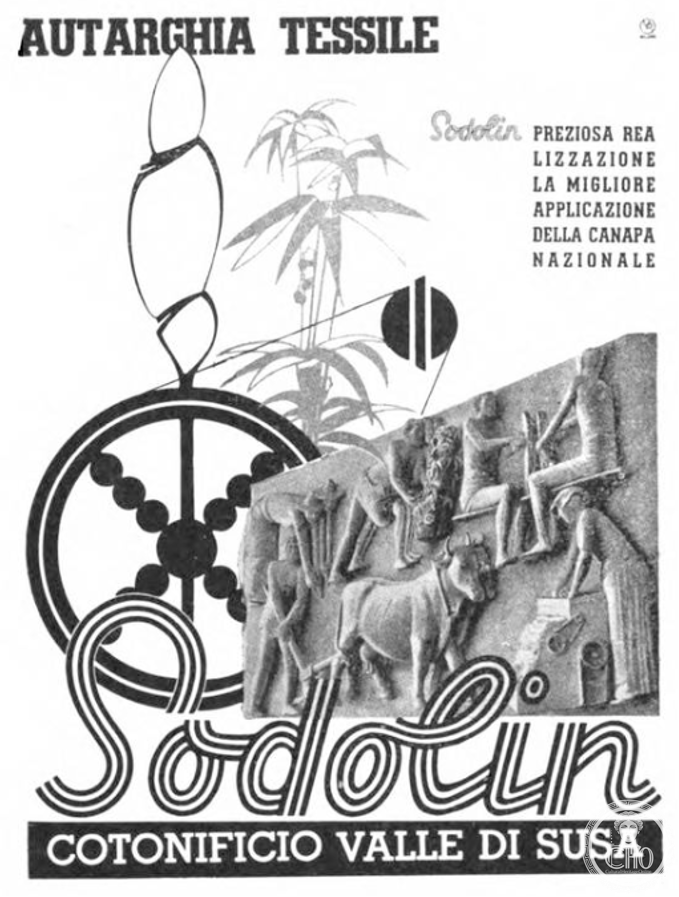
A hemp plant drawn as an ornament, a spinning wheel reduced to a geometric rose, and — pasted diagonally across them — a photograph of an ancient stone relief with an ox and figures working fibre. The message runs straight past the 1930s toward antiquity: people have always made cloth without cotton.
«AUTARCHIA TESSILE» stands across the top. The product name is written twice, once small in script — Sodolin, «preziosa realizzazione, la migliore applicazione della canapa nazionale»: the best application of the national hemp — and once huge along the foot, in a triple-outline script that is the most graphically adventurous lettering in the whole series. Under it, plain and proud, the maker: COTONIFICIO VALLE DI SUSA.
A cotton mill without cotton
The company behind the sheet was one of the giants of Italian cotton. Founded as Wild & Abegg in 1880 by the Swiss entrepreneurs Emilio Wild and Augusto Abegg, with its first mill at Borgone in the Valle di Susa, it grew into a chain of plants along the valley west of Turin and took the name S.A. Cotonificio Valle di Susa in 1923. Its problem in the sanctions years is printed in its own name: a cotonificio lives on imported cotton. Sodolin was the answer — a fibre worked from Italian-grown hemp, dressed here in the language of preciousness («preziosa realizzazione») precisely because it was a substitute. The ancient relief does the rhetorical heavy lifting: fibre from the land, the image says, is not a wartime expedient but the oldest textile tradition there is.
Marks and date
The small circular agency monogram with «MILANO» beneath it sits in the upper right corner, as on the other sheets of the series; the collector reads it as the mark of the Milanese concessionaire IGAP, a reading the scan cannot confirm. No signature resolves on the scan, no date is printed, and the sheet is published without an attribution; the «autarchia tessile» slogan places it with its companions in the late 1930s.
About this image. The work is still protected by copyright: under Italian law (L. 633/1941) rights run for 70 years from the death of the author. Since the author has not been identified, that term cannot be considered expired, and the image is treated as fully protected. It is reproduced here for documentation, study and critical purposes only, under Art. 70 of L. 633/1941 and the fair-use provision of 17 U.S.C. §107. The scan was made by the collector from his own copy of the sheet, part of the period material he keeps in a private archive: owning the physical sheet is not the same as holding the rights to the work. The image is not offered for sale, no reproduction rights are granted, and any request concerning the work should be addressed to the rights holders. Cultural Heritage Online publishes this material to document it, with no celebratory intent; see our terms and the DMCA contact published there.
Sources
- Cotonificio Vallesusa — the Wild & Abegg foundation of 1880 and the 1923 company name
- MuseoTorino — Cotonificio Valle Susa, the group’s plants in the valley and around Turin
- The sheet itself, for the product name, the copy and the agency monogram.