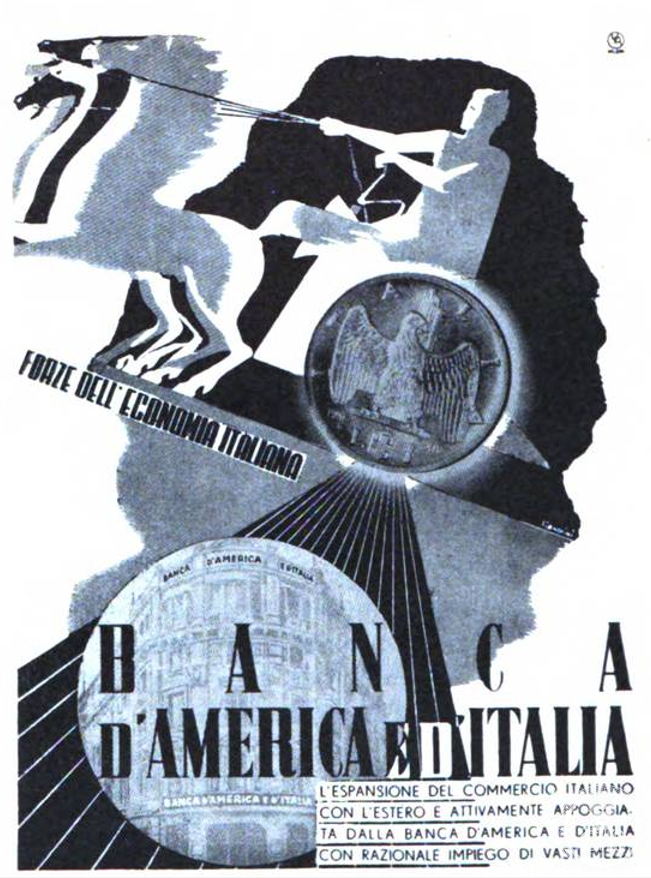
A bank that wants to look dynamic has a problem: nothing it does can be drawn. The solution here is to borrow — a Roman charioteer at full stretch across the top of the page, a coin the size of a wheel, and a photograph of the head office worked into a globe.
The charioteer drives two horses left to right, drawn in the flat, faceted style the 1930s used for anything that had to look both ancient and fast. Under the horses runs the series banner, «FORZE DELL’ECONOMIA ITALIANA» — forces of the Italian economy — the counterpart of the «forze del lavoro italiano» found on the industrial sheets of the same campaign. In the centre, a coin bearing an imperial eagle catches a beam of light; below it, inside a second circle, a photograph of a corner building with the bank’s name across its cornice. The copy is as sober as the imagery is theatrical: the expansion of Italian trade with foreign countries, it says, is actively supported by the Banca d’America e d’Italia «with the rational employment of vast means».
A Neapolitan bank with a Californian owner
The bank behind the chariot had a more interesting pedigree than the drawing lets on. It was founded in Naples on 14 November 1917 as the Banca dell’Italia Meridionale, by a group of local businessmen. In 1919 it was bought by Bancitaly, the vehicle of Amadeo Giannini — the Ligurian-Californian who had founded the Bank of Italy in San Francisco and would go on to build the Bank of America — and in 1922 it took the name on this sheet, Banca d’America e d’Italia. Its branches followed the emigration map: Liguria, Puglia, Campania, the regions whose families had accounts on both sides of the Atlantic. That is the quiet irony of the page: in a campaign about economic self-sufficiency, the bank advertising itself as a force of the Italian economy was American-owned, and its business was precisely the foreign trade the copy mentions. The bank survived the century better than the regime: it passed to Deutsche Bank in 1986.
Marks and date
Top right sits the small circular agency monogram with «MILANO» beneath it that recurs throughout the series; the collector reads it as the mark of the Milanese concessionaire IGAP, a reading the scan is too small to confirm. There looks to be a minute inscription along the edge of the beam below the coin, but it does not resolve into letters. The sheet carries no date and is published without an attribution; the campaign it belongs to is the autarky-era series of the late 1930s.
About this image. The work is still protected by copyright: under Italian law (L. 633/1941) rights run for 70 years from the death of the author. Since the author has not been identified, that term cannot be considered expired, and the image is treated as fully protected. It is reproduced here for documentation, study and critical purposes only, under Art. 70 of L. 633/1941 and the fair-use provision of 17 U.S.C. §107. The scan was made by the collector from his own copy of the sheet, part of the period material he keeps in a private archive: owning the physical sheet is not the same as holding the rights to the work. The image is not offered for sale, no reproduction rights are granted, and any request concerning the work should be addressed to the rights holders. Cultural Heritage Online publishes this material to document it, with no celebratory intent; see our terms and the DMCA contact published there.
Sources
- Banca d’America e d’Italia — foundation in Naples in 1917 as Banca dell’Italia Meridionale, purchase by Giannini’s Bancitaly in 1919, renaming in 1922, sale to Deutsche Bank in 1986
- The sheet itself, for the series banner, the copy and the agency monogram.