
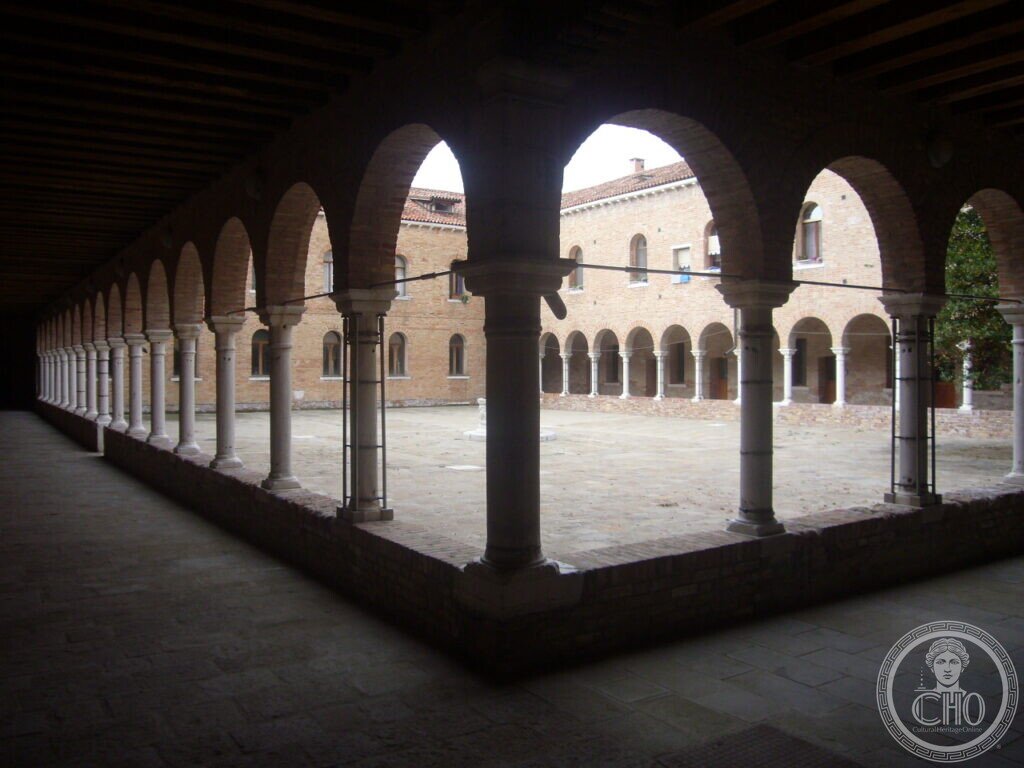
A Benedictine convent of the late 1400s that became a knitwear factory and is now the city’s craft centre: twelve artisan workshops, theatre companies and a great composer’s archive around a quattrocento cloister.
At a glance
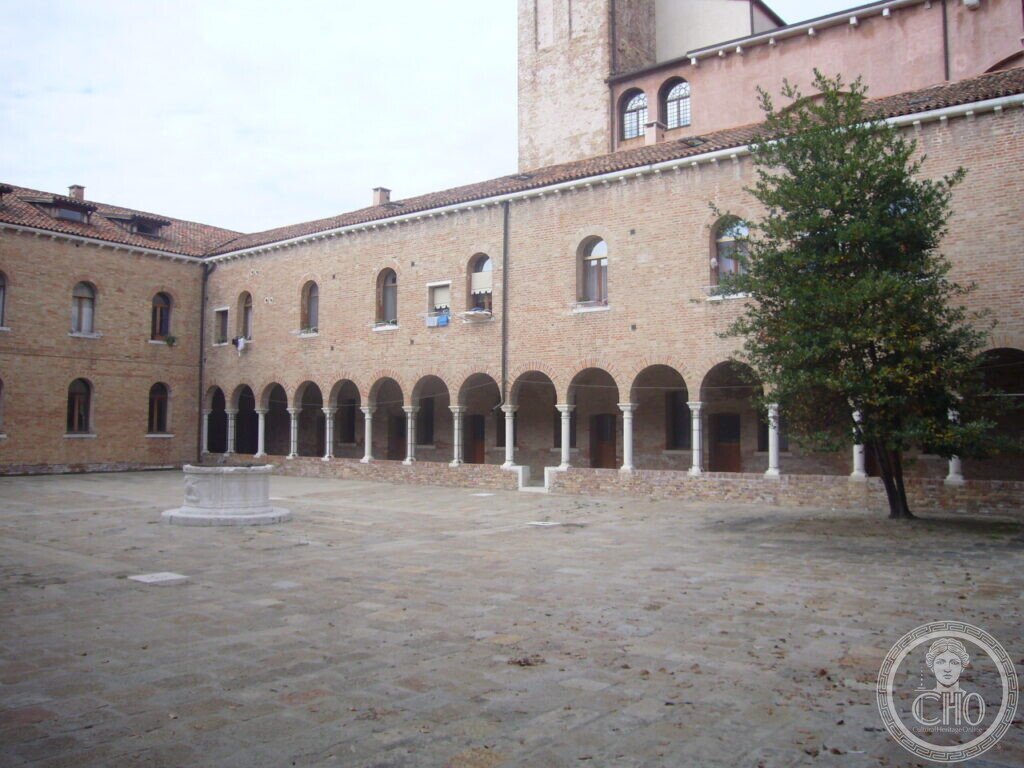
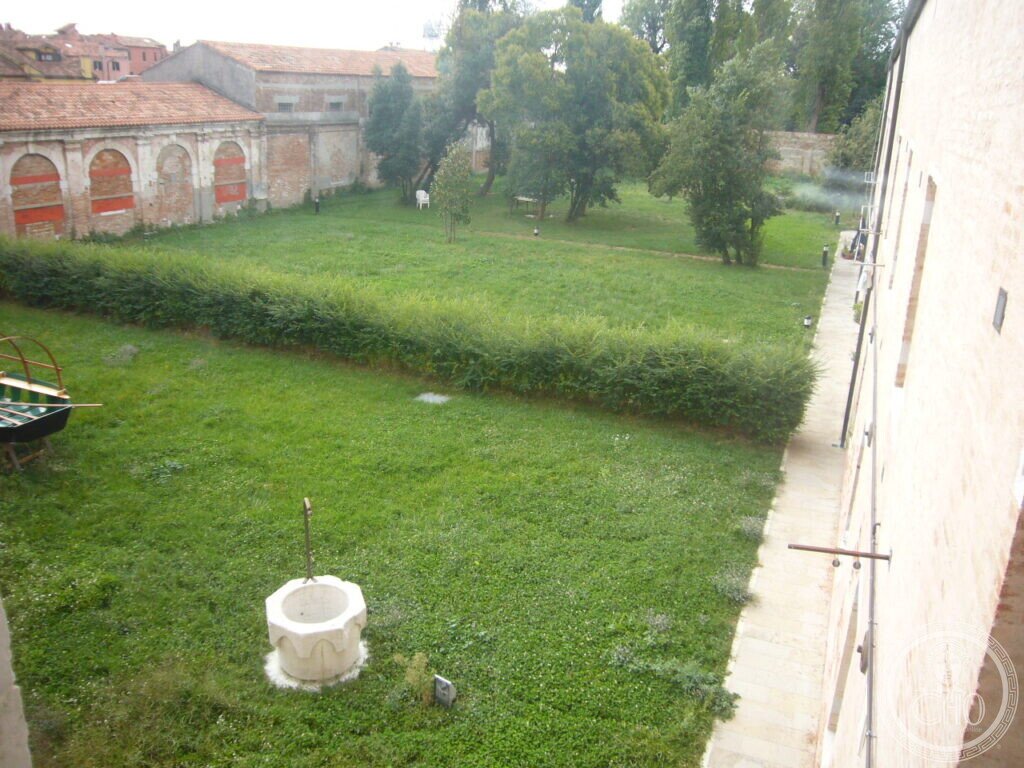
Behind a plain brick front near the Palanca vaporetto stop, the former convent of Santi Cosma e Damiano keeps one of the least-known cloisters in Venice: a full square of low brick arcades on stone columns, with its well-heads still in place and a four-thousand-square-metre walled garden behind. The city restored the complex in the late 1990s and filled it with work — twelve craft workshops, four halls of around 400 square metres each, artists’ studios and cultural associations. It is the rare Venetian monument you visit not for what it was, but for what it does.
Key facts
- Founded: late 15th century as a Benedictine convent, established by the nun Marina Celsi
- Cloister: fifteenth-century, brick arcades on stone columns, restored for public use
- Industrial era: from 1895, knitwear factory of the Herion company
- Restoration: radical five-year restoration by the City of Venice, mid-to-late 1990s
- Today: 12 artisan workshops, 4 halls (~400 m² each), studios for 8 young artists (Fondazione Bevilacqua La Masa), C.T.R. Centro Teatrale di Ricerca, Pantakin theatre company, Luigi Nono Archive
- Garden: approx. 4,000 m², recovered with the restoration
- Location: approx. 45.4255 N, 12.3236 E
History
The convent was established towards the end of the fifteenth century by Marina Celsi, a Benedictine nun, on what was then a garden island facing the city. The adjoining church went up in the first decade of the 1500s and was consecrated on 30 May 1583. By the eighteenth century the complex was rich: the church held canvases by Tintoretto, Tiepolo and Sebastiano Ricci, and Antonio Gaspari built the altar of the Blessed Virgin of the Rosary between 1708 and 1710. The Napoleonic era scattered that wealth — two paintings confiscated in 1806 went to the Brera in Milan — and closed the convent’s religious life.
Like much of the Giudecca, the buildings then went to industry. From 1895 the complex worked as a knitwear factory of the Herion company, one of the island’s several textile and manufacturing concerns. When production ended, the convent sat as one more piece of the Giudecca’s abandoned industrial fabric until the mid-1990s, when the City of Venice took it in concession from the state and began an almost five-year restoration. The complex reopened as a centre for craft and culture, and the fifteenth-century cloister and the garden returned to public use.
What you see
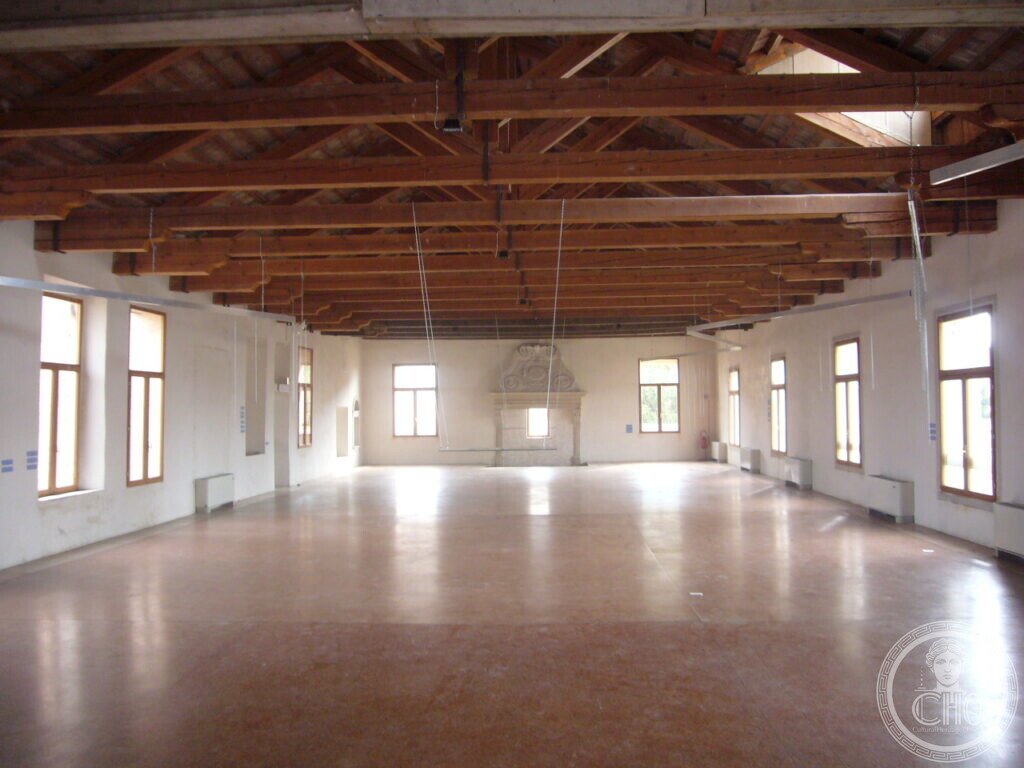
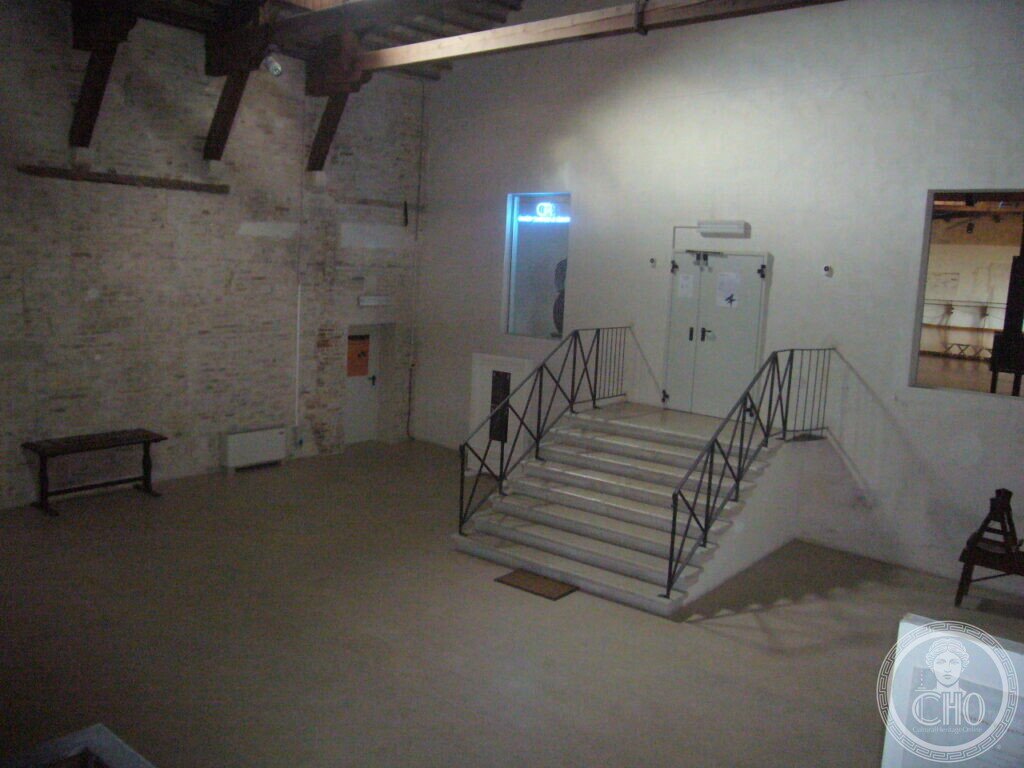
The cloister is the heart of the complex: four brick arcades on simple stone columns around a paved court, with a carved well-head at its centre and the church’s bell tower rising behind the roofline. The arcade walk is cool and dim even at midday; the court beyond it holds the light like a room. Upstairs, the restoration uncovered a long hall under open timber trusses with a monumental stone fireplace at its end wall, now used for events and rehearsals, and everywhere the work spaces keep their exposed brick and beams.
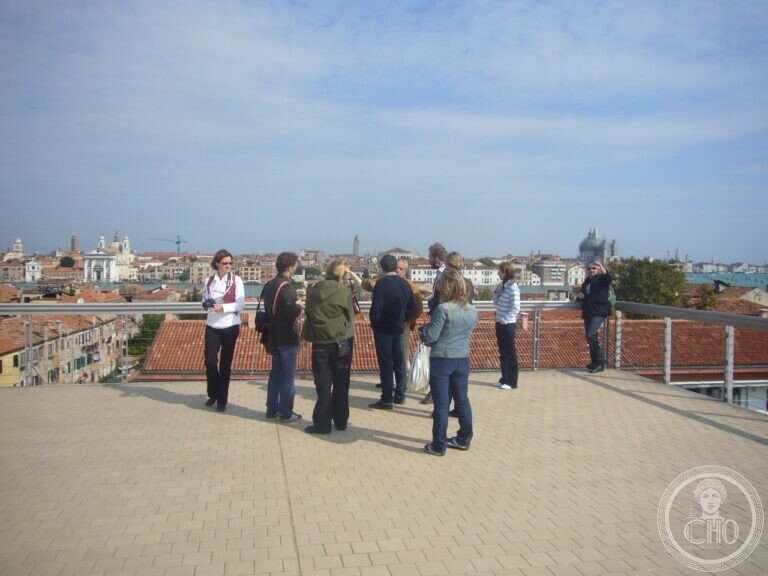
From the upper floor the walled garden opens out — lawns, hedges and mature trees behind the arcaded boundary wall — a scale of green space almost nowhere else in the historic city.
Cultural significance
Santi Cosma e Damiano is the clearest built summary of the Giudecca’s whole story: monastic island, factory island, and now an island working out what comes after industry. The city’s answer here was neither museum nor hotel but production — metalwork, glass decoration, perfume, paper and bookbinding, mask-making and digital craft in the twelve workshops, theatre research with C.T.R. and Pantakin, young artists’ studios assigned each year through the Fondazione Bevilacqua La Masa, and the archive of composer Luigi Nono, the Giudecca’s own. The cloister that once organised prayer now organises work.
Practical information
- The complex is a working craft and culture centre; the cloister and grounds are generally accessible during opening hours and public events.
- Workshops open individually; exhibitions and performances are announced by the resident associations.
- For current access arrangements, check the City of Venice page for SS. Cosma e Damiano.
Getting there
Take the vaporetto to Palanca (lines 2, 4.1 or 4.2); the complex is a short walk into the island, behind the Redentore side of the Giudecca. Google Maps: Ex Convento SS. Cosma e Damiano.
Sources & resources
Find it on the map
See this place and what’s around it →Record researched and written by Carla Szathvary for Cultural Heritage Online, 2026.
📷 Become a Cultural Heritage Online photographer
Share your photos of places: they stay published under your name as the author. The more they're seen, the more you get noticed — and soon a contest will reward the most appreciated photos.
Log in or sign up free to add a photoIs this page about you?
This page is read by travellers and heritage enthusiasts who find it on Google. Tell us how you are connected to this place and we will take it from there.