
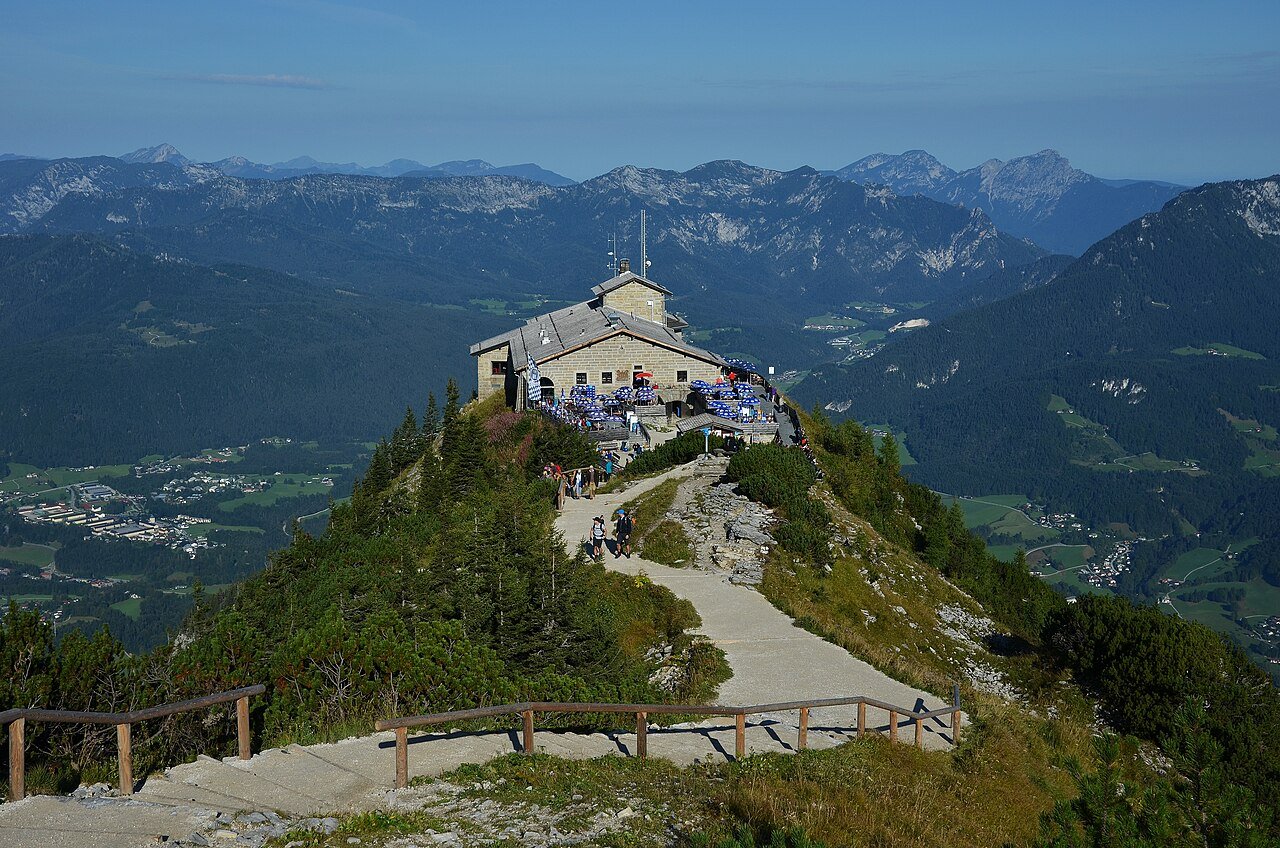
A road and a brass-clad elevator, built in thirteen months to reach a summit tea house Hitler almost never used. The building he barely visited became the wartime myth of his mountain fortress; the building itself has been a public restaurant since 1952.
At a glance
The Kehlsteinhaus was commissioned in 1937 by Martin Bormann as a representation building on the Kehlstein summit above Berchtesgaden, 1,834 metres up, reached by a 6.5-kilometre mountain road with a single hairpin and a final tunnel and elevator cut 124 metres through the rock. It was completed within about thirteen months, in the summer of 1938, and presented to Hitler around his fiftieth birthday in April 1939 — whether it was intended as a birthday gift is disputed among sources, and the official site itself makes no such claim. Hitler visited only rarely, by most counts fourteen to seventeen times in total; Eva Braun used it far more often.
It should not be confused with the wider Obersalzberg complex below — the Berghof, demolished in 1952, and the bunker system, on which forced labourers were used, unlike on the Kehlstein building itself, where the workforce was paid specialists.
Key facts
- Construction: road and building built in about thirteen months from spring 1937 to summer 1938, at an estimated cost of around 30 million Reichsmark; more than 3,000 workers, including highly paid Italian mountain-road specialists, worked day and night shifts. Twelve workers died during construction. No forced labour is documented on this project — unlike the bunker system on the wider Obersalzberg from 1943, where forced labourers, chiefly Czech and Italian, were used.
- The building: road elevation gain reported as 700 to 800 metres depending on the source; five tunnels totalling 277 metres; a final 124-metre elevator shaft with a mirrored, brass-panelled car.
- Hitler’s visits: at least 14 documented, by some accounts up to 17, first on 16 September 1938. His distrust of the elevator — fear that lightning could strike the winch mechanism — is contemporary testimony; other explanations circulated after the war are not equally well sourced.
- 25 April 1945: an RAF raid of 359 Lancasters and 16 Mosquitoes devastated the Obersalzberg complex below; the Kehlsteinhaus itself was not hit.
- 4–5 May 1945: US 3rd Infantry Division troops entered Berchtesgaden on 4 May, followed by French 2e DB troops the same evening and by the 101st Airborne, including Easy Company, the following morning — the popularised claim that the paratroopers arrived first does not match the unit-level record.
- 1952: Bavarian authorities demolished the Berghof ruins below, fearing they would become a pilgrimage site; the intact Kehlsteinhaus opened as a restaurant on 17 May of the same year, saved by the intervention of district governor Theodor Jacob.
- Coordinates: 47.6115° N, 13.0419° E.
Who tells it, and where the accounts diverge
The wartime name itself is an outsider’s invention: French ambassador André François-Poncet, received there in October 1938, coined the «Eagle’s Nest» in a vivid published account that fixed the building in Allied imagination as the dictator’s mountain fortress. The documented visiting record undercuts the myth directly — the official site’s own history states plainly that Hitler seldom visited.
The 1945 capture has three claimants. Popular culture, chiefly the television series Band of Brothers, made Easy Company’s arrival on the terrace canonical; unit records place the 7th Infantry Regiment first into Berchtesgaden on 4 May at 15:58, French 2e DB troops passing through that same evening, and the 101st Airborne arriving only the next morning, roughly seventeen hours later. The photographs of paratroopers on the terrace are real; the claim to have been first is not supported by the record of who moved when.
The clearest divergence is in what Bavaria chose to keep. The Berghof, Hitler’s actual residence, was dynamited in 1952 to prevent it becoming a shrine; the Kehlsteinhaus, standing on the same mountain, was opened as a restaurant three weeks later and placed in 1960 under a charitable trust whose profits still go to local causes. Since 1999 the Dokumentation Obersalzberg, run separately at the foot of the mountain, has set out to hold the two facts together — the alpine postcard and the decisions about persecution and war made on this ground — including the testimony of the forced labourers absent from the summit building’s own story.
Media
Street View — a 360° panorama on the summit terrace.
Video — Dokumentation Obersalzberg, «Idyll und Verbrechen – Hitler und der Obersalzberg».
Video — Mark Felton Productions, «Inside Hitler’s Eagle’s Nest — Then & Now».
What you see today
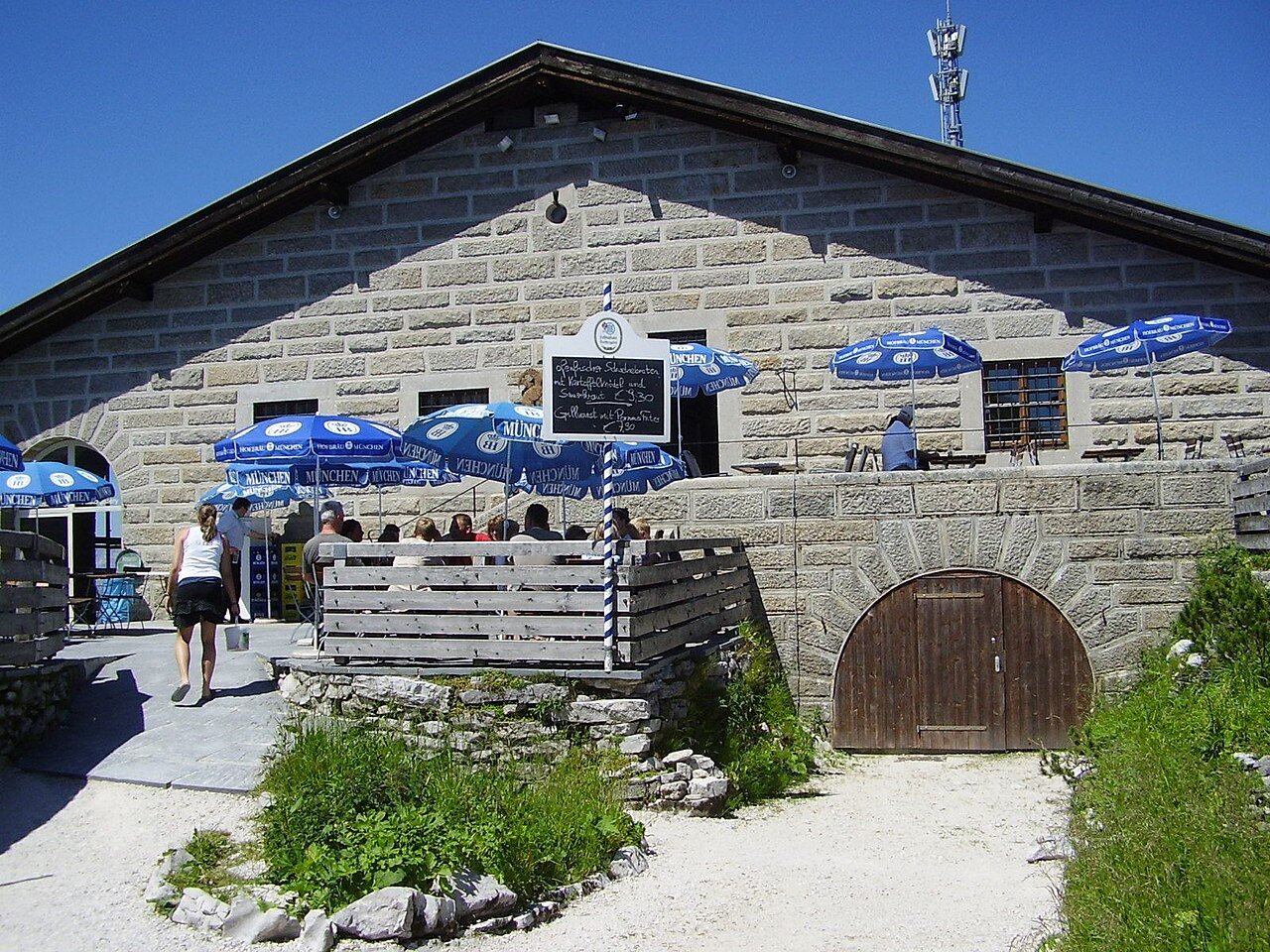
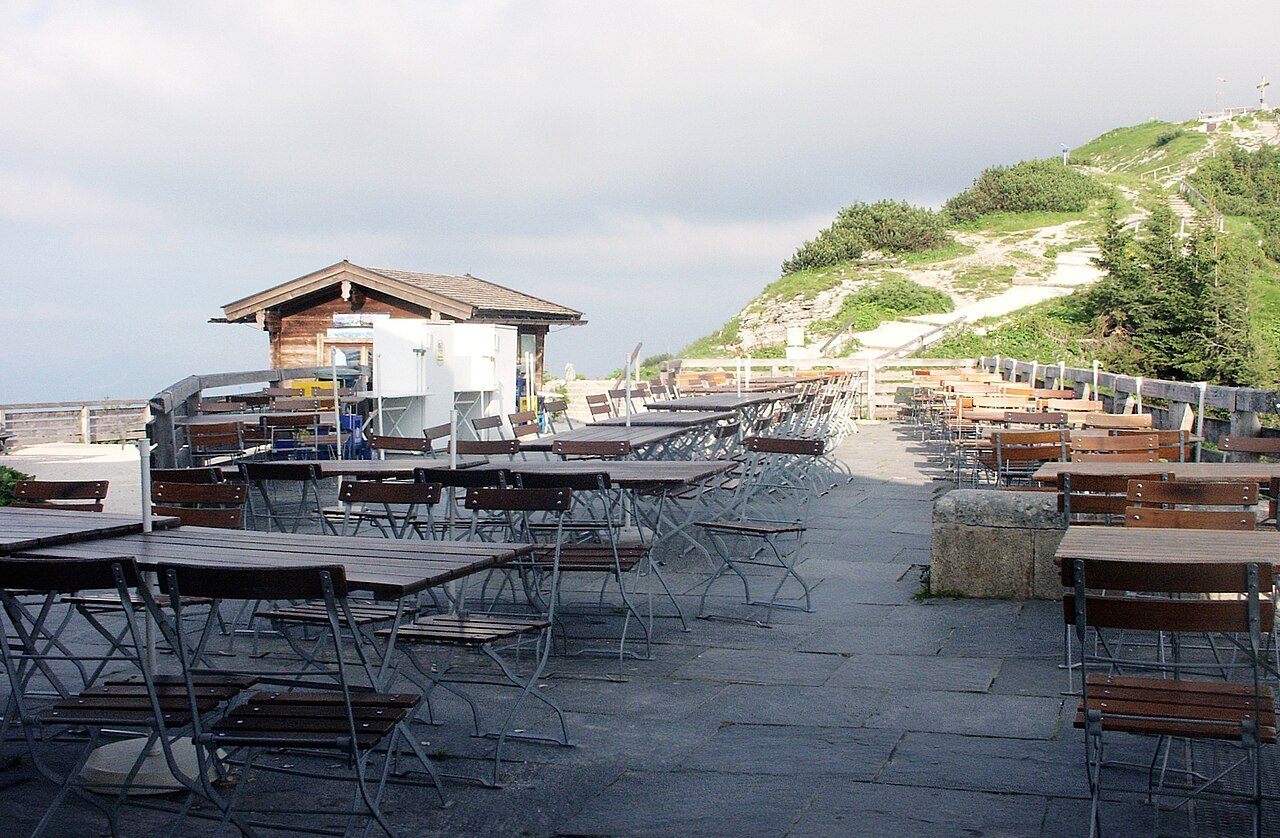
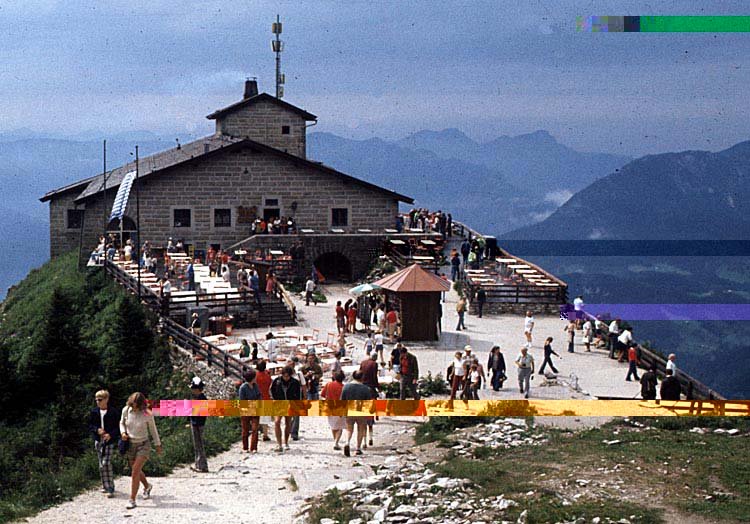
- The Kehlsteinhaus itself: a seasonal mountain restaurant, administered by a charitable trust (Berchtesgadener Landesstiftung) and run by private lessees, its profits going to charitable purposes.
- The original 1938 elevator, still in use to reach the building from the access tunnel.
- The Dokumentation Obersalzberg, a separate institution at the foot of the mountain, with the permanent exhibition «Idyll and Atrocity» and partial access to the bunker system.
Getting there
Open seasonally, 8 May–30 September and 1 October–8 November (closed in winter for avalanche risk). Private vehicles are banned on the summit road: access is only by the special RVO bus line 849 from the Obersalzberg-Hintereck car park, about fifteen minutes, followed by the tunnel and elevator or a twenty-five-minute walking path.
Sources
- Kehlsteinhaus (kehlsteinhaus.de), official site — engineering figures, visiting history, the 1952 restaurant opening and the charitable trust.
- Dokumentation Obersalzberg (obersalzberg.de), Institut für Zeitgeschichte München–Berlin — the Berghof, the 1952 demolition, the bunker system and its forced labourers, the exhibition.
- Berchtesgaden municipal tourism pages (berchtesgaden.de) — current opening dates, bus access.
- HistoryNet, on the May 1945 capture of Berchtesgaden — unit-level times and dates for the US and French forces.
- Wikipedia, Kehlsteinhaus, used as cross-check only.
Find it on the map
See this place and what’s around it →📷 Become a Cultural Heritage Online photographer
Share your photos of places: they stay published under your name as the author. The more they're seen, the more you get noticed — and soon a contest will reward the most appreciated photos.
Log in or sign up free to add a photoIs this page about you?
This page is read by travellers and heritage enthusiasts who find it on Google. Tell us how you are connected to this place and we will take it from there.