

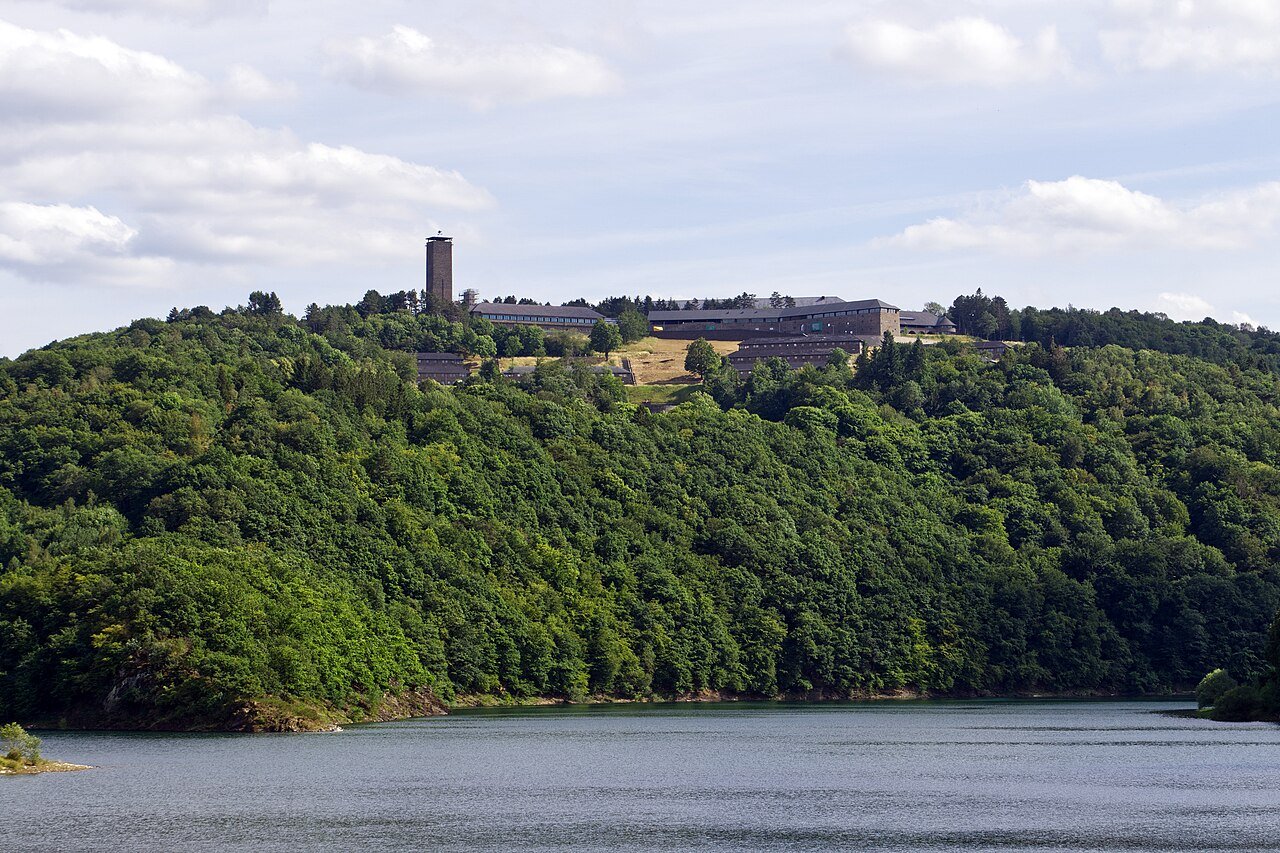
One of three monumental schools built to train the Nazi party’s future leadership stood empty of the public for six decades — first as a Belgian military camp, then, since 2006, as a documentation centre inside a German national park.
At a glance
Vogelsang was one of three «Ordensburgen» — with Krössinsee in Pomerania and Sonthofen in the Allgäu — built from 1934 to train the party’s rising cadre, the «Junker». Cologne architect Clemens Klotz designed the complex; up to 1,500 workers built the first phase in about two years, and it was handed over to Hitler on 24 April 1936. Training ran only from 1936 to 1939: worldview, geopolitics, race theory and intensive sport, taught by an organisation overseen by Robert Ley. The war interrupted the programme almost as soon as it began, and after 1945 the site passed from the British army to the Belgian army, which held it as a training camp for fifty-five years.
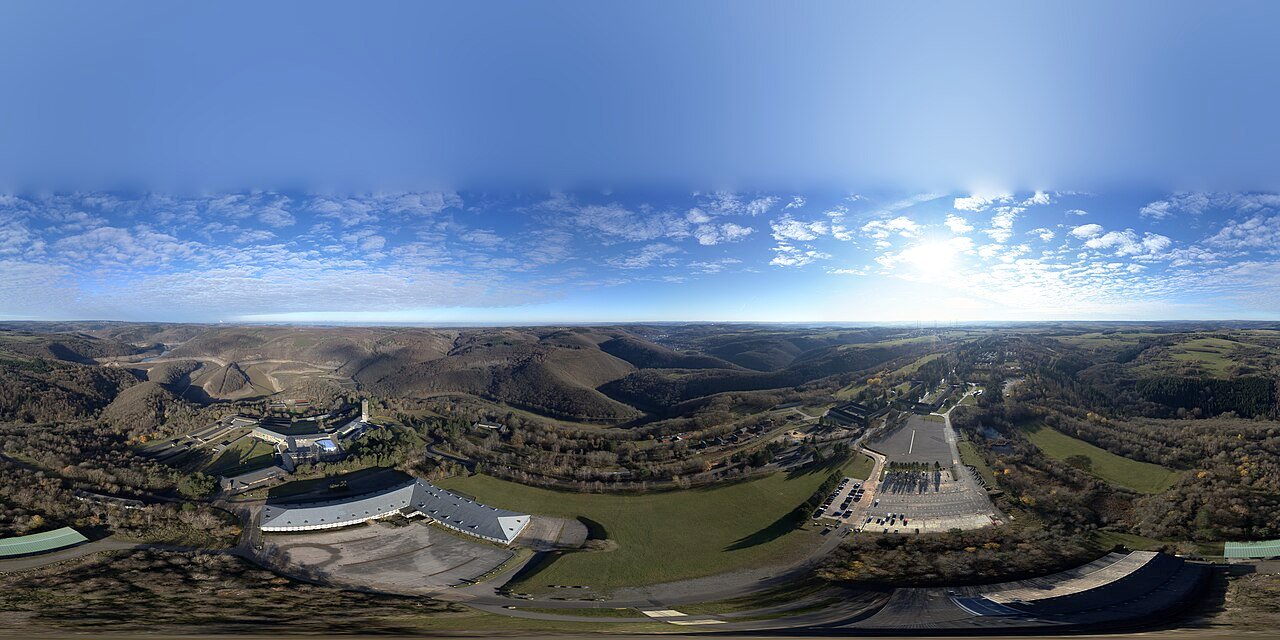
Returned to Germany at the end of 2005, the complex reopened to the public in 2006 and today houses the documentation centre «Destiny: Master Race» alongside the visitor centre of the Eifel National Park.
Key facts
- Construction: groundbreaking 15 March 1934, foundation-stone ceremony 22 September 1934, topping-out 15 December 1934; up to 1,500 workers on the first phase. A far larger complex, including a never-built «Haus des Wissens» with a 2,000-seat hall, was planned but abandoned.
- Training, 1936–1939: first Junker arrived 1 May 1936. Sources on the number trained diverge — around 450 to 500 graduates by most accounts, up to 1,500 total across the three intake years by another — and are reported here as a range, not a single figure.
- Wartime use: the Wehrmacht took over the site in 1939 and Junker training ended; from 1941 the buildings briefly housed classes of the Adolf-Hitler-Schulen, and in 1944 a two-month Hitler Youth military fitness camp. Forty-two forced labourers, mostly women from Eastern Europe, were exploited on site between 1942 and 1945.
- Capture and occupation: taken by the US Army on 4 February 1945 after Allied air raids had already damaged several buildings; held by the British army until 1950, then by the Belgian armed forces as «Camp Vogelsang» until 2005 — sixty years with no public access.
- Heritage status: the buildings were placed under monument protection in 1989; on 17 December 2013 the entire roughly 140-hectare site was listed as an area monument (Flächendenkmal), a listing that explicitly protects the Nazi-era buildings and the later NATO-era military modifications together, as one document of use.
- Coordinates: 50.5866° N, 6.4479° E.
Who tells it, and where the accounts diverge
The regime’s own recruitment rhetoric promised an elite drawn from all social strata, selected on merit. The surviving personnel files tell a narrower story: most Junker came from lower-middle-class families with basic schooling and an apprenticeship, admitted chiefly through party connections and a district leader’s recommendation. The regime’s own internal review is the sharper document — a 1939 study by training official Kölker judged the intellectual programme insufficient and the physical demands excessive. When American troops entered in February 1945, Time magazine reported flatly that «no superman strutted in Burg Vogelsang».
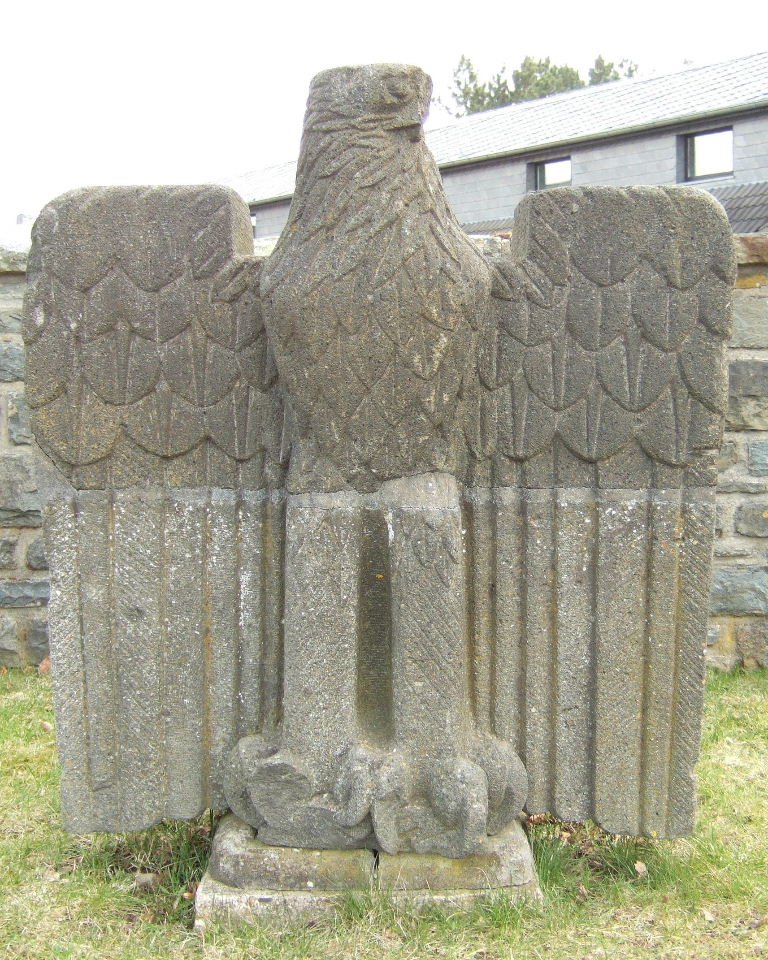
The postwar occupation is its own paradox. Fifty-five years as a closed Belgian garrison altered the site — war-damaged buildings were rebuilt, new barracks added — but also froze it, keeping one of the largest built Nazi-era complexes standing precisely because no one could develop it. The 2013 listing makes that paradox explicit, protecting the military additions of both regimes as a single layered document. The torch-bearer sculpture by Willy Meller that still dominates the central square carries bullet marks left by American soldiers in 1945, while its Hitler dedication and swastika light-fittings were removed; the choice to leave the marks visible, rather than restore or remove the figure, is the site’s own answer to how such architecture should be shown.
Media
Street View — a 360° panorama inside the Vogelsang IP grounds.
Video — WDR, «Hitlers Eliteschüler: Die NS-Ordensburg Vogelsang in 360°».
Video — Vogelsang IP, official site tour.
What you see today
- «Vogelsang IP» (Internationaler Platz): the NS-Dokumentation Vogelsang, a permanent exhibition on the selection and indoctrination of the Junker, and on the architecture of the complex as a propaganda tool.
- The Eifel National Park Centre, with a separate interactive exhibition on the surrounding wilderness.
- The Sonnwendplatz with Willy Meller’s torch-bearer sculpture, its 1945 bullet damage left visible.
- Guided tours of the grounds in German, English and Dutch; a restaurant, shop and overnight accommodation on site.
Getting there
Vogelsang 70, 53937 Schleiden, inside the Eifel National Park on the Dreiborn plateau. Open daily 10:00–17:00; exhibition admission €12 (€8 reduced). By car via the B266, signposted, with a barrier gate and a 2.5 km walk or shuttle from the central car park; by public transport, National Park shuttle buses run from Kall and Simmerath railway stations.
Sources
- Vogelsang IP (vogelsang-ip.de), official site — today’s offer, exhibition content, visitor information, site size.
- Stiftung Denkmal, memorialmuseums.org — postwar chronology, forced labour figures, the 2016 documentation building.
- zukunft-braucht-erinnerung.de — construction dates, costs, the 1939 Kölker review, graduate figures.
- Bundeszentrale für politische Bildung (bpb.de) — wartime use, the 1945 capture, the 2005–06 reopening.
- KuLaDig, Landschaftsverband Rheinland heritage database — the 2013 Flächendenkmal listing and its rationale.
Find it on the map
See this place and what’s around it →📷 Become a Cultural Heritage Online photographer
Share your photos of places: they stay published under your name as the author. The more they're seen, the more you get noticed — and soon a contest will reward the most appreciated photos.
Log in or sign up free to add a photoIs this page about you?
This page is read by travellers and heritage enthusiasts who find it on Google. Tell us how you are connected to this place and we will take it from there.