
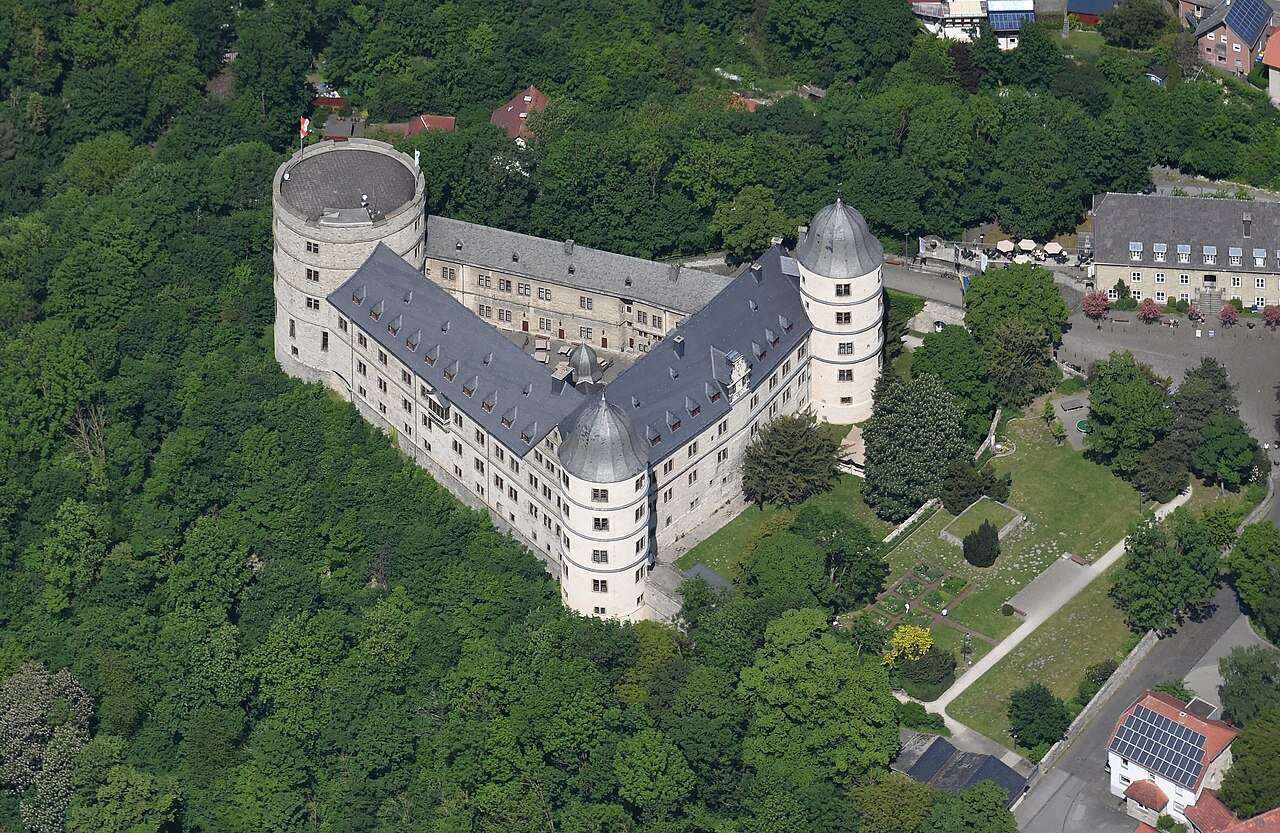
Germany’s only fully enclosed triangular castle was leased to Heinrich Himmler’s SS in 1934 for one hundred years at one Reichsmark a year. The rebuilding that followed was carried out by concentration camp prisoners, and the district museum that runs the site today documents both stories with its own figures.
At a glance
The castle was built between 1603 and 1609 as a second residence of the Prince-Bishops of Paderborn, on a spur above the Alme valley. In 1934 the district of Büren leased it to the SS; under castle captain Manfred von Knobelsdorff it housed pseudo-scientific «Germanic» racial research, and the project grew into plans for an assembly place for the highest SS generals, centred on the castle’s North Tower. The labour for the expansion came from a camp set up expressly for the purpose, which from September 1941 was the independent concentration camp Niederhagen. It was a concentration camp, not an extermination camp: the memorial documents deaths from hunger, cold, disease, mistreatment and executions.
Today the Kreismuseum Wewelsburg runs the castle museum and, in the former SS guard building, the memorial museum «Wewelsburg 1933–1945» with the permanent exhibition Ideology and Terror of the SS.
Key facts
- The lease: concluded in 1934 between the SS and the district of Büren — 100 years, at a symbolic rent of one Reichsmark a year; the official takeover ceremony was held on 22 September 1934. The declared purpose was an SS «Reichsführerschule».
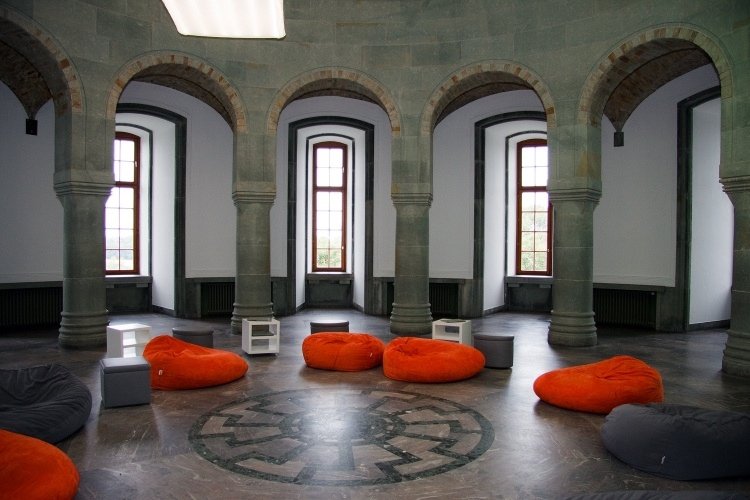
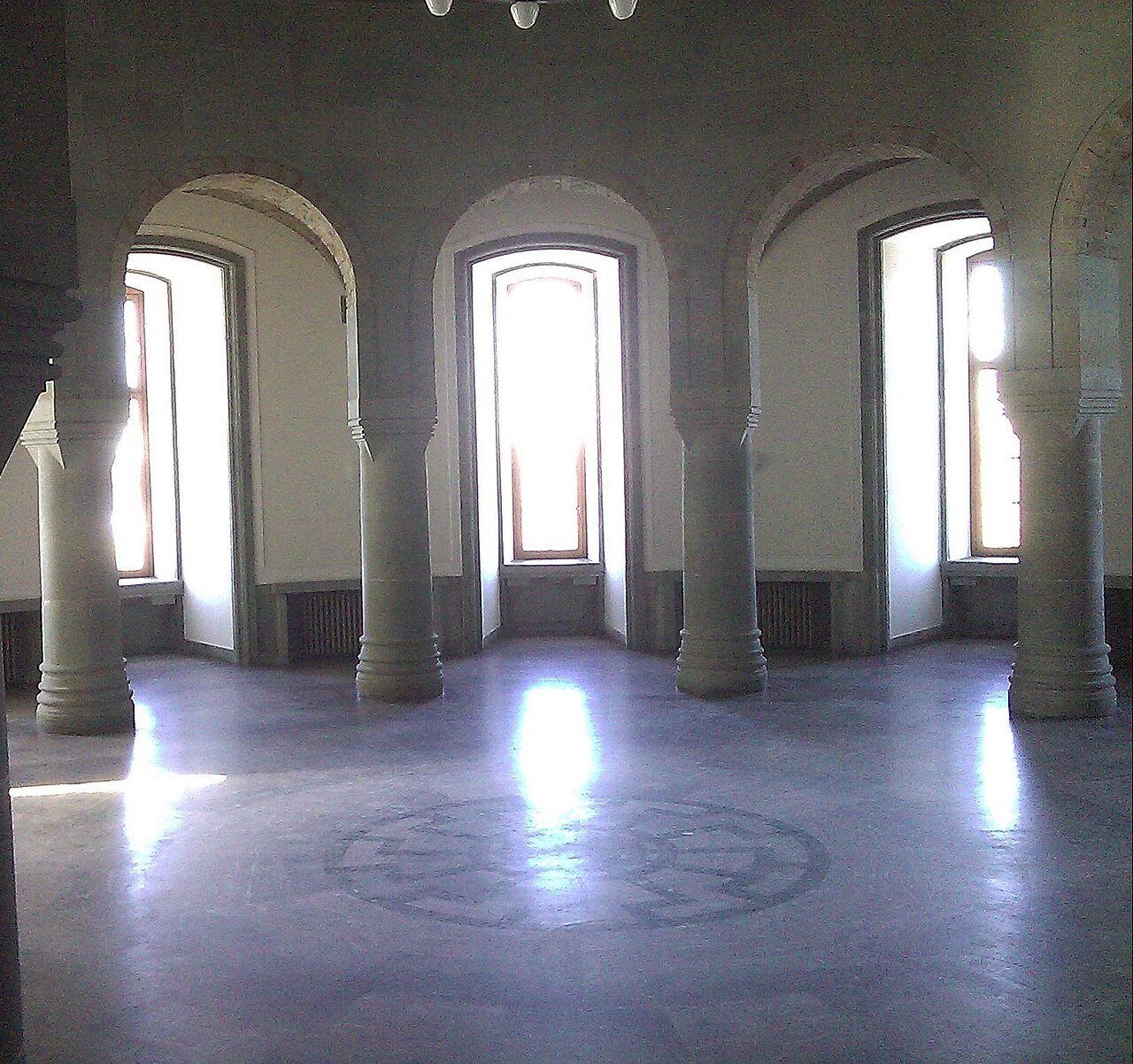
- The rebuilding: directed by architect Hermann Bartels of Münster, working directly with Himmler, who visited at least 25 times. From 1939 the North Tower was remodelled — a crypt excavated by camp prisoners, and the Obergruppenführersaal with twelve columns and a sun-wheel floor inlay. Wartime plans grew to a complex of buildings and ramparts of 600-metre radius centred on the tower, including the complete rebuilding of the village.
- The camp: prisoners from Sachsenhausen were put to work on the castle from May 1939; from September 1941 the camp was the independent Konzentrationslager Niederhagen, organisationally on the same level as main camps such as Buchenwald. Prisoner groups documented by the memorial include Jehovah’s Witnesses, political prisoners, Roma, homosexuals, Jews, prisoners of war and forced labourers from Poland, the USSR, Czechoslovakia, France, the Netherlands and Belgium.
- The figures, as the memorial states them: more than 3,900 prisoners were deported to Niederhagen in total; at least 1,229 people died on site of hunger, cold, disease and mistreatment; at least 56 people were murdered on the camp grounds or at a nearby SS shooting range. The museum’s own aggregate is at least 1,285 dead.
- The end: after Stalingrad, construction stopped in spring 1943 and the main camp was dissolved, leaving a residual detachment of 42 prisoners, almost all Jehovah’s Witnesses, administered as a subcamp of Buchenwald; no deaths are documented in that final phase. On 31 March 1945 an SS squad attempted to blow up the castle, which burned down to its outer walls; US troops liberated the remaining 42 prisoners on 2 April 1945.
- Coordinates: 51.6069° N, 8.6511° E.
Who tells it, and where the accounts diverge
The image of Wewelsburg as an occult cloister of a secret order comes, in the first place, from SS men themselves. Postwar memoirs by Walter Schellenberg and accounts fed to journalist Willi Frischauer by Himmler’s adjutant Karl Wolff painted the SS as a mystic order with the castle as its sanctuary; the round-table legend grew out of nothing more than surviving oak furniture and coats of arms. The memorial’s own research states the counter-finding plainly: no ritual acts by the SS at Wewelsburg can be verified in written sources, no records survive for the design models of the Obergruppenführersaal, and even the name «Black Sun» for the floor inlay is not attested in any SS-era document — the far-right scene fixed on the symbol only from the 1990s. The museum’s answer is physical rather than rhetorical: coloured bean-bag seats sit on the sun-wheel mosaic, and the director cites complaints on right-wing forums that the rooms have been «desecrated» as evidence the approach works. Precisely because the design was not an official emblem of the regime, it remains legal in Germany — which is why it was adopted.
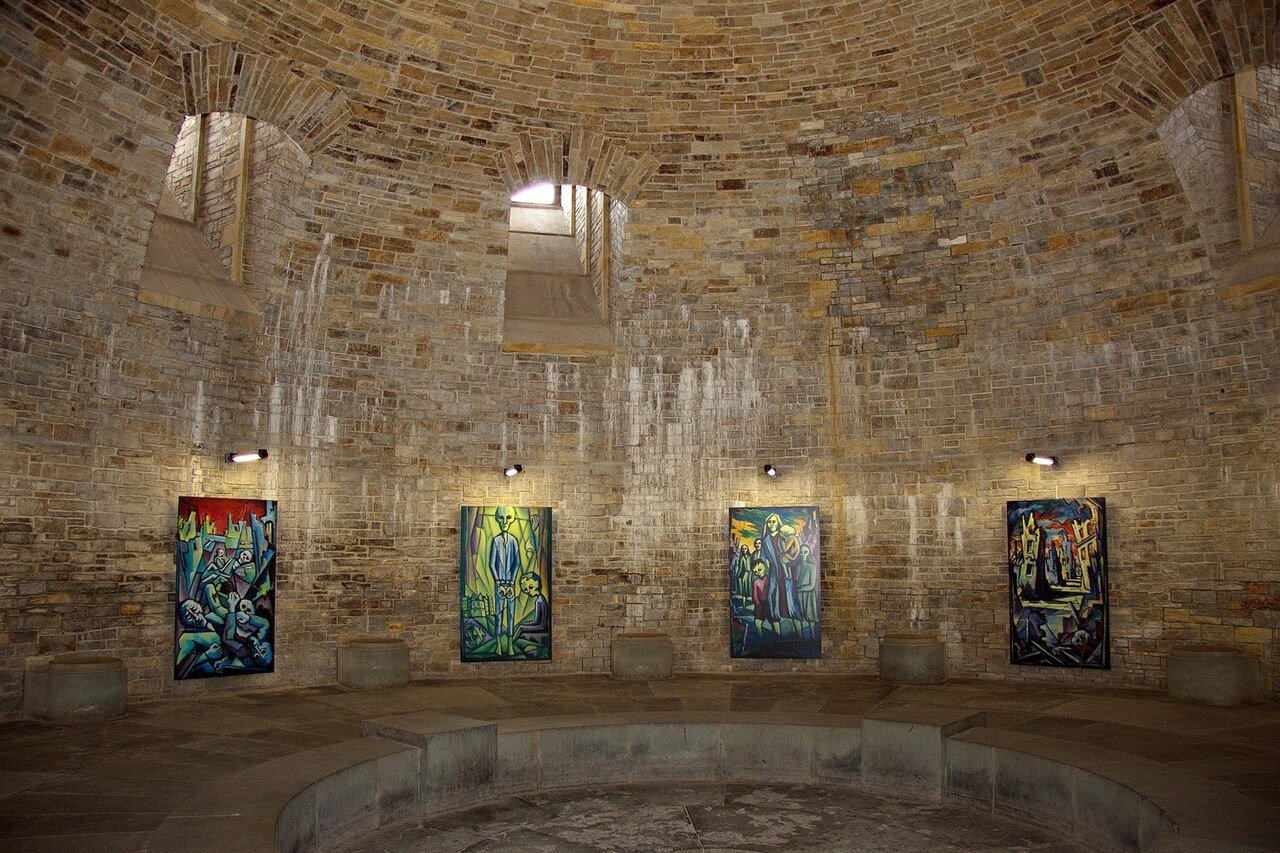
The other divergence is about time. The village looted the burning castle in April 1945 — the memorial’s own account keeps that in. A memorial cycle painted by Jo Glahé in the crypt in 1950 was largely ignored; serious public debate began only in the mid-1970s; the district opened its documentation centre in 1982, and the present exhibition, which deliberately includes the North Tower rooms in the visitor route, dates from 2010. The victims of the camp were commemorated on the former roll-call ground only in 2000, on the initiative of young residents of Wewelsburg itself.
Media
Street View — a 360° panorama at the castle.
Video — BBC Reel, «The castle at the centre of Nazi terror».
Video — Kreismuseum Wewelsburg, official museum film (English subtitles).
3D model — «Wewelsburg in 3D», by f7digital.
What you see today
- The Ideology and Terror of the SS permanent exhibition — 850 square metres in the former SS guard building, with original objects including Himmler’s pocket calendar, camp barrack walls and prisoner clothing.
- The North Tower rooms — the Obergruppenführersaal with the sun-wheel floor inlay, and the crypt with reproductions of Glahé’s 1950 memorial cycle — on the visitor route.
- The Historical Museum of the Prince-Bishopric of Paderborn in the castle itself, which also still houses a youth hostel.
- The memorial marker of 2000 on the former roll-call ground of the Niederhagen camp; an annual commemoration is held on 2 April.
Getting there
Burgwall 19, 33142 Büren-Wewelsburg. Open Tuesday to Friday 10:00–17:00, weekends and holidays 10:00–18:00, closed Mondays. The memorial museum is free of charge; the historical museum charges a small fee. Bus S61 runs from Paderborn central station to the «Kreismuseum» stop. House rules ban clothing and symbols of the far-right scene on museum grounds.
Sources
- Kreismuseum Wewelsburg (wewelsburg.de), official memorial pages — the canonical prisoner and death figures, camp history, exhibition and visiting details.
- Kirsten John-Stucke, museum director, ICOM 2016 paper on dark tourism at Wewelsburg — the myth-making history, the memorial chronology 1950/1982/2000/2010, the museum’s handling of the sun-wheel symbol.
- LWL Westfälische Geschichte portal — the 1934 lease terms and takeover.
- Buchenwald Memorial, satellite camps documentation (aussenlager.buchenwald.de) — the camp chronology from the 1939 Sachsenhausen detachment to the 1945 liberation.
- Wikipedia, Wewelsburg, used as cross-check only.
Find it on the map
See this place and what’s around it →📷 Become a Cultural Heritage Online photographer
Share your photos of places: they stay published under your name as the author. The more they're seen, the more you get noticed — and soon a contest will reward the most appreciated photos.
Log in or sign up free to add a photo