
Three cities built the same architecture at the same moment, for the same reasons, in the same empire. Then the empire ended, the border moved, and each of them woke up in a different country. Subotica is in Serbia. Timișoara and Oradea are in Romania. The buildings did not move at all.
What they hold is the Hungarian Secession — Szecesszió — the national variant of Art Nouveau that Ödön Lechner and his followers built by grafting folk-art ornament and glazed Zsolnay ceramic onto the flowing line of Jugendstil. Between roughly 1900 and 1914 it was the most modern thing a provincial Hungarian city could commission, and these three commissioned it hard. Then 1918 redrew the map, two generations of the twentieth century went past, and the standard art-historical account of Art Nouveau settled on six cities — Brussels, Vienna, Paris, Nancy, Barcelona, Glasgow — none of which is any of these.
Subotica: a market town that spent its fortune on flowers
Subotica sits at the northern edge of Serbia, about ten kilometres from the Hungarian border, at the heart of the Vojvodina. Under the Dual Monarchy established in 1867 it grew into a prosperous railway and agricultural town — the line arrived in 1869, electricity by 1896 — and the money from grain, livestock and trade found its way into three buildings that still make the walk worth the detour.
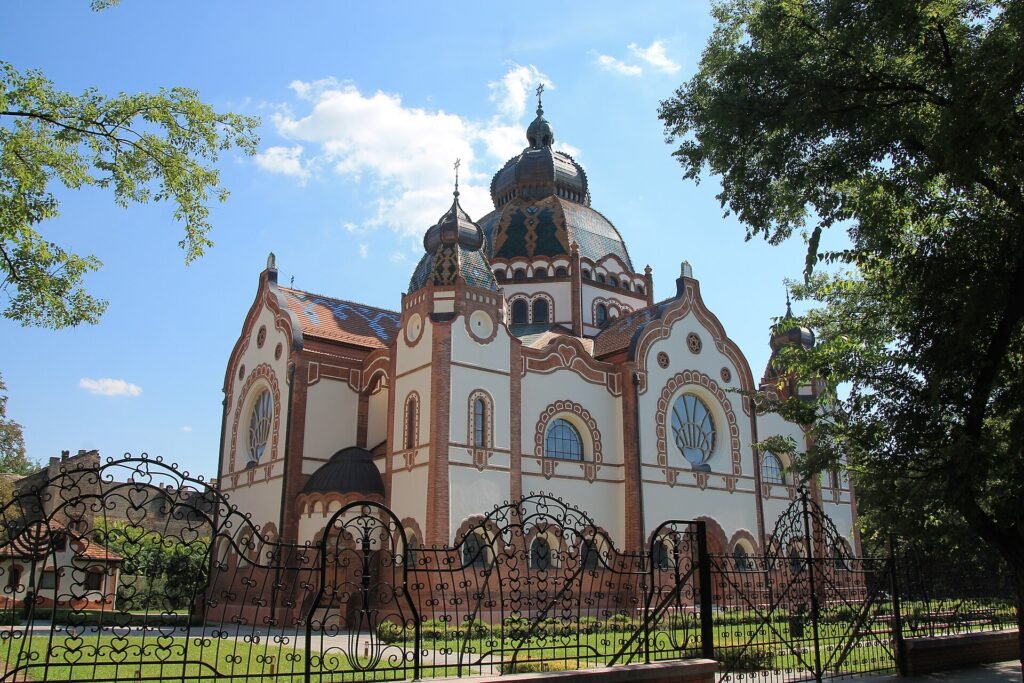
Marcell Komor and Dezső Jakab built the Synagogue between 1901 and 1903, placing a single congregation beneath a self-supporting dome carried on a modern steel structure. It is one of the finest surviving Art Nouveau religious buildings in Europe, and the second-largest synagogue on the continent after the Dohány Street Synagogue in Budapest. It is also the clearest case of what the century did to this heritage: the building fell into disrepair after the Second World War and the near-destruction of the local Jewish community, and a long restoration returned it to public use only in 2018.
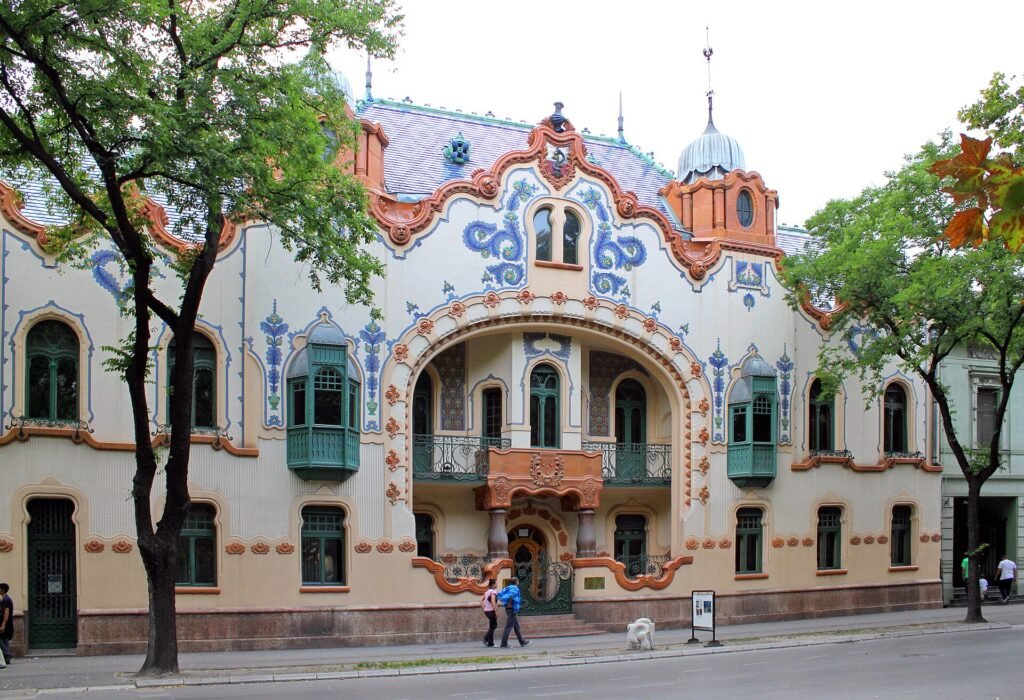
The same partnership won the tender announced in 1906 for a new town hall and built it between 1908 and 1910, interiors finishing in 1912 — a vast facade of vegetal ornament and symbolic figures on Trg slobode, its tower over the central square. And in 1904 the architect Ferenc J. Raichle built himself a house, which is the one people photograph. Raichle covered it in hearts and flowers rendered in Zsolnay ceramic from Pécs, Murano mosaic, wrought iron, carved wood and stucco, with a floral iron parapet across the top. Ornament here is not applied to the building; it is the building’s whole language. Since 1968 it has housed the city’s Gallery of Contemporary Art.
Oradea: fifteen years, one city centre
Oradea lies in Bihor County, in the historical region of Crișana, roughly ten kilometres from the Hungarian frontier. Its centre was essentially rebuilt in the fifteen years before the First World War, funded by a prosperous mixed population — Hungarian, Romanian, Jewish and German — and designed by architects trained in Budapest and Vienna. Two currents met there: Lechner’s folk-derived Hungarian Secession and the cooler Vienna Secession. What came out is recognisably neither, and recognisably Oradea.

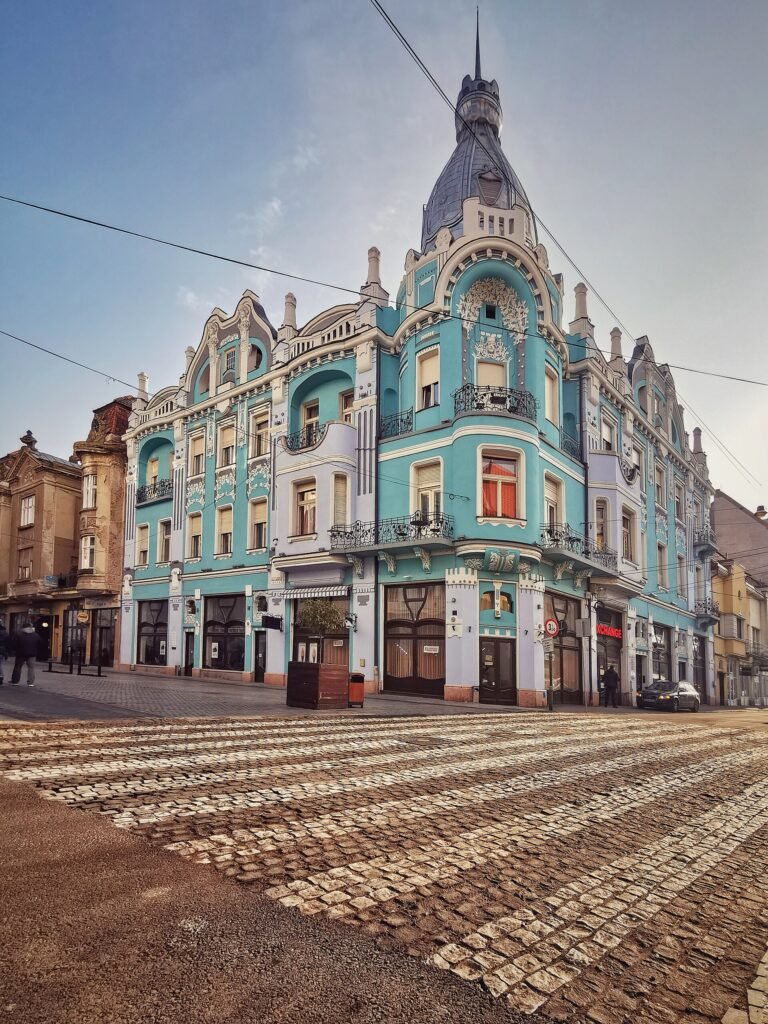
The emblem is the Black Eagle Palace, again by Komor and Jakab, built in 1907–1908. It is not one block but three asymmetrical bodies joined by a glazed, glass-roofed passage that runs between Union Square, Vasile Alecsandri Street and Independenței Street, branching so that the arcade forms a Y in plan. At the junction hangs the stained-glass black eagle that gives the building its name, executed in 1909 in the Oradea workshop of Neumann K. The palace originally held a hotel, a casino, offices and a restaurant; the passage still works as a public shopping arcade, which is the most useful thing that can happen to a monument.
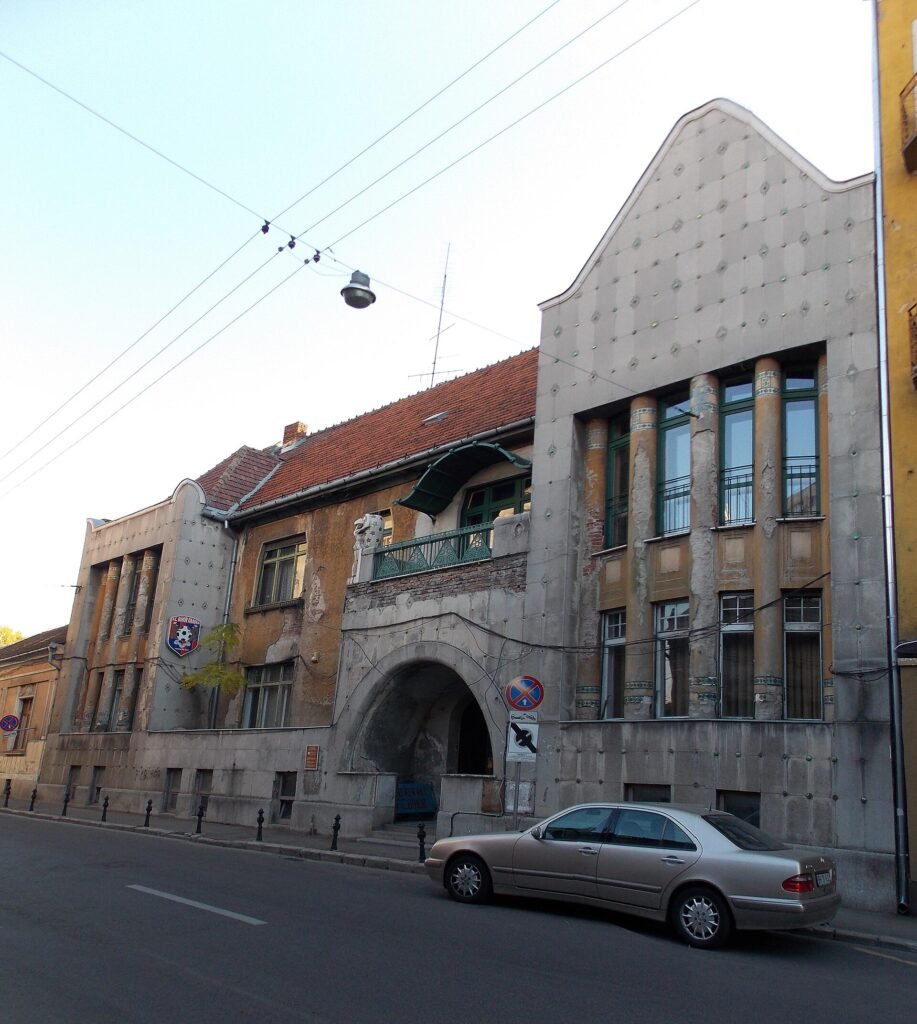
From Union Square short walks lead past the Moskovits and Apollo palaces, the Stern and Ullmann and Füchsl palaces, and the Vágó brothers’ Darvas–La Roche House, which is a museum of the style compressed into a single villa. Oradea is a member of the Réseau Art Nouveau Network and sits on the Art Nouveau European Route, alongside Brussels, Vienna and Budapest. A sustained programme of facade restoration has brought much of the centre back to how it looked before 1914.
Timișoara: not a monument, a fabric
Timișoara is the other Romanian city on the Art Nouveau European Route, and it works differently from Oradea. There is no single building everyone comes for. There is a whole turn-of-the-century city, and the way to read it is to walk.
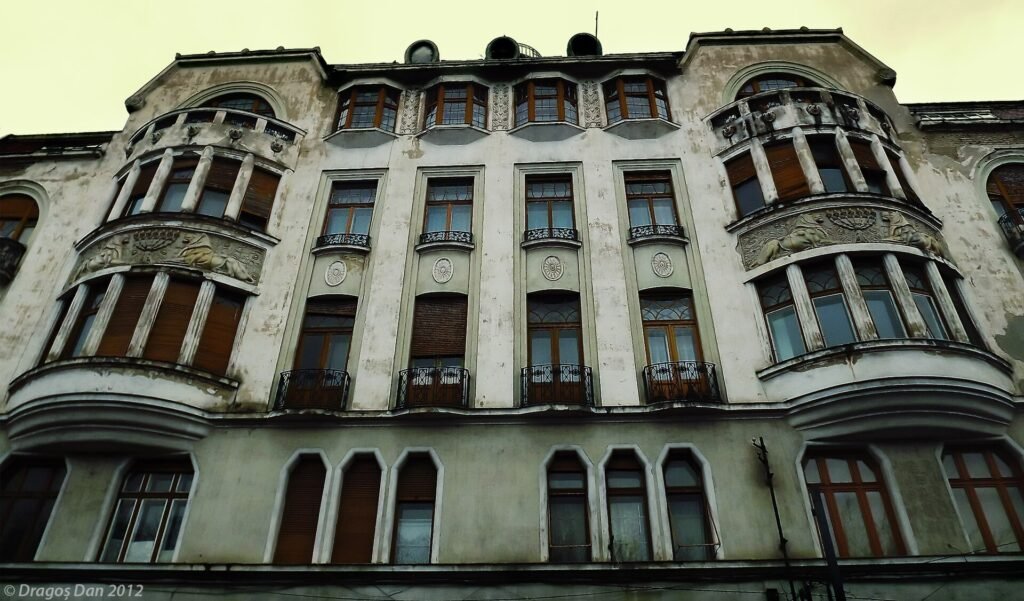
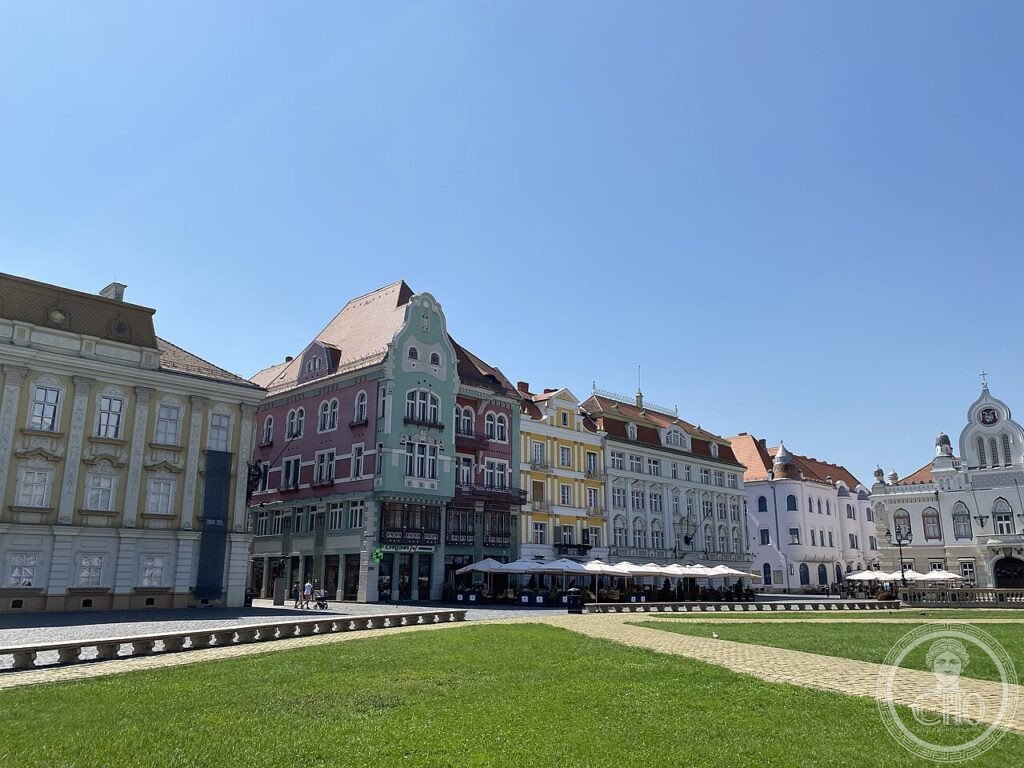
Much of it carries one signature. László Székely, born in 1877 and educated in Budapest, was appointed chief architect of Timișoara in 1903 and held the post until 1922. His Ștefania Palace went up in 1908–1909; the Hilt-Vogel and Széchenyi palaces in 1911–1913; the Neptune Public Bath, with its tiled interiors, between 1912 and 1914. On Piața Unirii he worked with Arnold Merbl on the Brück House of 1910–1911, built for the merchant Salamon Brück, whose initials sit in the pediment — four storeys behind a facade of ceramic tiles drawn from Hungarian folklore, closed glazed balconies on the first floor and a bow window climbing two levels.
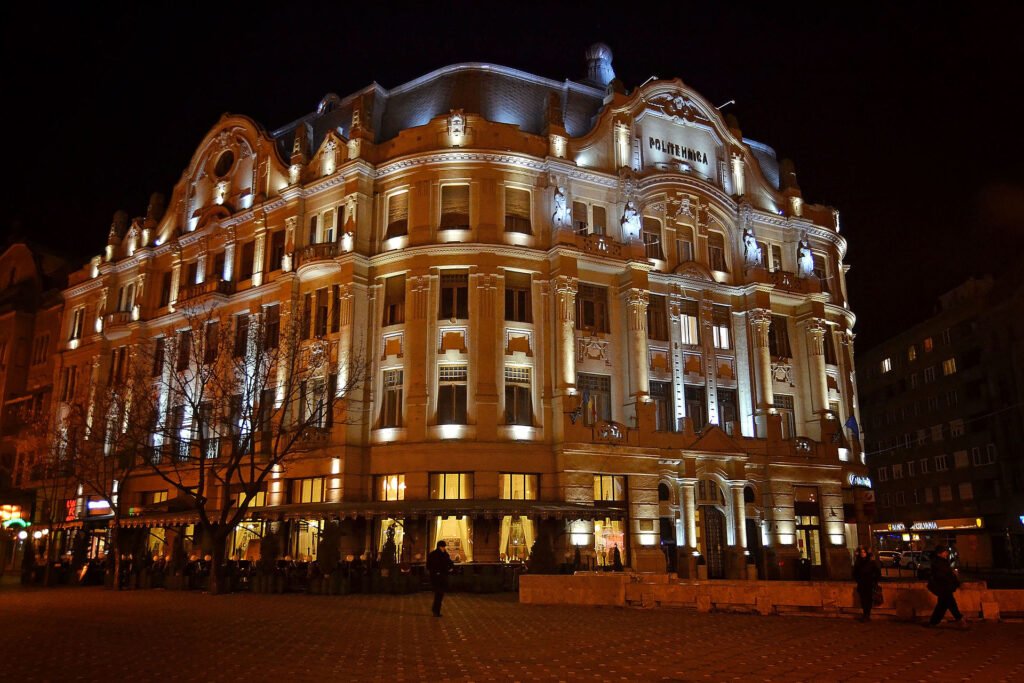
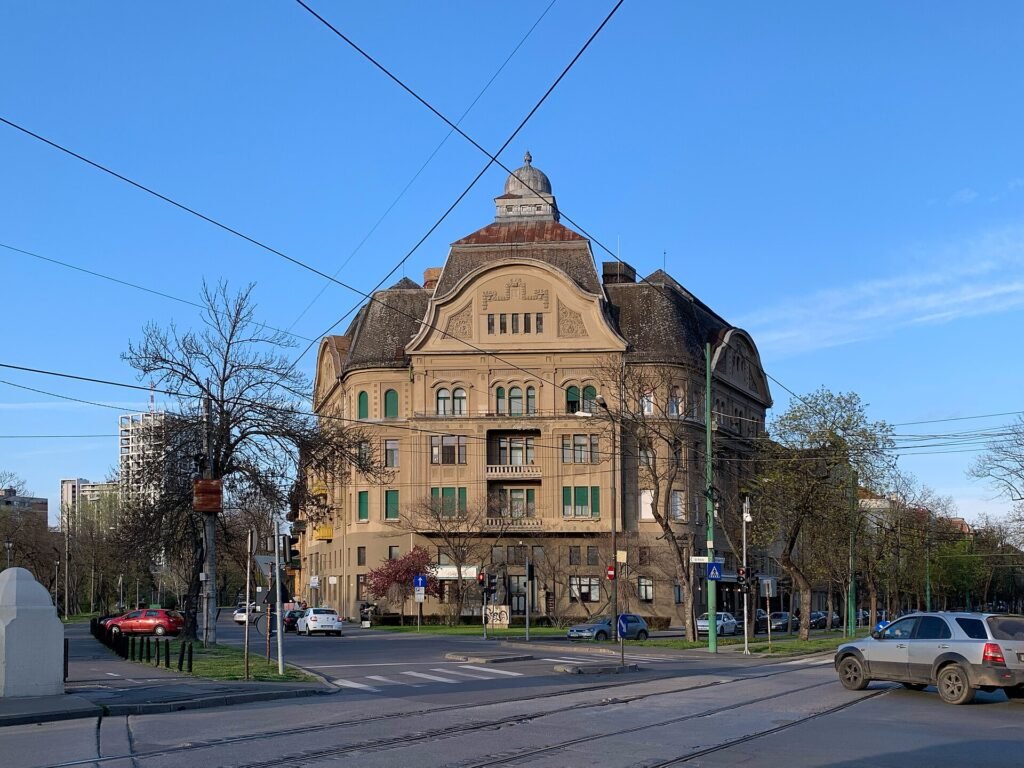
A few minutes away, on Piața Victoriei, Lipót Baumhorn’s Lloyd Palace (1910–1912) closes one side of the square with rounded corners, statues and bas-reliefs that mix eclectic and Vienna Secession motifs. But the part of Timișoara that stays with you is not on either square. It is Fabric — the old Gyárkülváros, the factory suburb — and Iosefin, where street after street of ordinary apartment houses from the same decades carry the same stucco garlands and tiled accents at a domestic scale. That is what a complete Secession city looks like when nobody arrives to redevelop it.
Why the map stayed small
The reason these cities are missing from the standard account is not aesthetic, and it is not about quality. The canonical six were capitals or near-capitals, and they were on the Grand Tour circuit before Art Nouveau arrived. Subotica, Timișoara and Oradea were provincial when they built, they ended up on redrawn borders in 1918–1920, and then they spent two generations behind a line that Western art historians did not cross. Nobody came to write the first paragraph, so there was no second one.
The buildings, meanwhile, benefited from exactly the neglect that kept them off the map. Border cities that stop growing stop demolishing. What survives in these three is not a handful of restored showpieces but continuous streetscape — the ordinary buildings alongside the famous ones, which is the only way a style can actually be read.
Going
All three are close together and close to the same border. Subotica is on the Budapest–Belgrade railway, ten kilometres from Hungary, and is often done as a day trip from Szeged or a stop between the two capitals; its three principal buildings are a short walk from Trg slobode. Oradea and Timișoara are both in western Romania, Timișoara served by Traian Vuia International Airport (TSR) and a major rail junction with direct trains from Bucharest and cross-border services into Hungary.
Most of what you want to see in Timișoara is a private apartment building or a shop: admire it from the street. In Subotica the Synagogue works as a cultural venue and welcomes visitors, the Raichle Palace is open during gallery hours, and parts of the City Hall can sometimes be visited with a guide. In Oradea the Black Eagle passage is simply a street with a roof, and open whenever the shops are.
Sources
- Cultural Heritage Online place cards, with their own cited sources: Subotica — The Hungarian Secession in the Vojvodina, Oradea — Romania’s Art Nouveau Capital, Timișoara — Secession Facades of the Banat
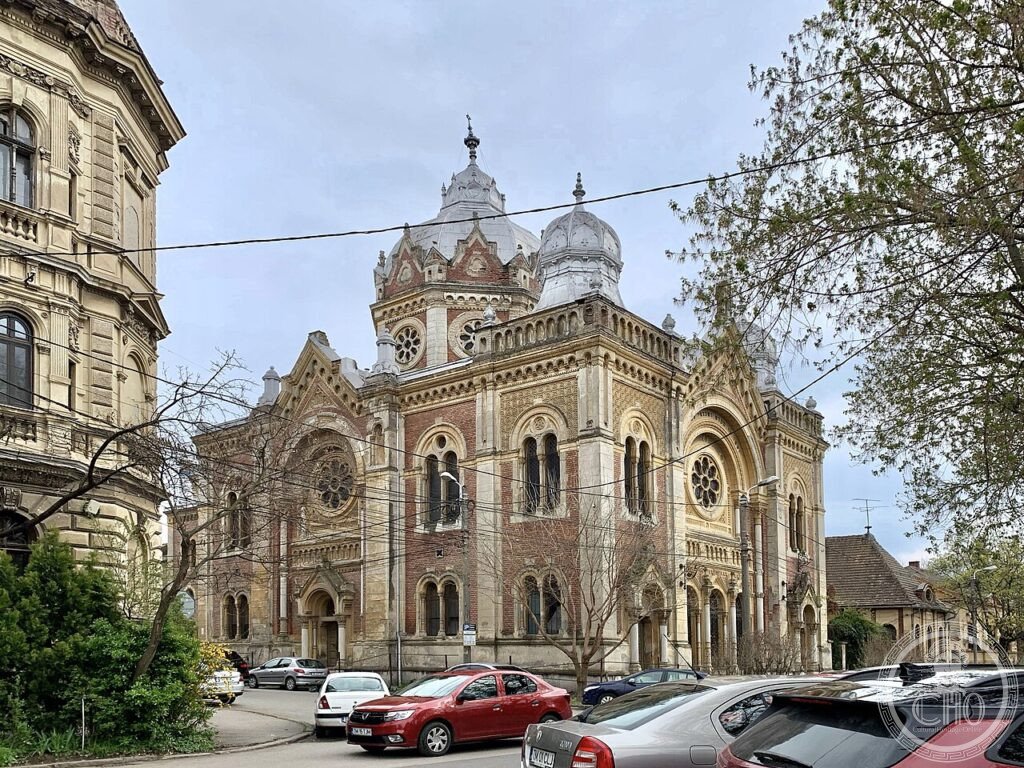
- Individual buildings: Raichle Palace, Subotica Synagogue, Black Eagle Palace, Darvas–La Roche House, Ullmann Palace, Moskovits Miksa Palace, Brück House, Lloyd Palace, Neptun Baths, Fabric Synagogue
- Réseau Art Nouveau Network and the Art Nouveau European Route, membership of Oradea and Timișoara
- All photographs: Wikimedia Commons, under the Creative Commons licence named in each caption. Photographers are credited individually.