
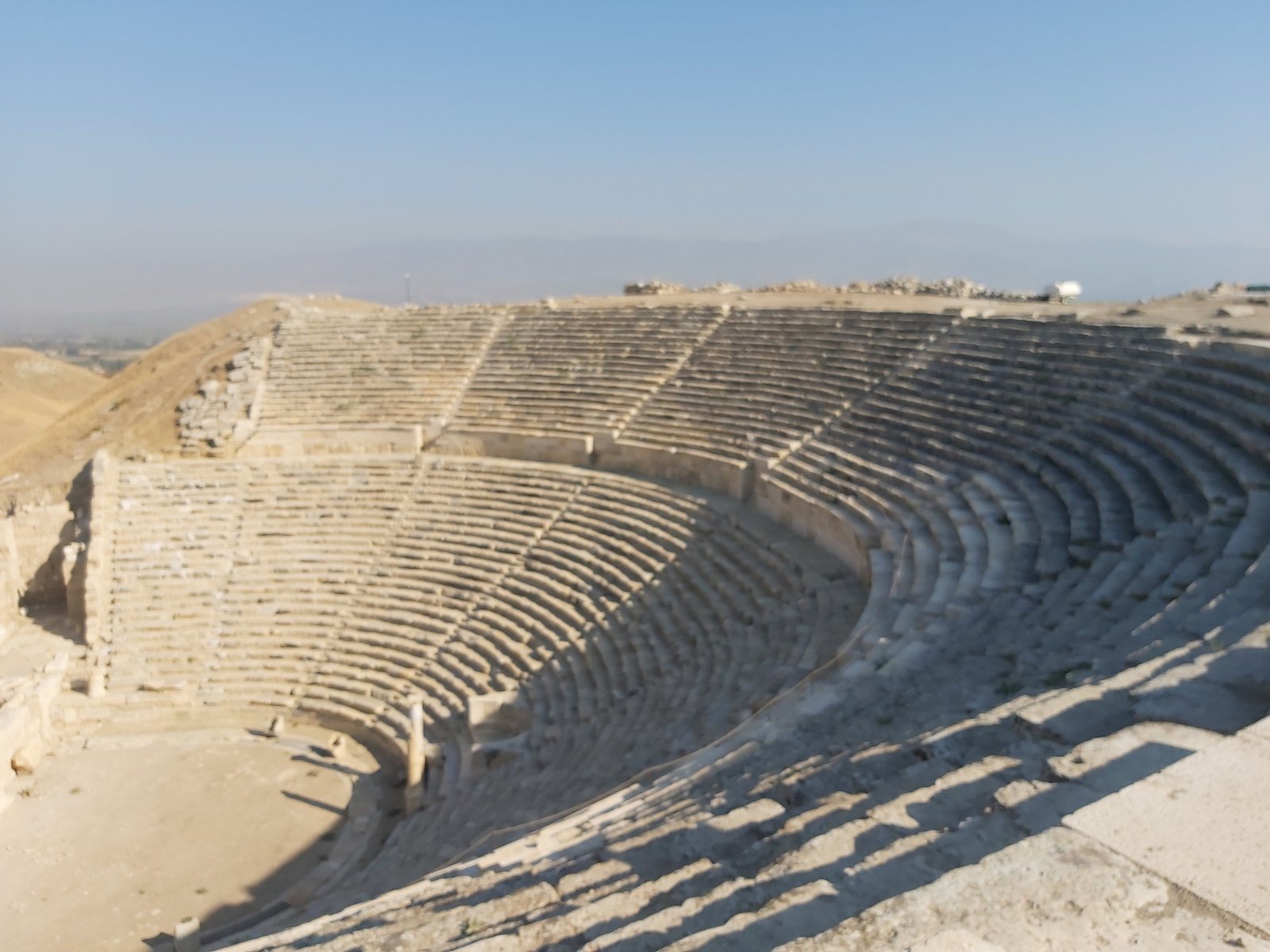
In May 2024 the excavators at Laodicea on the Lycus lifted a marble head out of the rubble packed into the stage building of the Western Theatre. It belonged to Hygieia, the goddess of health, and it had been lying there for roughly sixteen centuries because somebody in a hurry had used her to fill a wall. The find is a small one by the standards of Anatolian archaeology. What makes it worth an article is where it happened: a city whose coins carried the names of its doctors, and whose most famous piece of writing mocks it for selling eye ointment.
A head, and the body still underground
The excavation at Laodicea on the Lycus, near Denizli in western Türkiye, has been directed since 2003 by Professor Celal Şimşek of Pamukkale University. Work has run year-round since 2008, and the focus in recent seasons has been the stage building of the Western Theatre — a Hellenistic structure of the second century BC.
Earlier in the 2024 season the team recovered a statue of Asclepius, the god of medicine. Then, in May, came the head of his daughter Hygieia. It was lifted carefully from where it lay, and digging continued in the place where her body is presumed to be. As of the announcement, the body had not been found.
Both sculptures, Şimşek said, “were made in the Late Hellenistic-Early Augustan Period in the classical style of the fourth century BC” — that is, made around two thousand years ago, in deliberate imitation of a manner four centuries older still. Ancient sculpture is full of this kind of backdating; a Roman client who wanted a god of healing wanted one who looked like the gods of Praxiteles.
Why she survived: a wall built in a hurry
The interesting part is not the carving but the rubble.
Around AD 395–396, under the emperors Theodosius and Arcadius, Laodicea decided to defend itself against Sasanian incursions. The city that had to be walled was much smaller than the city of its prosperity, and the new circuit was thrown up fast. Part of it was built straight over the stage building of the Western Theatre.
To raise a wall quickly you need mass, and mass was standing all around in the form of a redundant theatre. According to Şimşek, the compartments and the parodos passages of the stage building were filled with rubble and statues. Painted ceiling coffers, pilaster capitals and painted columns went into the same fill. So did a great many sculptures of the late Hellenistic and early Augustan periods — thrown in, as he puts it, as fill.
This is the ordinary fate of ancient art, and it is worth saying plainly because it cuts against the way discoveries are usually reported. Hygieia was not hidden, buried or saved. She was construction aggregate. The reason her face is in good condition is that she was packed in tight and left alone, which is more protection than most marble gets across sixteen hundred years. The late Roman engineers who dumped her into a compartment did more for her survival than any of her worshippers.
The city where the doctors were on the coins
Laodicea is a reasonable place to find a god and goddess of health, and Şimşek made the connection when the head came up: the presence, in the territory administered from Laodicea, of the Herophileion — a medical school in the tradition of Herophilus of Chalcedon, the Alexandrian anatomist.
The school itself was not in the city. Strabo, who was a contemporary of the men who ran it, places it at the sanctuary of Men Karou, on the road between Laodicea and Carura. Zeuxis Philalethes — “truth-lover” — led it; Alexander Philalethes, a pupil of Asclepiades of Bithynia, succeeded him at the end of the first century BC; Demosthenes Philalethes followed, and was celebrated as an eye doctor. Şimşek singles out Strabo’s mention of “a doctor named Alexandros”.
The measure of what these men meant to the city is not literary but numismatic: the names of Zeuxis and Alexander appear on coins struck by Laodicea. Cities put gods, emperors and magistrates on their money. Laodicea put its physicians there.
The joke in the letter
Which brings the story round to the text that made Laodicea famous among people who have never heard of Zeuxis.
The Book of Revelation addresses seven churches in Asia, and the last and harshest letter goes to Laodicea: you are lukewarm, neither hot nor cold, and I am about to spit you out of my mouth. The image is usually read as pure metaphor. It is not. Laodicea’s water arrived tepid along an aqueduct from warm springs, while Hierapolis up the road had its famous hot water and Colossae its cold — a fact the excavations have confirmed in the pipework, and one we set out in our page on the site.
The rest of the letter works the same way. It tells the Laodiceans, who were rich, to buy gold refined in the fire; it tells them, in a city of black wool, to buy white garments; and it tells them to buy eye salve to anoint your eyes, that you may see. Every item on that list is something Laodicea sold. The banking, the textiles — and the ointment, from the city whose medical tradition produced a celebrated oculist.
Şimşek makes the point himself: the mention of eye salve in the letter shows the city mattered in health, not only in trade. Read that way, the Hygieia head and the Revelation letter are two pieces of the same fact. A first-century writer reached for eye ointment as the obvious thing to say to a Laodicean, in the same decades when the city was putting up statues of the goddess of health and stamping its doctors’ names on its coinage.
What you can see today
Laodicea is on the UNESCO World Heritage Tentative List and is among the most visited archaeological sites in Türkiye, with restoration running alongside excavation for more than twenty years. Two theatres, a stadium, colonnaded streets, bath complexes and two Early Christian basilicas have been re-erected or consolidated. The Western Theatre — the one in the photograph, where the sculptures came out — takes the afternoon breeze from the west, which is why it was put on that side of the hill.
The head itself is not on the hill. Finds of this kind go to the Denizli Museum, and anyone travelling for the sculpture rather than the site should check with the museum before setting out, because newly excavated material takes time to appear in the galleries. The site is a short drive from Pamukkale, and the two are normally seen on the same day.
If you go, the thing to look for is the stage building at the foot of the cavea, and the late wall driven across it. That wall is the reason there is anything to report.
Sources
- Statements by Professor Celal Şimşek, head of the Laodicea excavations, Pamukkale University, to Anadolu Agency, May 2024 — on the dating of the two sculptures, the Theodosius–Arcadius walls of c. AD 395–396 built over the stage building, the filling of the compartments and parodos passages with rubble and statues, the Herophileion, Strabo’s “Alexandros”, and the eye salve of the Revelation letter.
- ArtDog Istanbul, Head of Hygieia Found in Laodicea — for the sequence of the 2024 season (the Asclepius statue first, the Hygieia head on 20 May), the continuing search for the body, and the second-century BC date of the stage building.
- Strabo, Geography XII, on the Herophilean school at the sanctuary of Men Karou between Laodicea and Carura; on Zeuxis, Alexander and Demosthenes Philalethes and the appearance of their names on the city’s coinage, the standard reference entries in the Oxford Classical Dictionary and the Dictionary of Greek and Roman Biography and Mythology.
- Revelation 3:14–22.
Note on the images: this article does not reproduce the excavation photographs of the Hygieia head, which are held by the news agencies that published them. The photograph above shows the theatre where the find was made and is used under a free licence.