
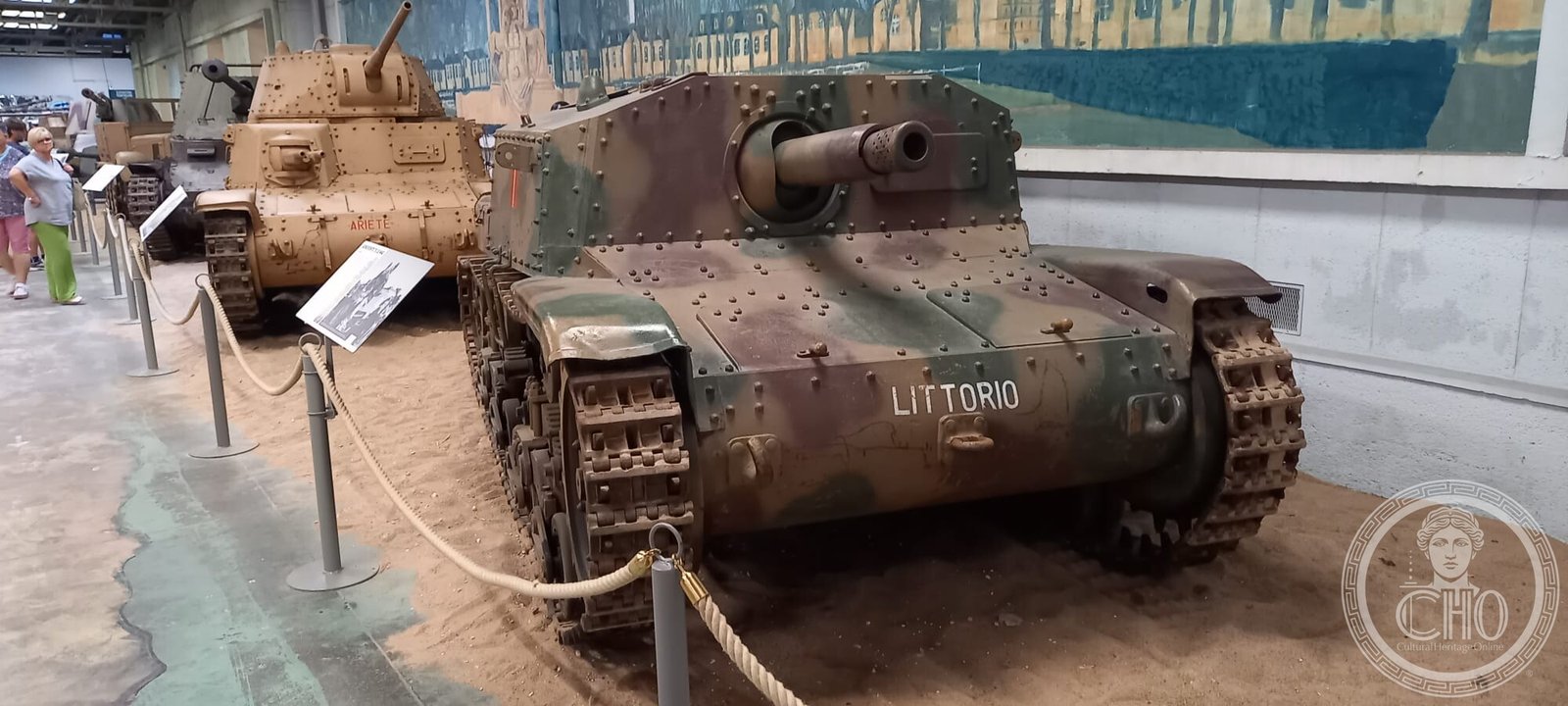
Sixty of these self-propelled guns were built, in a single year. Two are left. One of them is in the Loire, in a hangar in Saumur, three hundred metres from a Gothic castle.
At a glance
The Musée des Blindés — also called the Musée Général Estienne — holds the largest collection of armoured fighting vehicles in the world: well over 880 of them, more than two hundred still in running order. It grew out of the French army’s armour school at Saumur, and was opened in 1977 on the initiative of Colonel Michel Aubry. Among the vehicles are two Italian machines that survive almost nowhere else: a Semovente da 75/18 M40 and a medium tank M15/42.
Key facts
- Founded: 1977, on the initiative of Colonel Michel Aubry
- Named after: General Jean-Baptiste Eugène Estienne, who created the French tank arm in the First World War
- Collection: more than 880 armoured vehicles, over 200 of them operational
- The Italian pair: Semovente da 75/18 M40 (1941) and Carro Armato M15/42 (1943)
- Where: 1043 route de Fontevraud, Saumur, Maine-et-Loire
Why these two matter
Italian armour of the Second World War has largely ceased to exist. The vehicles were built in small numbers, most were destroyed or abandoned in North Africa and Italy, and what remained after 1945 went to the scrapyards of a country that had no reason to keep it. The result is that a machine which was once produced in the dozens is now counted in ones and twos, and that the surviving examples are scattered across countries that captured them rather than the country that made them.
The Semovente in this hall is a case in point. Sixty M40 were built, all in 1941. The specialist censuses of surviving vehicles count two left: this one, and one recovered after the war from the scrapyard at El Alamein and now at the war memorial there. Everything else went for scrap.
The Semovente da 75/18 M40
The idea belonged to Colonel Sergio Berlese of the Italian artillery: take the chassis of the M13/40 medium tank, remove the turret, and set a 75 mm howitzer low in a fixed casemate at the front. It was the same reasoning that produced the German assault gun, arrived at independently, and it gave the Italian army the most effective armoured vehicle it fielded. Ansaldo delivered the first prototype on 10 February 1941, thirteen months after the tank it was based on. Sixty were built on the M13/40 hull that year; later versions used the longer hulls of the M14/41 and the M15/42.
Its most publicised action came on 10 June 1942, south of the Knightsbridge Box during the battle of Gazala, where a group of Semoventi broke up a British armoured attack.
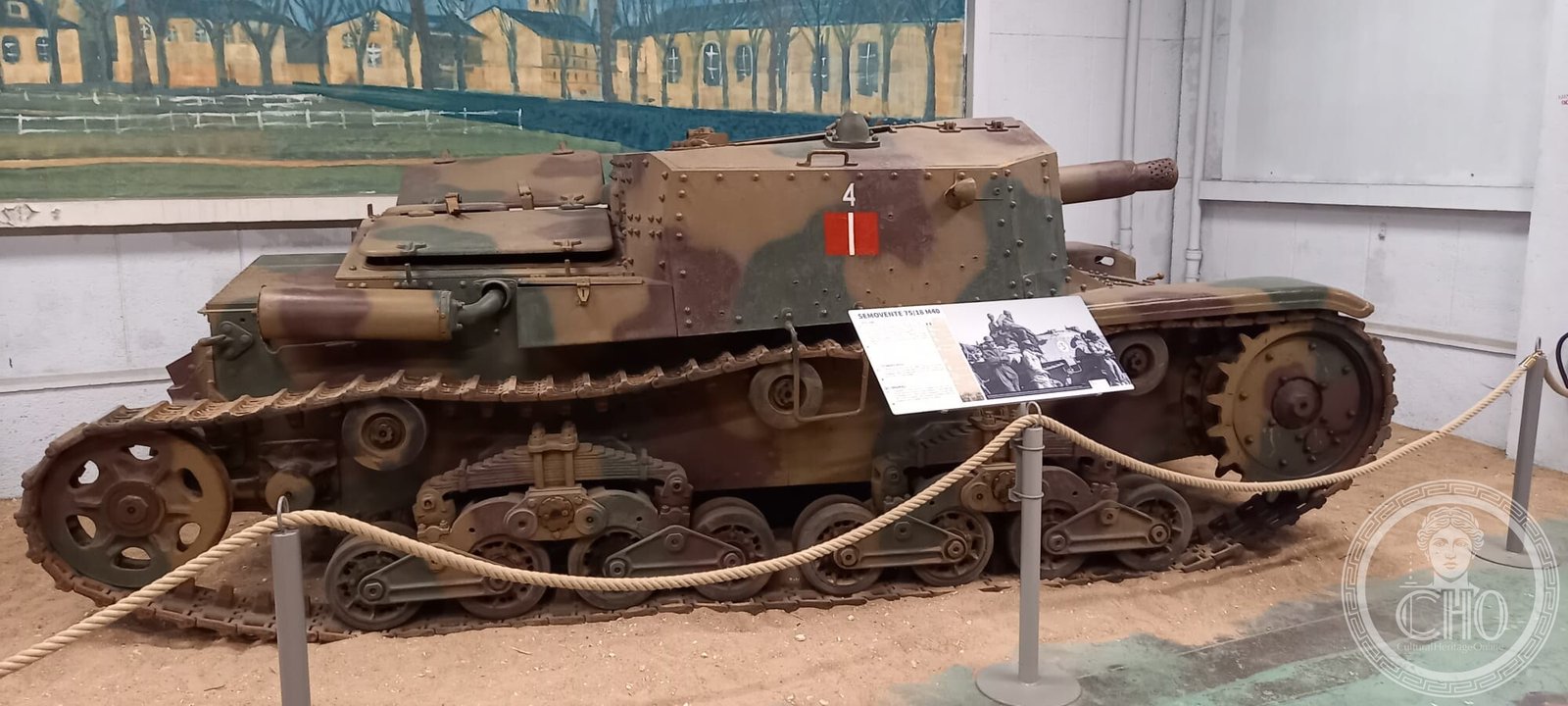
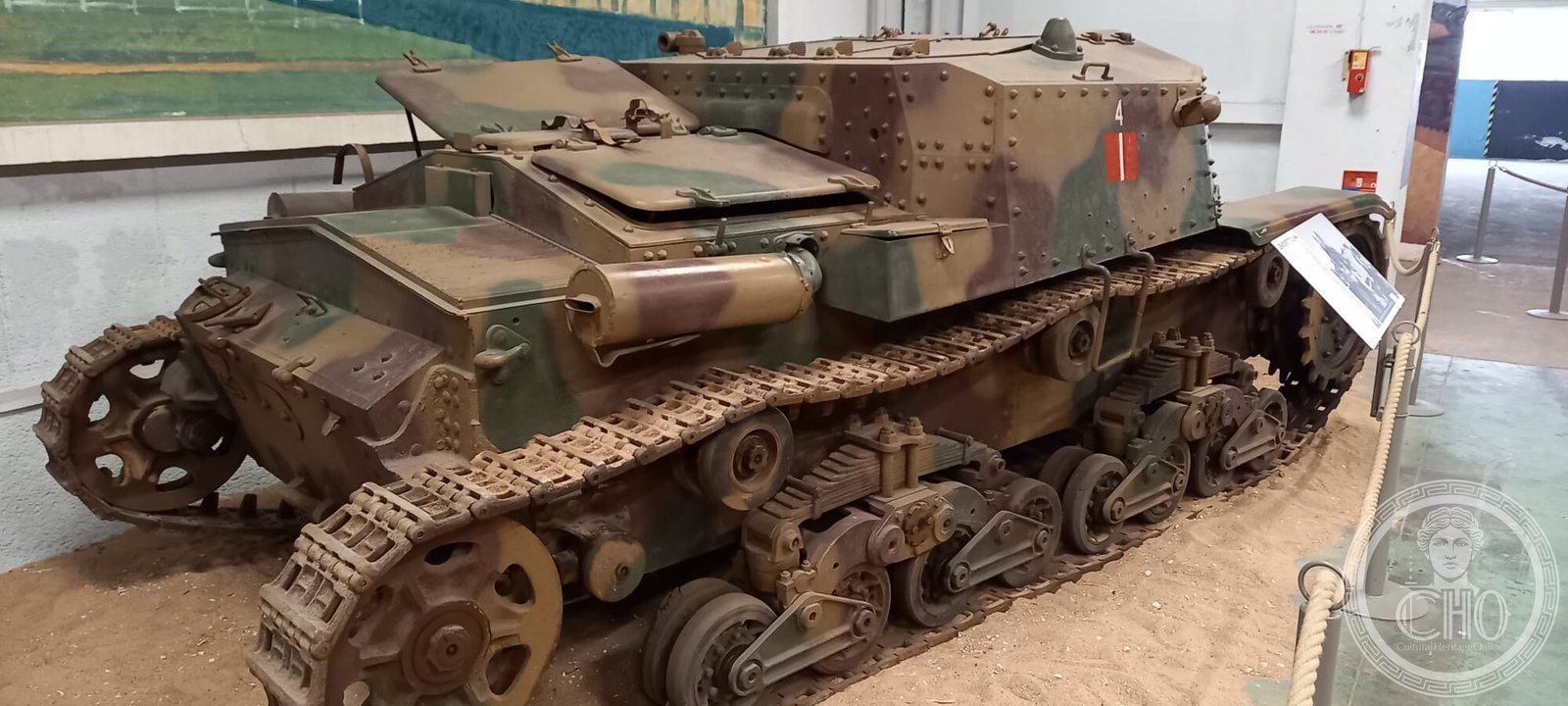
What the photographs show, better than any specification, is how small it is. The fighting compartment barely clears the top of the tracks; the gun is short and thick, made for lobbing shells rather than for velocity; the whole vehicle is riveted, plate to plate, in a way that had already been abandoned elsewhere by 1941. The suspension is the giveaway — leaf springs and small paired road wheels, a system designed in the 1930s for a lighter machine and asked to carry more than it was meant to.
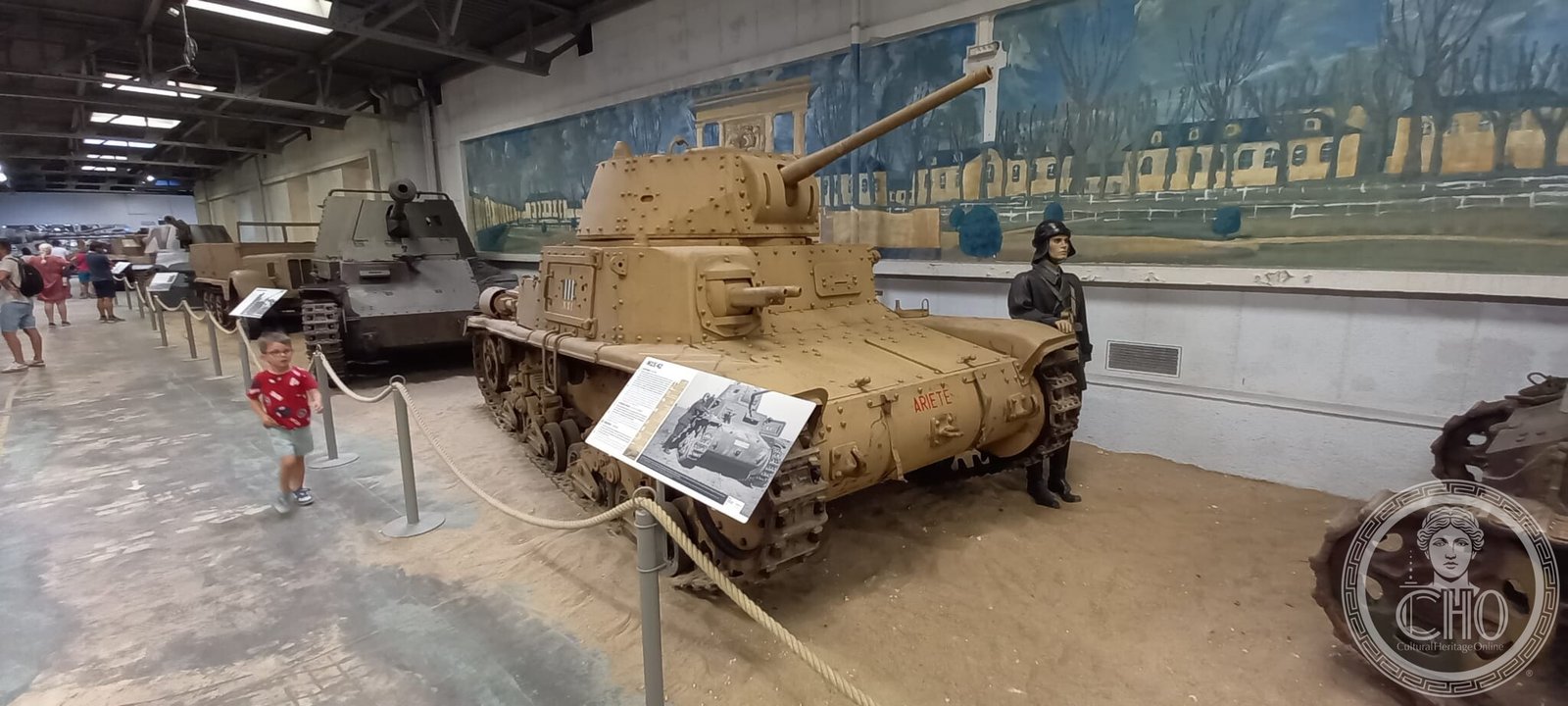
The Carro Armato M15/42
The tank standing near it is the end of the same family, and the end of the line. The M15/42 was drawn up from July 1942 by a team under the engineer Giuseppe Rosini; the prototype was tested between December 1942 and March 1943, and production began at Fiat-Ansaldo in July 1943. The hull was lengthened by fifteen centimetres to take a bigger engine, which needed longer tracks; the gun was the 47/40, longer and faster than the 47/32 it replaced.
The significant change is the one nobody wanted. The M15/42 ran on petrol, not diesel — a Fiat-SPA 15TB of 190 horsepower — because Italy’s diesel reserves were running out. A tank crew would rather have diesel: it burns less readily when the hull is hit. The switch is a fuel-supply decision written into the design of a fighting vehicle, and it tells you the state of the country that built it.
How many were made is genuinely disputed: the figures in circulation run between 112 and 248, depending on what is counted and when. Production was cut in half by the armistice of 8 September 1943; the Germans took about ninety-two of them, ordered more in 1944, and used them under their own designation, Panzerkampfwagen M 15/42 738 (i).
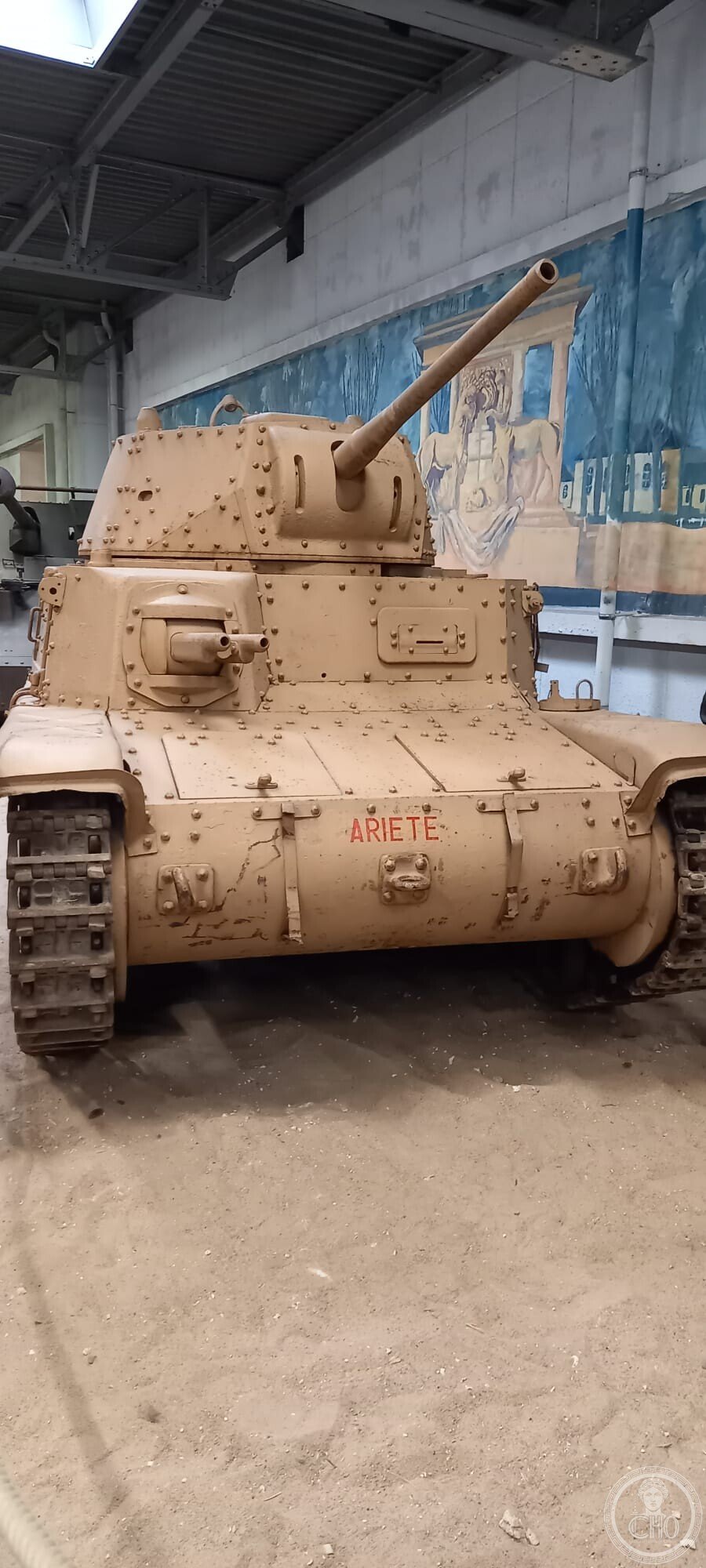
The two vehicles carry the names of the two Italian armoured divisions of the North African campaign — the 132nd, Ariete, and the 133rd, Littorio. Whether the paint is original or was applied for display, the labels in the hall do not say, and we have not been able to establish it. Read them as names, not as proof of which unit these particular machines served with.
Practical information
- Open to the public, with an admission charge; check the museum’s own site for current hours and prices before travelling.
- The collection is very large. Allow at least half a day if you intend to see it properly; the Italian vehicles are a small part of it and are easy to walk past.
- Vehicles are roped off but freely photographed, as our contributor’s pictures show.
- Combine it with the Château de Saumur, in the same town.
Getting there
The museum is on the eastern edge of Saumur, on the route de Fontevraud, about two kilometres from the town centre and the railway station. GPS: 47.24404, -0.07135 — open in Google Maps.
Nearby
- Château de Saumur — the castle above the Loire, in the same town.
Sources
- Wikipedia (English) — Musée des Blindés: the museum’s other name, Musée Général Estienne; its beginning in 1977 under Colonel Michel Aubry; more than 880 armoured vehicles, over 200 of them operational; the dedication to General Jean-Baptiste Eugène Estienne, creator of the French tank arm.
- Wikipedia (English) — Semovente da 75/18: the vehicle conceived by Colonel Sergio Berlese; Ansaldo as manufacturer; the first prototype delivered on 10 February 1941, thirteen months after the M13/40; sixty M40 built in 1941 on the M13/40 hull, 162 M41 on the M14/41 and 190 M42 on the M15/42 before the armistice; the action of 10 June 1942 south of the Knightsbridge Box at Gazala.
- Wikipedia (Italian) — M15/42: the design led by the engineer Giuseppe Rosini from July 1942, prototype tested December 1942 to March 1943, production at Fiat-Ansaldo from July 1943; the hull lengthened by 15 cm and the longer tracks; the 47/40 Mod. 1938 gun; the change from diesel to the petrol Fiat-SPA 15TB of 190 hp because diesel reserves were running down; production figures disputed between 112 and 248; about 92 vehicles taken by the Germans, 28 more ordered in 1944, redesignated Panzerkampfwagen M 15/42 738 (i).
- Tank Encyclopedia and the published censuses of surviving armoured vehicles, for the count of two surviving M40 — the Saumur vehicle and one recovered from the El Alamein scrapyard.
- The identification of both vehicles was read from the museum’s own labels in the contributor’s photographs (SEMOVENTE 75/18 M40; M15/42), and the descriptions of hulls, guns and running gear were made from those photographs.
Find it on the map
See this place and what’s around it →📷 Become a Cultural Heritage Online photographer
Share your photos of places: they stay published under your name as the author. The more they're seen, the more you get noticed — and soon a contest will reward the most appreciated photos.
Log in or sign up free to add a photo