

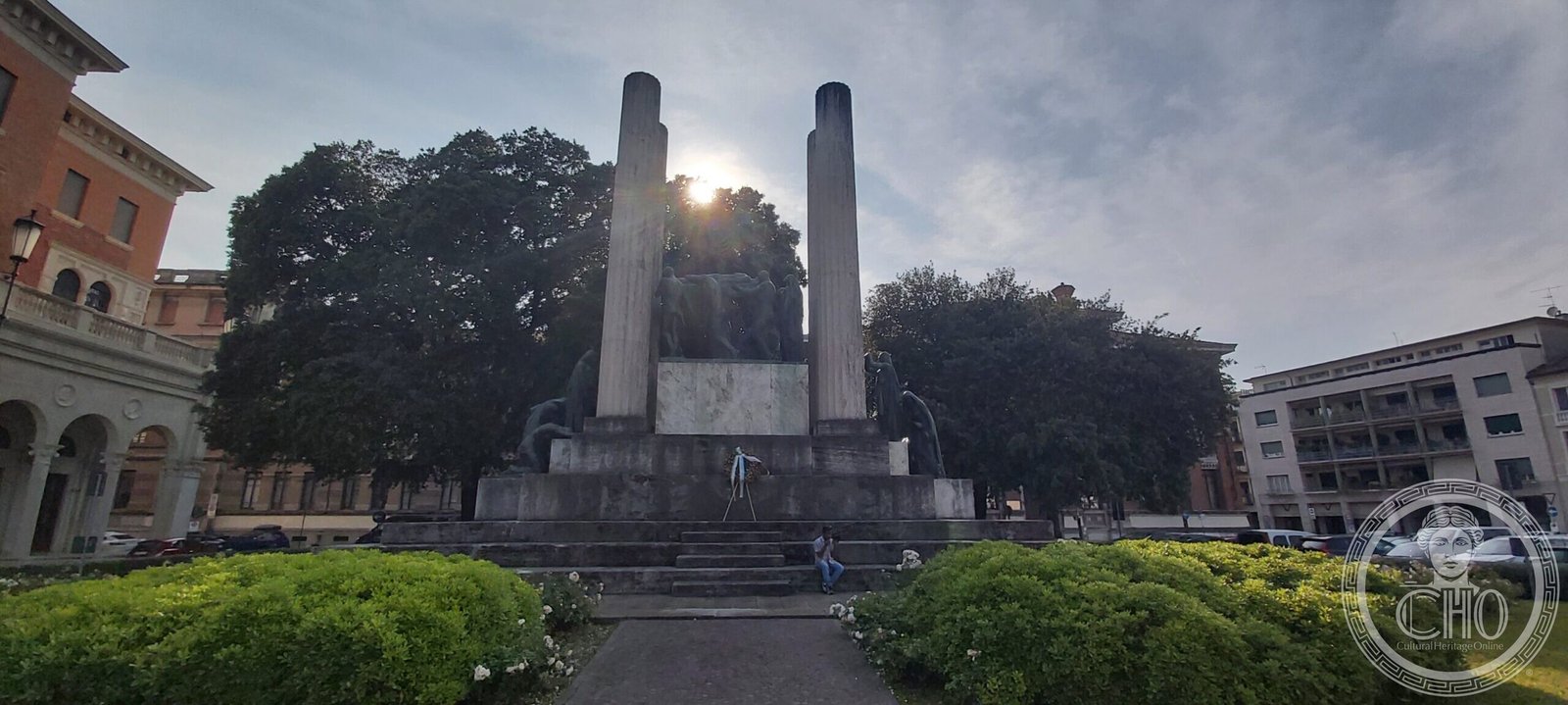
Sixteen bronze figures carry a dead man towards two marble columns. The sculptor refused to give him a face or an inscription, and said so: without either, he could be anyone’s.
At a glance
At the north-east corner of Piazza della Vittoria stands the monument the city calls Gloria. Two tall marble pylons rise from a stepped stone base; between and below them, sixteen bronze figures form a funeral procession — comrades and mourning women carrying a fallen soldier towards the columns, which stand for the temple of glory. It was won in a national competition in 1926–27 by Arturo Stagliano and unveiled on 4 November 1931 in the presence of the King.
Key facts
- Sculptor: Arturo Stagliano (Guglionesi, Molise, 10 March 1867 – Turin, 7 April 1936)
- Competition: national, announced 1 June 1926; the winner chosen 27 February 1927
- Unveiled: 4 November 1931, with Vittorio Emanuele III and the podestà Ignazio Chiarelli
- Composition: sixteen bronze figures on a stepped stone base, between two marble pylons
- Damaged: 7 April 1944 — the bombing toppled side figures and damaged the foundations
- Restored: from spring 1946; a full restoration re-inaugurated 24 September 2016
- Address: Piazza della Vittoria, Treviso — north-east corner
History
Treviso spent the last year of the Great War inside the artillery range. The city and the province wanted a monument to that, and went about it properly: a national competition opened on 1 June 1926, and on 27 February 1927 the commission chose Arturo Stagliano, a sculptor from Molise who had trained at the Naples Academy under Domenico Morelli and who in 1904 had moved to Turin to work in the studio of Leonardo Bistolfi. He had already made the war memorials of Novara and the ossuary at Cuneo.
The site was made for it. The old Piazza Bressa and Piazza della Cavallerizza were combined and renamed Piazza della Vittoria, and on 4 November 1931 — the anniversary of the armistice on the Italian front — the King unveiled the monument and the new post office in the same ceremony.
On 7 April 1944 the bombing of Treviso threw down the side figures and damaged the foundations. Restoration began in the spring of 1946. A further, complete restoration was finished and re-inaugurated on 24 September 2016.
What you see
Two plain marble shafts, close together and very tall, with no capitals and nothing on top — a doorway rather than a temple front. Between them, at the head of a short flight of steps, the bronze group: a body carried horizontally, bearers on either side, women on the lower platforms with their heads down. The central figure has a sword, a shield with a Christian cross on it, and laurel.
What it does not have is the point. Stagliano wrote that the work has neither a defined face nor an inscription. There is no list of names on the sculpture, no unit, no date of a battle. Compare it with the standard product of the same decade — a helmeted victory, an eagle, a slogan — and the difference is deliberate: this is a funeral, and the dead man is not identified because he is meant to stand in for whoever the person looking has lost.
Approach it from the south, with the sun behind the columns, and the bronzes go almost black between two white verticals. It was designed to be seen from the square, at that distance, with the post office on the left.
Practical information
- Open square, always accessible, no charge.
- Best light in the late afternoon, when the columns catch the sun from behind.
- Allow 15 minutes; the post office and the Riccati building are on the same square.
Getting there
Piazza della Vittoria is in the southern part of the walled centre of Treviso, about ten minutes on foot from Treviso Centrale station. GPS: 45.66313, 12.24252 — open in Google Maps.
Nearby
- Palazzo delle Poste e Telegrafi — unveiled with the monument on 4 November 1931.
- Istituto Tecnico Riccati — on the same square.
- Walls of Treviso
Sources
- Wikipedia (Italian) — Monumento ai caduti (Treviso): the competition announced 1 June 1926 and decided 27 February 1927; the inauguration of 4 November 1931 with Vittorio Emanuele III; sixteen bronze figures forming a funeral procession; the sword, the shield with a Christian cross and the laurel on the central figure; Stagliano’s statement that the work has neither a defined face nor an inscription; the position at the north-east corner of Piazza della Vittoria, formerly Piazza Bressa and Piazza della Cavallerizza; the damage of 7 April 1944, the restoration from spring 1946 and the re-inauguration of 24 September 2016.
- Wikipedia (Italian) and the monograph Arturo Stagliano 1867–1936. Sculture e disegni (A. Panzetta) — the sculptor’s dates, Guglionesi 10 March 1867 to Turin 7 April 1936; his training under Domenico Morelli at Naples and his move to Bistolfi’s studio in Turin in 1904; the war memorials of Novara and the ossuary of Cuneo.
- Local press — the presence of the podestà Ignazio Chiarelli at the unveiling.
- The description of the group as it stands today was made from the contributor’s photograph.
Find it on the map
See this place and what’s around it →Record researched and written by Stefano Vigolo for Cultural Heritage Online, 2026.
📷 Become a Cultural Heritage Online photographer
Share your photos of places: they stay published under your name as the author. The more they're seen, the more you get noticed — and soon a contest will reward the most appreciated photos.
Log in or sign up free to add a photoRequest to use these images
Each photograph is by the person named on it. Cultural Heritage Online is the seller: it runs the payment, handles tax and delivers the file, and the photographer receives 70% of the price net of tax. Buying gives you the right to use the image in your own project — a website, an article, a presentation — with the file and a written licence. Read the Terms of Sale.
What you receive. The file as it is held in our archive: the photographer's own original, without the Cultural Heritage Online watermark, unretouched and not enlarged. This is a working archive built over many years by many people, so the files differ — some were taken recently, others years ago with the equipment of their time. Older pictures are usually smaller: a camera from fifteen or twenty years ago simply recorded fewer pixels than a phone does today, so the resolution is lower and the print comes out smaller. We say so rather than hide it. The size, weight, format and year of each one are printed below it, and the print size is given at 300 dpi. Nothing is upscaled to make a number look better. Where the picture on this page has been cropped for the layout, the file you receive is the full frame, which may be wider or taller than what you see here.
Gloria, the war memorial of Treviso
Photo: Stefano Vigolo
€3.00
2593 × 1166 px · JPG · 555.7 KB
prints 22 × 10 cm at 300 dpi · taken 2025
Is this page about you?
This page is read by travellers and heritage enthusiasts who find it on Google. Tell us how you are connected to this place and we will take it from there.