
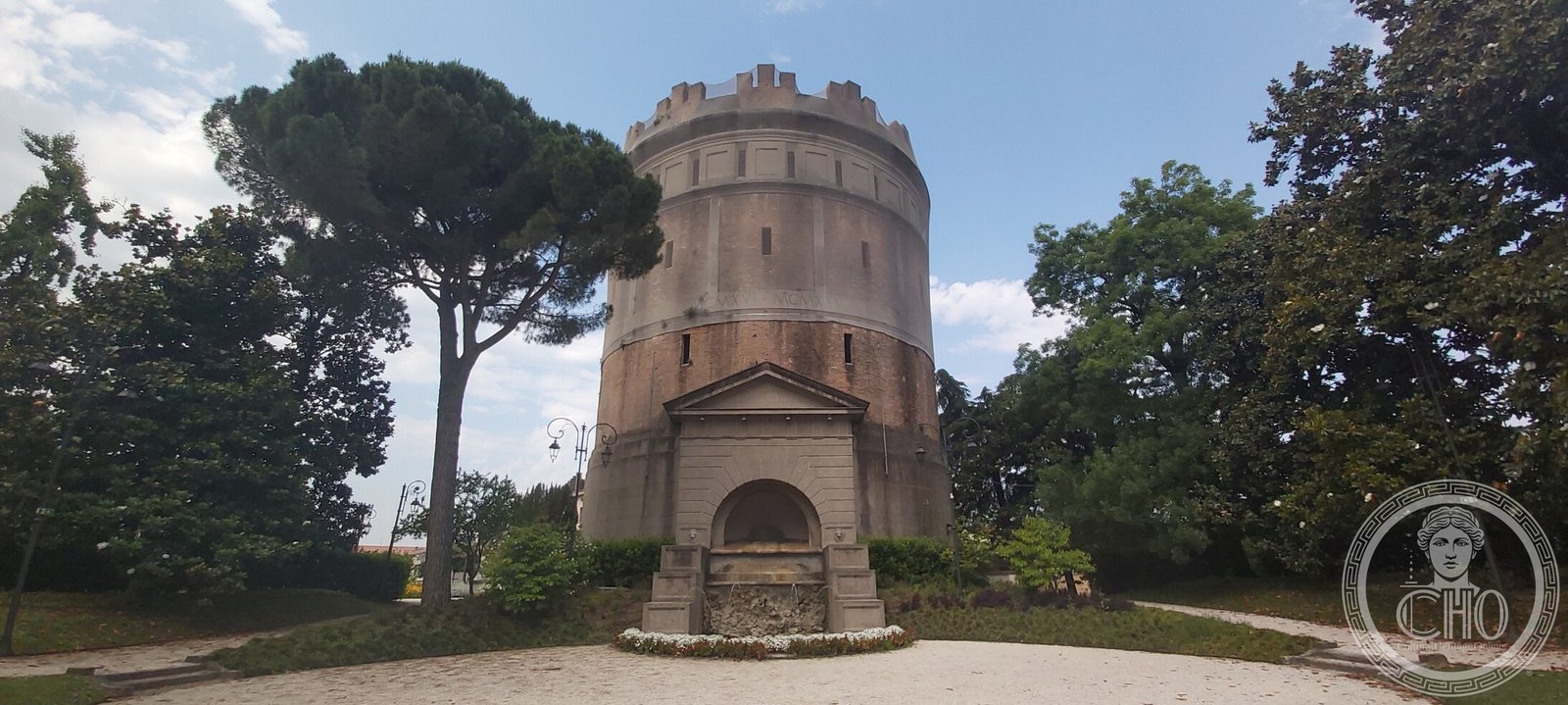
A 36-metre reservoir dressed as a Roman mausoleum, built on the bastion where an air raid had buried ninety-three civilians. The dates cut into its wall are not the years it was built: they are 1916 and 1925, the raid and the memorial.
At a glance
Padua’s first modern water reservoir stands at the edge of the old city, on the sixteenth-century bastion known as the Bastione della Gatta. It was designed by Tullio Paoletti, chief engineer of the municipality, and inaugurated on 14 June 1925 — at the time the largest aqueduct reservoir in Italy and among the largest in Europe. It is also a grave. On 11 November 1916 an Austro-Hungarian air raid struck the bastion and ninety-three civilians sheltering there were killed; they were never recovered, and the memorial chapel at the tower’s foot was raised over them in the same campaign that raised the tank above.
Key facts
- Engineer: Tullio Paoletti, chief engineer of the Comune di Padova
- Built: 1923–1925; inaugurated 14 June 1925 in the presence of Marshals Diaz and Cadorna
- Height: 36 metres
- Capacity: 2,000 cubic metres, fed by the springs of Dueville in the province of Vicenza
- Beneath it: the sacello of the Rotonda, over the ninety-three civilians killed on 11 November 1916
- Around it: the Giardini della Rotonda, about 5,163 square metres of terraces and fountains, opened 1925 and restored in spring 2024
- Where: Giardini della Rotonda, near Piazza Mazzini, Padua
History
The bastion came first. Padua’s sixteenth-century walls left a wide earthwork on the northern edge of the city, and in the First World War its vaults were used as a public shelter. On 11 November 1916 a bomb hit it. Ninety-three civilians died inside, and the collapse was such that the bodies were left where they fell; the city declared official mourning and put up a plaque in 1918.
In the early 1920s the municipality needed somewhere to store water. The aqueduct drew on the springs of Dueville, forty kilometres north, which yielded steadily through the night while the city drank by day, and the difference had to be held somewhere high. Tullio Paoletti, the city’s chief engineer, put the tank on the bastion — and in doing so had to build over the dead. His answer was to make the two things one building: a memorial chapel at ground level, circular, carried on reinforced-concrete buttresses, and above it the reservoir, its concrete frame wrapped in a drum of brick and stone that quotes the great cylindrical mausoleums of antiquity.
It opened on 14 June 1925, with the Marshals of Italy Armando Diaz and Luigi Cadorna present — a civil-engineering inauguration conducted as a war commemoration. The gardens laid out around it opened the same year. A century later, in spring 2024, the gardens were restored with funding from Fondazione Cariparo: the original planting was brought back and the fountains made to run again.
What you see
From the gardens the tower reads as a single fat cylinder, tapering slightly, crowned with a ring of blunt merlons. Below the crown a band of shallow panels runs right around the drum; below that the wall changes texture from render to bare brick, and it is on this dividing course that the inscription is cut, in Roman capitals set well apart: MCMXVI · MCMXXV. It is worth pausing on those two numbers, because they are the reason the building is shaped the way it is. They are not the years of construction. They are 1916, the raid, and 1925, the year the dead were finally given a monument.
At the base, facing the main path, a small pedimented aedicule frames an arched niche with a fountain that spills into a rough stone basin — the public face of the sacello. Inside, a bronze votive lamp in the form of a Medusa’s head hangs from the ceiling, and a small altar on the back wall carries a bronze relief after Mantegna’s Lamentation, the Paduan painter’s most famous composition. The chapel is in poor condition and has been flagged as needing urgent restoration.
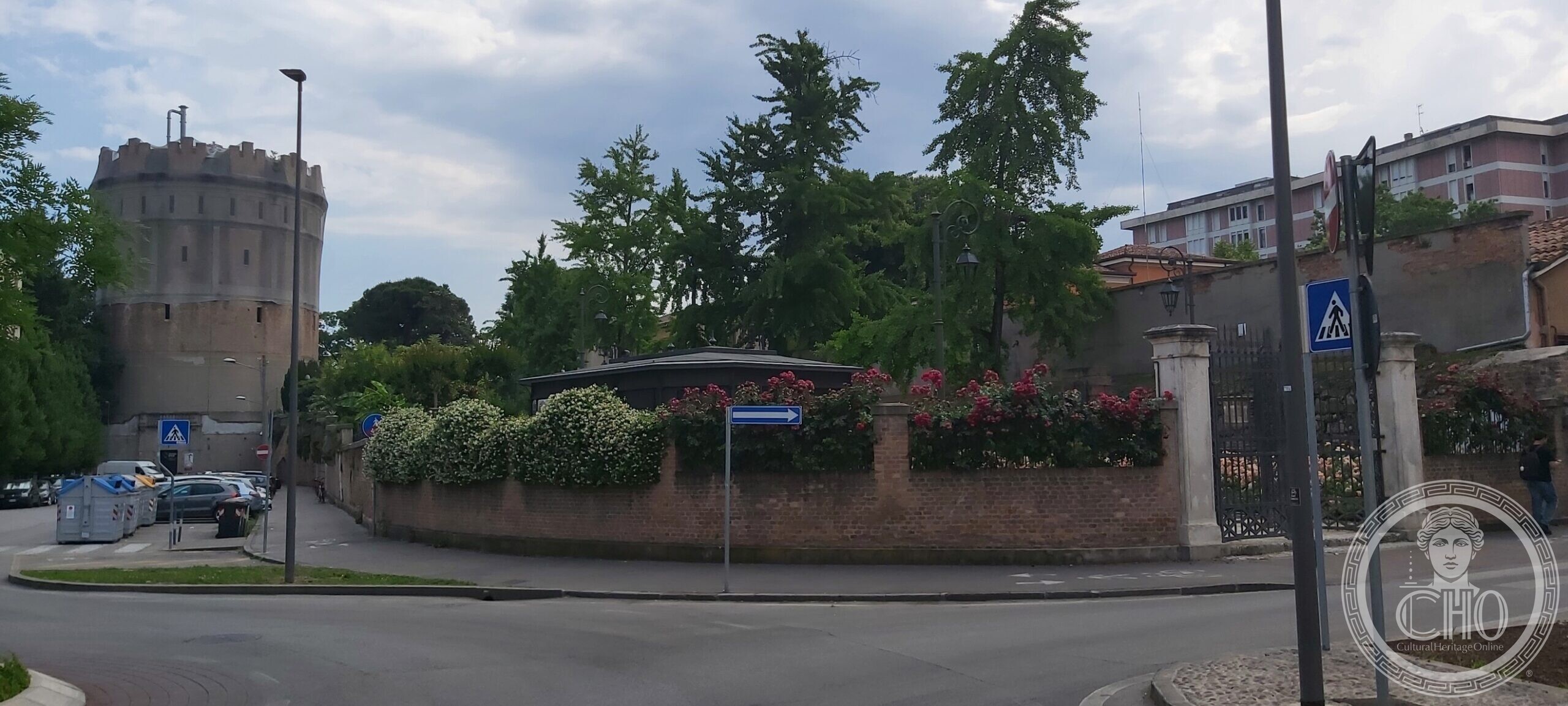
Walk out to the street corner and the building changes character completely. From below, over the brick garden wall and the roses, only the crenellated top is visible above the trees: from that angle it stops looking like a water tank altogether and looks like the keep of a castle that was never there.
Practical information
- The gardens are a public park, freely accessible; the tower and the sacello are seen from outside.
- Five circular terraces, each with its own fountain, step up around the base — the fountains run again since the 2024 restoration.
- Allow 20–30 minutes, more if you walk the terraces.
Getting there
The Giardini della Rotonda lie just north of the historic centre, beside Piazza Mazzini, about ten minutes on foot from the Scrovegni Chapel and fifteen from Padova railway station. GPS: 45.41516, 11.87514 — open in Google Maps.
Nearby
- Casa del Mutilato — Padua — on Piazzale Mazzini, two minutes away: the veterans’ house built for the men the same war sent home maimed.
- Palazzo Liviano — Gio Ponti — the university building of the following decade.
Sources
- Padova e la Grande Guerra — Il sacello della Rotonda: the raid of 11 November 1916, the ninety-three victims, the 1918 plaque, the 1925 chapel, the Medusa lamp and the Mantegna relief, and Paoletti’s reservoir above it.
- Blog di Padova — I giardini della Rotonda: construction 1923–1925, inauguration 14 June 1925, height 36 m, capacity 2,000 m³, the Dueville springs, the garden’s 5,163 m² and the 2024 Cariparo restoration.
- PadovaOggi — on the centenary of the gardens and the reopening of the fountains.
- The inscription MCMXVI · MCMXXV was read from the contributor’s photograph of the drum.
Gallery
More views — photographs by Stefano Vigolo, 2026.
Find it on the map
See this place and what’s around it →Record researched and written by Stefano Vigolo for Cultural Heritage Online, 2026.
📷 Become a Cultural Heritage Online photographer
Share your photos of places: they stay published under your name as the author. The more they're seen, the more you get noticed — and soon a contest will reward the most appreciated photos.
Log in or sign up free to add a photoIs this page about you?
This page is read by travellers and heritage enthusiasts who find it on Google. Tell us how you are connected to this place and we will take it from there.