

For twenty-seven years Émile Gallé came to this valley to have his ideas made in glass. The furnaces went cold in 1969. The village kept the knowledge.
At a glance
Meisenthal sits in a narrow wooded valley in the Northern Vosges, close enough to the German border that its history was written twice over. A glassworks opened here in 1704 and stayed open for two hundred and sixty-five years. What makes the place matter beyond local industrial history is a single working partnership: between 1867 and 1894 Émile Gallé (1846–1904), the Nancy botanist and designer who led the École de Nancy, used the Meisenthal furnaces as his laboratory. The glassworks itself now calls the village the cradle of Art Nouveau glass. The Musée du Verre occupies part of the old industrial site, alongside the Centre International d’Art Verrier, where a furnace burns again.
Key facts
- Glassworks founded: 1704, by descendants of the Walter family of the nearby Soucht glassworks; the first furnaces were lit in 1711
- The Gallé years: 1867–1894, technical and decorative research carried out with local glassblowers
- Peak workforce: around 650 employees in the 1920s, producing blown and pressed utility glass
- Industrial closure: 1969
- On site today: Musée du Verre, Centre International d’Art Verrier, and the restored Halle Verrière
- Address: 1 place Robert Schuman, 57960 Meisenthal, France
History
The valley was glass country before Meisenthal existed. After the Thirty Years’ War emptied the region, glassmaking families moved through the Northern Vosges looking for the three things the craft needs in quantity: sand, potash and wood. In 1704 descendants of the Walter family, from the glassworks at Soucht, settled on an older inhabited site and opened a furnace. Housing, wood-drying sheds and potash kilns followed. The village that grew around the works made bottles, storage jars and window glass for Lorraine and Alsatian markets, then complete table services — drinking glasses, carafes, honey pots, mustard jars — which became its signature.
Then came Gallé. From 1867 to 1894 he worked with the Meisenthal glassmakers on techniques nobody had asked them for: layered coloured glass, inclusions, surfaces that behave like plant tissue. His interest was botanical before it was decorative, and getting the detail right forced the workshop to invent. In 1894 he opened his own glassworks in Nancy and the collaboration ended, though he kept buying Meisenthal glass paste. The techniques stayed in the village.
Coal, then the twentieth century. The manufactory expanded, employed around 650 people in the 1920s, survived two wars in a border region that changed nationality repeatedly, and specialised after 1945 in hand-made white, opal and coloured glass. It did not modernise its tooling in time. On 31 December 1969 the works closed. The site stood empty until the museum and, later, the glass art centre gave it a second life.
What you see
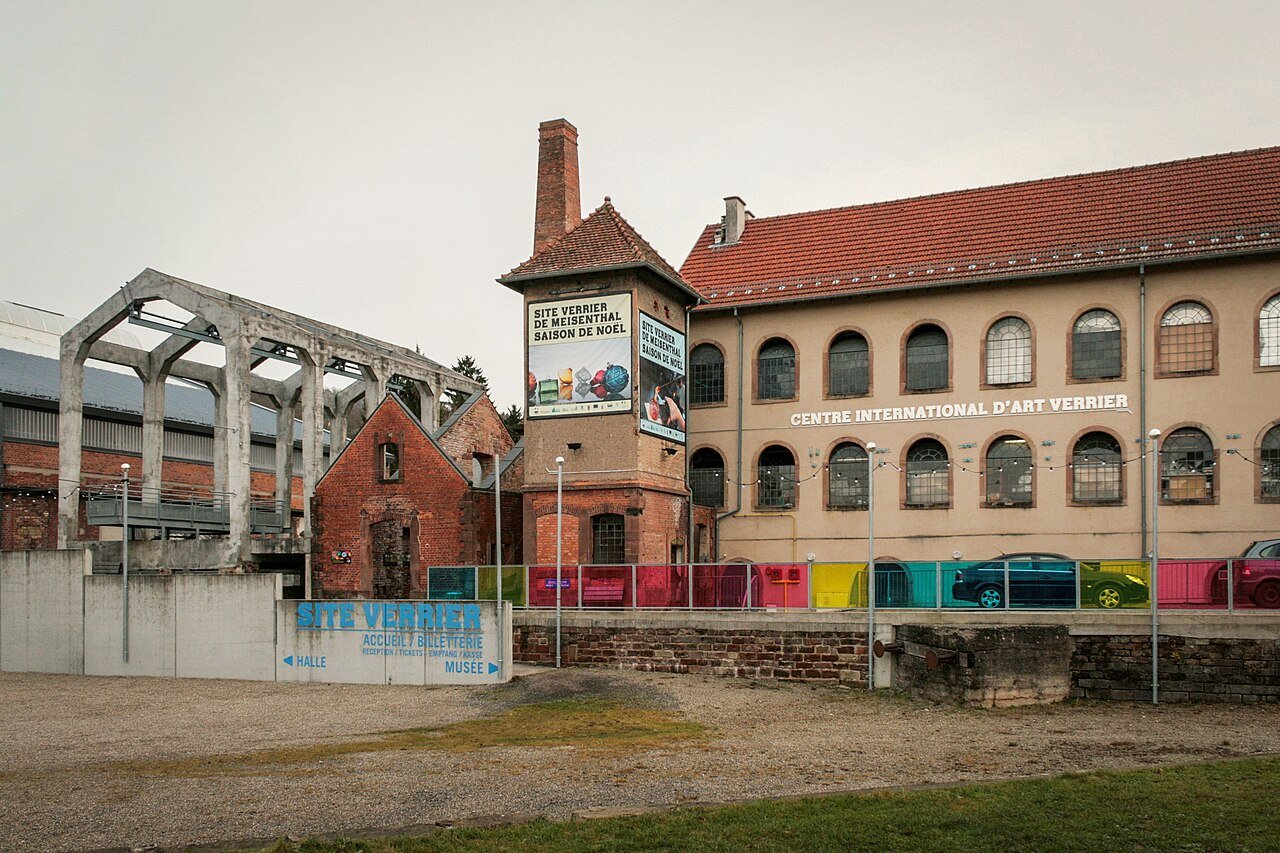
This is an industrial site, not a palace, and it reads as one. Brick and rendered workshop ranges, a tall brick chimney, bare concrete frames left standing where a hall came down, and the long arcaded elevation of the glass art centre with its round-headed windows. The volumes were built around the heat of a furnace and the movement of men carrying it: domestic at the edges, suddenly enormous in the middle, which is what a glassworks is.
Inside the Musée du Verre the argument is made in objects. Utility glass from the eighteenth and nineteenth centuries sits alongside the Gallé-period pieces, and the jump between them is the whole point: the same hands, the same furnace, a completely different idea of what glass is for. At the Centre International d’Art Verrier a furnace is lit and glassblowers work in front of visitors, which turns the museum’s historical claim into something you can hear.
Getting there
Meisenthal lies in the Pays de Bitche, in the north-east corner of Moselle, roughly an hour by road from Strasbourg, Saarbrücken and Sarreguemines. The nearest airports are Strasbourg and Saarbrücken; Luxembourg and Frankfurt-Hahn are within longer driving distance. Public transport into the valley is thin, and a car is the practical option. Coordinates: 48.9651, 7.3526 (Google Maps).
Nearby
- Nancy — The École de Nancy and French Art Nouveau, where Gallé took what he learned here
- The Musée de l’École de Nancy, in the Corbin villa, holds glass by Gallé, Majorelle and Daum
- The Pays de Bitche keeps two other glass sites: Saint-Louis-lès-Bitche and Soucht
Sources
- Site verrier de Meisenthal — official history of the glassworks
- Musées Grand-Est, regional museums network
- Wikimedia Commons, hero image record
- OpenStreetMap Nominatim, coordinate verification
Find it on the map
See this place and what’s around it →Events here — now on & upcoming
- Eugène Kremer, compagnon de l'Art nouveau01 Apr 2026 — 03 Jan 2027See the event →
📷 Become a Cultural Heritage Online photographer
Share your photos of places: they stay published under your name as the author. The more they're seen, the more you get noticed — and soon a contest will reward the most appreciated photos.
Log in or sign up free to add a photoIs this page about you?
This page is read by travellers and heritage enthusiasts who find it on Google. Tell us how you are connected to this place and we will take it from there.