
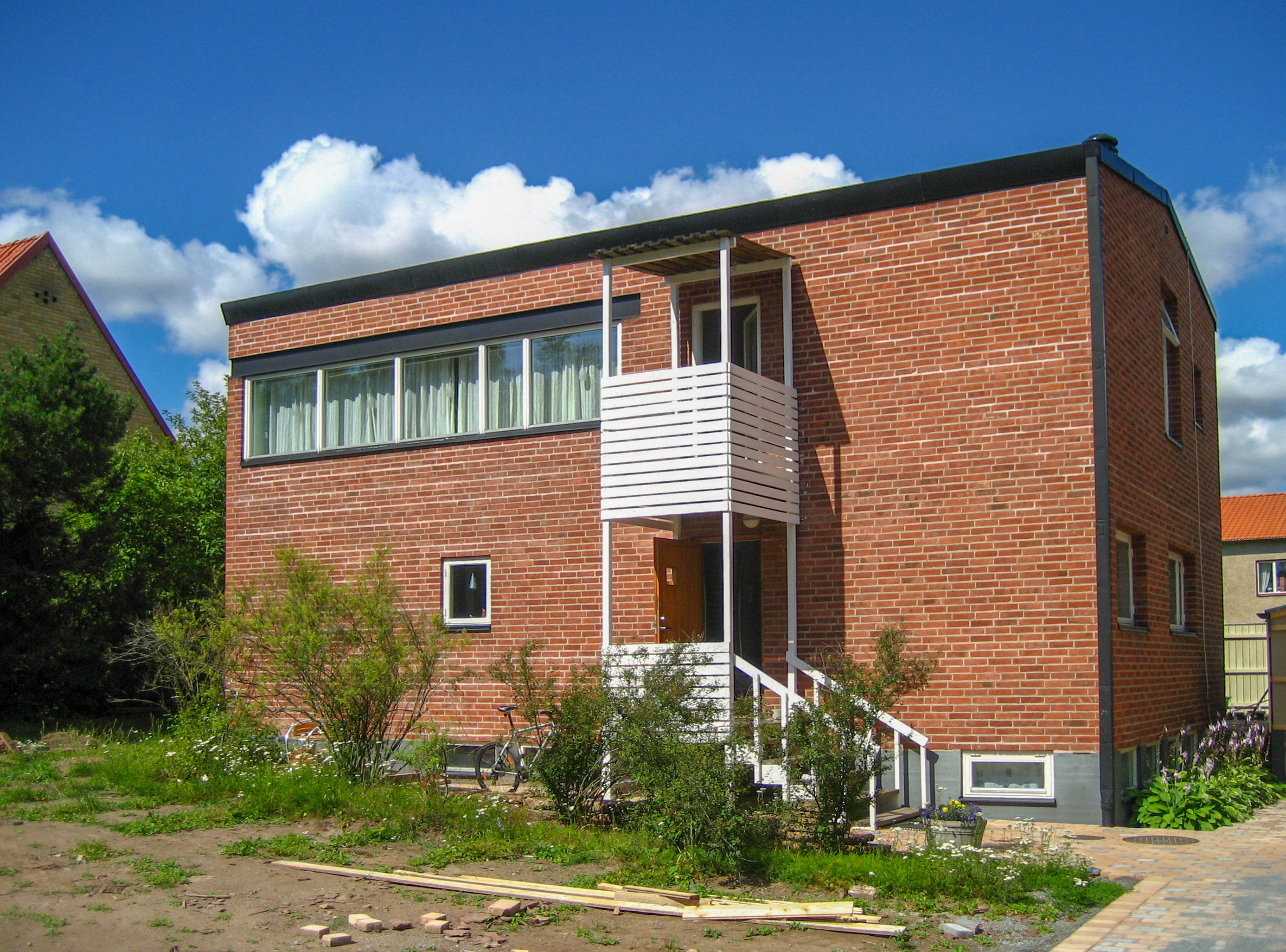
A modernist house in Uppsala that became an unexpected landmark in architectural history, credited as the believed source of the term brutalism.
At a glance
Villa Göth stands on Döbelnsgatan in the Kåbo neighborhood as a masterwork of early Swedish modernism. Completed in 1950 and designed by architects Bengt Edman and Lennart Holm, the residence was built for Elis Göth, head of the pharmaceutical company Pharmacia. Today it is protected as a building of special architectural interest (byggnadsminne).
History
Commissioned by one of Sweden’s leading industrialists, Villa Göth emerged during a pivotal moment in Nordic design. The house represents the philosophical shift toward honest material expression and functional clarity that would define mid-century modernism. Its construction and design philosophy would later influence international discussions about brutalism and the raw beauty of exposed materials.
What you see
The two-story residence with basement employs dark brick as its primary material, a choice that gives the façade visual weight and warmth. Rows of plain windows create rhythm across the elevations, while exposed I-beams frankly display the structural logic of the building.
Inside, the design refuses conventional concealment. Visible tongue-and-groove patterns from concrete formwork appear in the ceilings. Interior walls echo the dark brick exterior. Bathrooms on the first floor are finished in raw concrete (béton brut), deliberately shaped like Alvar Aalto’s iconic Aalto Vase. A central open stairway connects all floors, becoming the compositional heart of the open-plan interior.
Cultural significance
Villa Göth holds particular importance in international architectural history as the believed source of the term brutalism. The house exemplifies the aesthetic and ethical principles—material honesty, structural clarity, and rejection of ornament—that would define brutalist architecture globally. It remains a reference point for understanding how Scandinavian functionalism evolved and how Swedish design influenced postwar modernism.
Key facts
- Country: Sweden
- City: Uppsala Municipality
- Completed: 1950
- Architects: Bengt Edman and Lennart Holm
- Protected status: Byggnadsminne (building of special architectural interest)
- Coordinates: 59.844, 17.6298
Practical information & getting there
Villa Göth is located on Döbelnsgatan in the Kåbo neighborhood of Uppsala. As a protected historical building, exterior viewing is available, though interior access may be restricted. Uppsala is easily reached by train from Stockholm (approximately 40 minutes) and other Swedish cities. Visitors should check locally for any visiting arrangements or guided tour availability.
Sources & resources
Find it on the map
See this place and what’s around it →📷 Become a Cultural Heritage Online photographer
Share your photos of places: they stay published under your name as the author. The more they're seen, the more you get noticed — and soon a contest will reward the most appreciated photos.
Log in or sign up free to add a photoIs this page about you?
This page is read by travellers and heritage enthusiasts who find it on Google. Tell us how you are connected to this place and we will take it from there.