
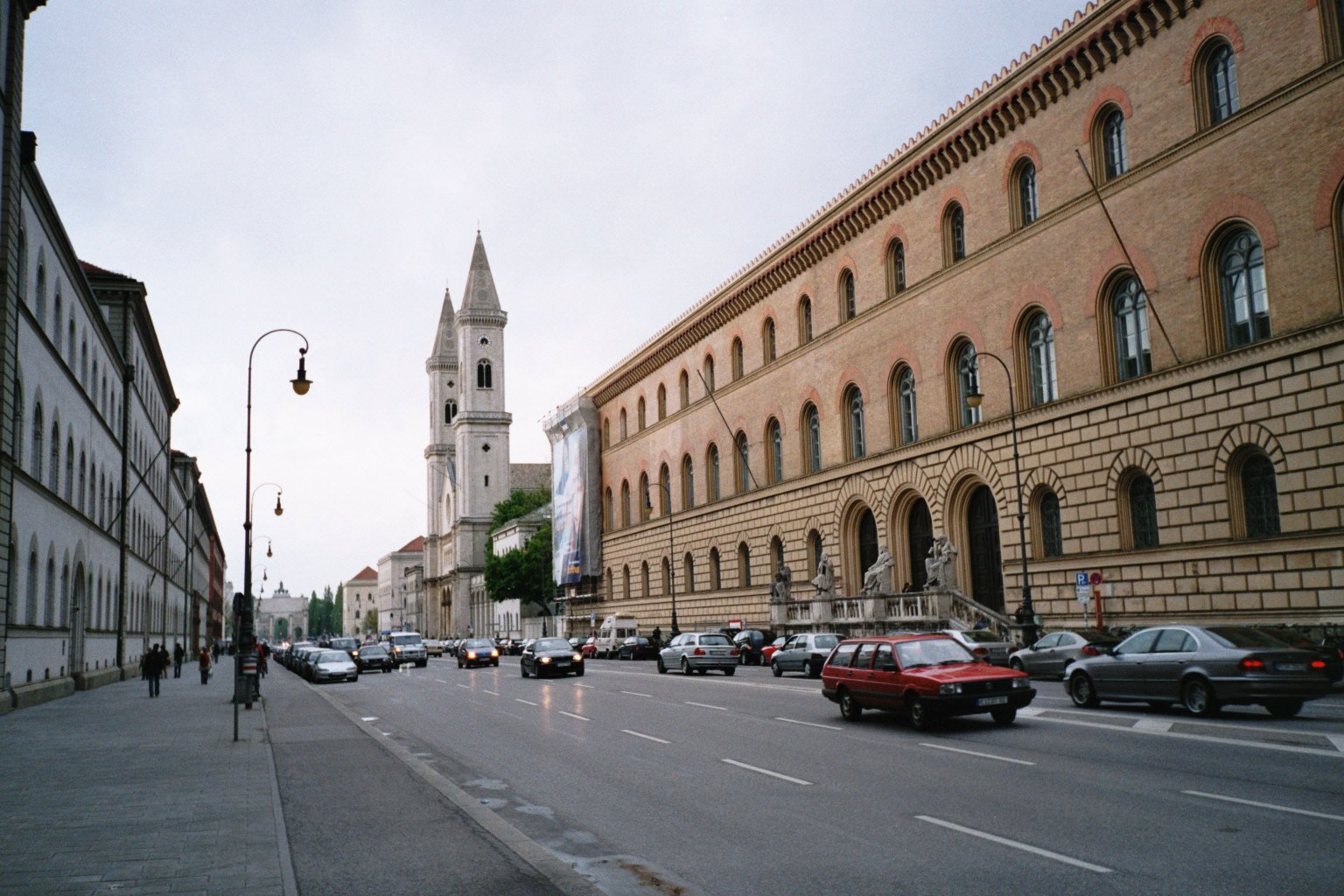
One of Munich’s four royal avenues, Ludwigstraße remains a masterpiece of urban planning—a grand boulevard that embodies King Ludwig I’s vision of a street worthy of his kingdom.
At a glance
Named after King Ludwig I of Bavaria, Ludwigstraße ranks among Munich’s most significant thoroughfares. It stands alongside the Brienner Straße, Maximilianstraße, and Prinzregentenstraße as one of the city’s four principal royal avenues. The street has maintained remarkable architectural uniformity since its conception.
History
King Ludwig I commissioned Ludwigstraße as part of an ambitious vision to create a boulevard that would reflect the grandeur and power of his kingdom. The avenue was designed to be worthy of royal aspirations—a physical manifestation of Munich’s status as a cultural and political capital. Throughout its history, the street has served as the ceremonial heart of the city, hosting state parades and funeral processions.
What you see
Ludwigstraße exemplifies the carefully orchestrated urban design that distinguishes Munich’s royal avenues. The boulevard’s defining characteristic is its architectural uniformity—a deliberate aesthetic unity that creates a cohesive sense of grandeur along its entire length. This consistency distinguishes it from more eclectic urban streets.
Cultural significance
The avenue embodies nineteenth-century aspirations for urban planning and royal magnificence. Its role as a stage for state ceremonies and public processions underscores its importance to Munich’s civic identity. Ludwigstraße remains a testament to neoclassical principles of urban design and the enduring influence of Ludwig I’s vision.
Key facts
- Country: Germany
- City: Munich (Maxvorstadt district)
- Coordinates: 48.146°N, 11.579°E
- Named after King Ludwig I of Bavaria
- One of four royal avenues in Munich
Practical information & getting there
Ludwigstraße runs through the Maxvorstadt district of Munich and is easily accessible by public transport. The avenue’s ceremonial character makes it ideal for walking tours exploring Munich’s neoclassical architecture and royal heritage.
Sources & resources
Find it on the map
See this place and what’s around it →📷 Become a Cultural Heritage Online photographer
Share your photos of places: they stay published under your name as the author. The more they're seen, the more you get noticed — and soon a contest will reward the most appreciated photos.
Log in or sign up free to add a photoIs this page about you?
This page is read by travellers and heritage enthusiasts who find it on Google. Tell us how you are connected to this place and we will take it from there.