
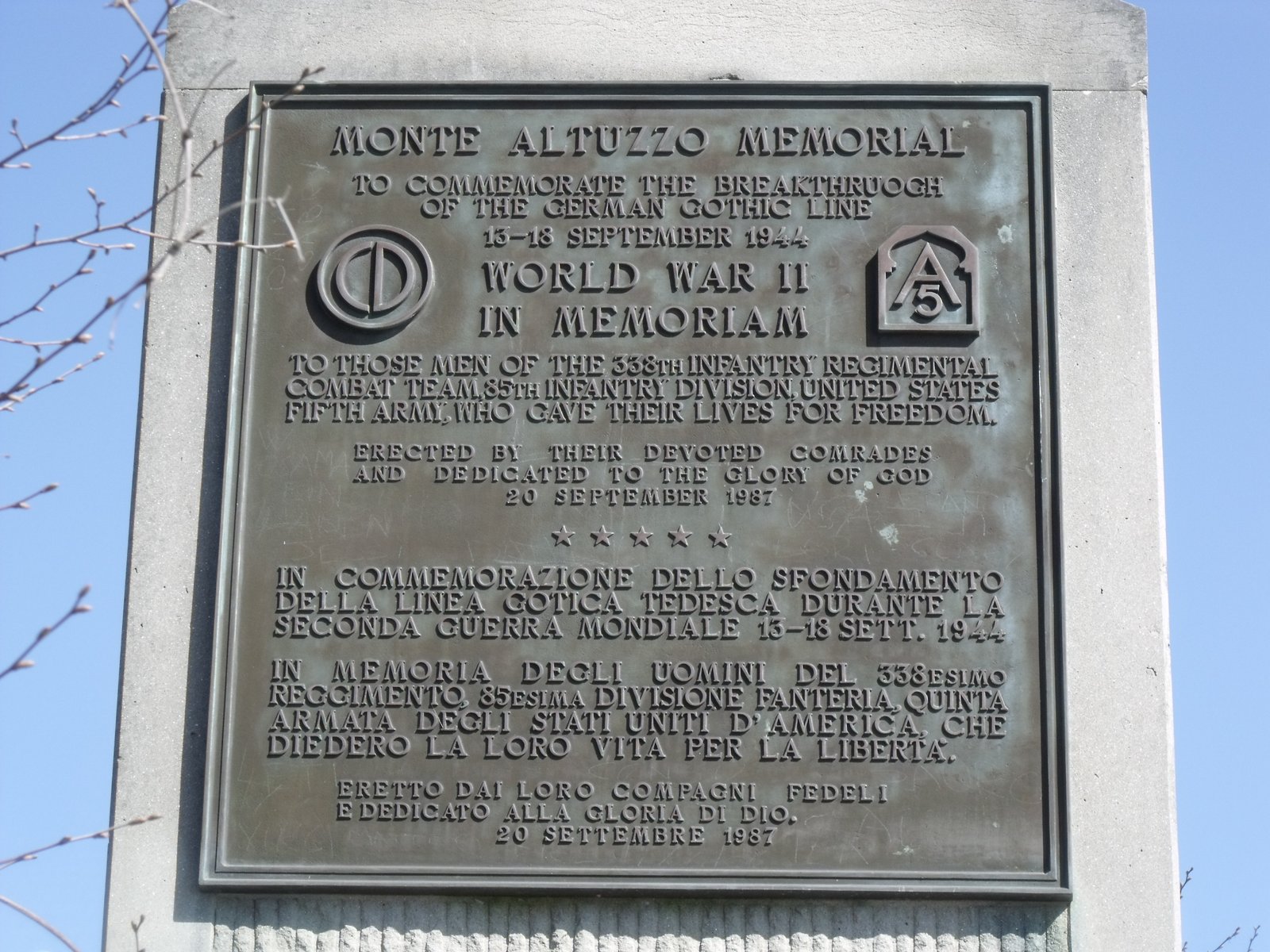
A mountain pass built into one of the Gothic Line’s strongest sectors, taken by two American divisions attacking from opposite sides of the same ridge in six days of continuous fighting. The two sides of that ridge remember the battle differently — and the sources cannot even agree on how many died taking it.
At a glance
The Gothic Line, Germany’s last major defensive system in Italy, ran in a belt up to 16 km deep from La Spezia to the Foglia valley, built by more than 15,000 forced labourers into over 2,000 fortified positions — machine-gun nests, anti-tank and mortar emplacements, thousands of shelters and rifle pits, tens of thousands of anti-tank mines. At Passo del Giogo, the line ran along the crest above Monte Altuzzo to the east and Monticelli to the west, held by the German 715th Infantry Division and the 4th Fallschirmjäger (Parachute) Division.
In September 1944, the US Fifth Army attacked both flanks of that crest at once — and the pass fell only after six days and nights of fighting that neither side’s own record fully agrees on.
Key facts
- Gothic Line scale: over 2,000 fortified positions along the line as a whole, including 2,375 machine-gun nests, 3,604 shelters, 16,006 rifle positions and roughly 72,500 anti-tank mines, built with more than 15,000 forced labourers
- At the pass: rock-and-log bunkers along the western and northern ridge, log bunkers on Hill 782, interlocking machine-gun fire covering 200 yards, camouflaged zigzag trenches; German defenders of the 715th Infantry Division and 4th Fallschirmjäger Division under General Trettner
- Attackers: US Fifth Army under General Mark Clark — the 85th Infantry Division («Custer»), 338th Infantry Regiment, on Monte Altuzzo; the 91st Infantry Division («Powder River»), 363rd Infantry Regiment, on Monticelli; the 34th Infantry Division («Red Bull») also engaged, with a diversionary attack at the nearby Futa Pass
- Battle: began 12–13 September 1944; Monte Altuzzo fell 17 September, the last height and the breakthrough of the «Green Line I» defence on 18 September; Firenzuola fell 21 September; the Futa Pass, bypassed, was taken with light resistance on 22 September
- Casualties: a commonly cited figure is around 500 American dead and over 2,000 wounded; other accounts give total Allied losses over the six days as high as 2,731, and at least one source cites roughly 3,000 American dead — the figures do not agree, and no single number should be treated as final; German losses are not reliably quantified, with 231 prisoners taken by 18 September
- Coordinates: 44.0468° N, 11.3881° E (the pass road)
How the ridge was held
The German positions above the pass used the same doctrine as fortified lines elsewhere in this curatela: not a wall but a network of interlocking fire, sited to make the terrain do as much of the defending as the concrete and timber did. Bunkers on Hill 782 and along the ridge crest covered each other’s approaches with machine guns able to sweep 200 yards of open ground, behind camouflaged trenches that followed the natural line of the ridge rather than a fixed geometric plan — a position built to be found only once an attacker was already inside its field of fire.
Six days on two flanks
The American plan attacked both shoulders of the pass simultaneously: the 85th Division on Altuzzo to the east, the 91st on Monticelli to the west, with the 34th Division making a diversionary push at the Futa Pass to draw German attention away from the main effort. It took six days and nights of continuous, close-range fighting to break the position. During the fighting on Monticelli, Private Oscar G. Johnson of the 91st Division held a position largely alone against repeated counter-attacks, an action later recognised with the Medal of Honor. Altuzzo fell first, on 17 September; the last German-held height above the pass went the following day, breaking the Green Line I defence and opening the road toward Florence and the Mugello valley beyond.
Who tells it, and where the accounts diverge
The battle’s standard telling centres on Monte Altuzzo and the 85th Division’s fight on the eastern shoulder — it is the version most often repeated, and the memorial best documented on Wikimedia Commons stands there. A regional Tuscan history project makes a point of telling «the other story», from Monticelli on the western shoulder: the 91st Division’s fight, the surviving bunker at Fonte Fredda, and Oscar Johnson’s Medal of Honor stand, alongside a separate memorial to the 363rd Infantry Regiment listing 436 names. Both sides of the same ridge have their own memorial, their own regiment, and their own version of which flank mattered more.
The casualty figures diverge even more sharply than the flank each account favours — a factor-of-six spread between the lowest and highest death tolls reported across otherwise credible sources. Rather than choose one, it is more honest to say plainly that six days of fighting on this ridge left a toll no single account has settled, on either side of it.
What you see today
- The memorial to the 85th Infantry Division and 338th Infantry Regiment near Omo Morto, on the Altuzzo side of the pass.
- A separate memorial to the 91st Infantry Division’s 363rd Infantry Regiment, listing 436 names, on the Monticelli side.
- Surviving German bunker remains and trench lines, including the position at Fonte Fredda, visible in the open countryside around the pass.
Getting there
Passo del Giogo lies on the SR503 north of Scarperia, in the Mugello area of Tuscany, on the route between Florence and the Apennine crossing toward Emilia-Romagna.
Nearby
- Scarperia, the nearest town, with its own medieval and knife-making heritage
- The Futa Pass, a short distance west, the site of the diversionary attack and a large German war cemetery
Sources
- Gotica Toscana APS, «Giogo Pass, September 20th 1944» and «Operation Olive: The Battles of the Giogo Pass» — fortification detail, unit identification, battle chronology.
- Storia e Memoria di Bologna, on the Fifth Army’s attack on the Giogo Pass.
- Sulleormedeinostripadri.it and tuttatoscana.net — casualty figures, cross-checked and found to diverge significantly; both cited without resolving the discrepancy.
- Goticalavia.it, «Monticelli: un’altra storia del Passo del Giogo» — the western-flank account, Fonte Fredda bunker, Oscar G. Johnson’s Medal of Honor action.
- Break-Through at Monte Altuzzo, US Army official history (ibiblio.org Hyperwar) — the 85th Division’s attack on Altuzzo.
Find it on the map
See this place and what’s around it →📷 Become a Cultural Heritage Online photographer
Share your photos of places: they stay published under your name as the author. The more they're seen, the more you get noticed — and soon a contest will reward the most appreciated photos.
Log in or sign up free to add a photo